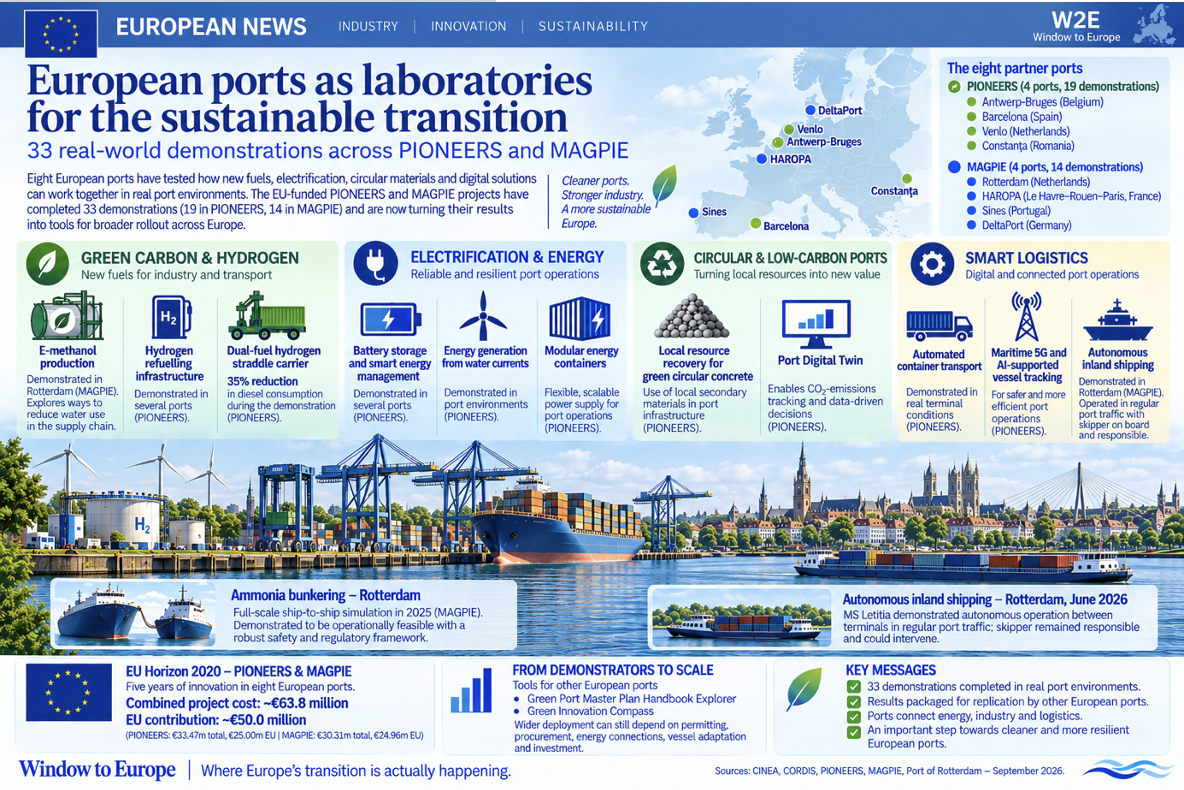
Eight European ports have spent five years testing how clean energy, alternative fuels, electrification and digital technologies can work together under real operating conditions. The EU-funded PIONEERS and MAGPIE projects have completed 33 demonstrations and are now making their experience available for wider use across European ports.
Ports are becoming important testing grounds for Europe’s sustainable transition. PIONEERS, coordinated by the Port of Antwerp-Bruges, completed 19 demonstrations, while MAGPIE, coordinated by the Port of Rotterdam, tested another 14 solutions. Together, the projects involved eight partner ports and focused on testing technologies and operational concepts under real port conditions.
PIONEERS covered clean energy, sustainable port design, transport and logistics, and digitalisation. Demonstrators included hydrogen refuelling, battery storage with smart energy management, electricity generation from water currents, modular energy containers and local resource recovery for circular concrete. A dual-fuel hydrogen straddle carrier reduced diesel consumption by more than 35% during testing. Other trials included automated container transport, a port digital twin and maritime 5G with AI-supported vessel tracking.
MAGPIE adds an interesting green-carbon dimension. An e-methanol demonstrator in Rotterdam investigated the production route and ways of reducing its water consumption. The project explicitly points to the chemical industry’s need for new green carbon feedstocks to defossilise the production of organic chemicals – an interesting connection between sustainable ports and Europe’s chemical transition.
Another MAGPIE demonstration addressed ammonia as a future marine fuel. In April 2025, Rotterdam carried out a full-scale simulation of ship-to-ship ammonia bunkering. The subsequent report concluded that such an operation can be carried out safely when carefully planned and embedded in an appropriate safety and regulatory framework. It also identified remaining technical issues, including the need for ammonia-specific transfer equipment.
A glimpse of the digital future: In 2026, the inland container vessel MS Letitia demonstrated autonomous operation between terminals in Rotterdam, including departure, navigation through regular port traffic and docking. The skipper remained on board, retained responsibility and could intervene. Project partners now intend to integrate elements of the technology into assistance systems for inland vessels.
From demonstrators to scale: The two projects have brought their experience together in practical tools for other ports, including PIONEERS’ Green Port Master Plan Handbook Explorer and MAGPIE’s Green Innovation Compass. Successful demonstration does not, however, mean immediate deployment: CINEA identifies permitting, procurement, energy connections, vessel adaptation, investment and coordination between stakeholders as continuing barriers to wider adoption.
The price tag: The scale is substantial but now precisely documented. PIONEERS had total costs of €33.47 million, including €25.00 million EU funding; MAGPIE cost €30.31 million, with an EU contribution of €24.96 million. Combined, that is approximately €63.8 million in project costs and €50.0 million in EU support over the five-year programmes.
CINEA – final PIONEERS/MAGPIE report, 22 September 2026
CORDIS – PIONEERS results
PIONEERS – 19 demonstrators
MAGPIE – e-methanol demonstrator
Port of Rotterdam – ammonia bunkering results
CINEA – autonomous inland shipping