https://www.michelin.com/en/publications/group/biotech-biotechnology-platform?utm_source=chatgpt.com
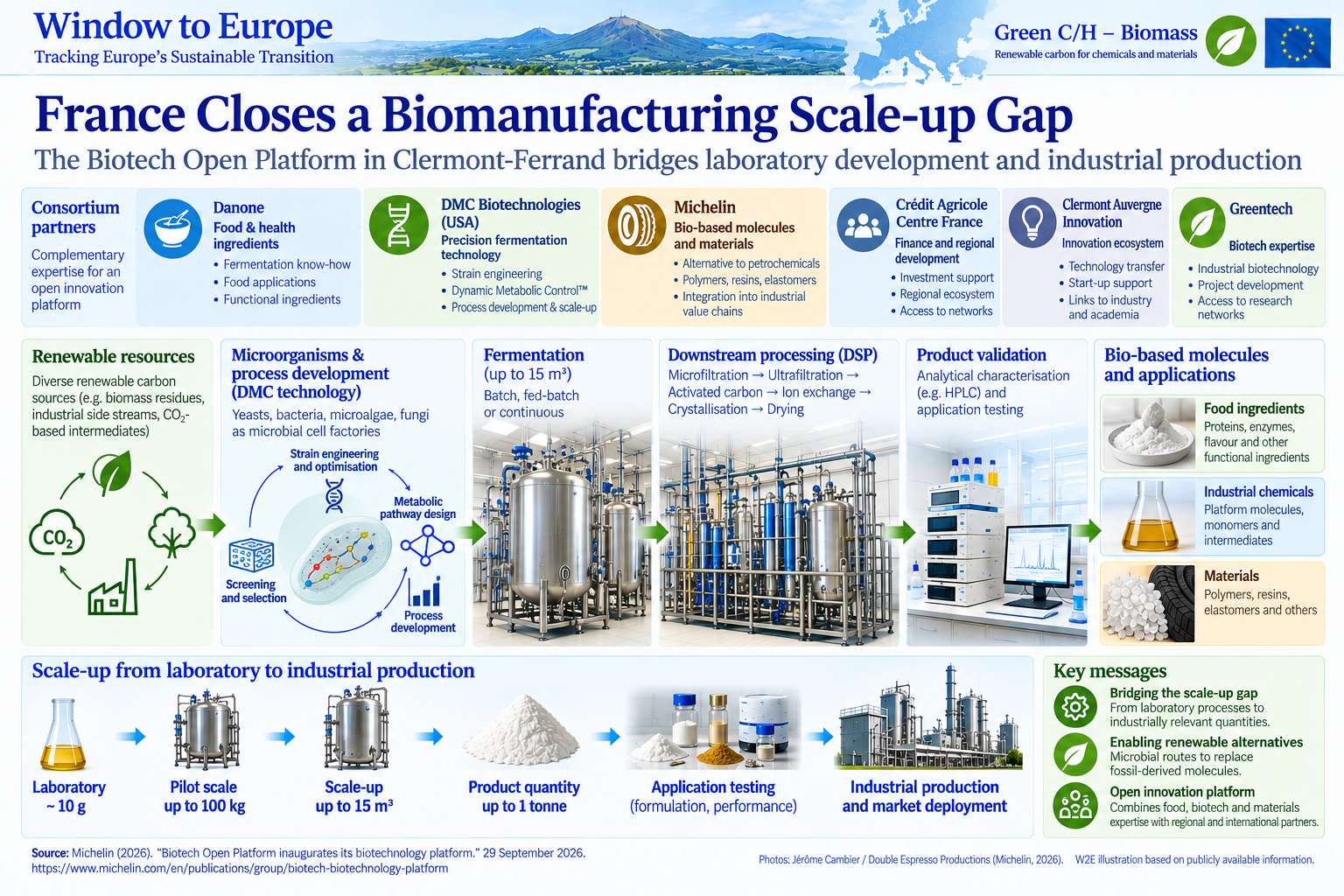
The Biotech Open Platform in Clermont-Ferrand bridges laboratory development and industrial production.
Advanced fermentation offers a route to proteins, enzymes, ingredients, chemicals and materials from renewable resources. But successful microbial production in the laboratory does not automatically translate into a robust and economically viable industrial process. Scale-up remains one of the major bottlenecks of industrial biotechnology.
The newly operational Biotech Open Platform (BIOP) in Clermont-Ferrand addresses this gap. Its 5,000 m² infrastructure integrates bioprocess development, fermentation and downstream processing and can take projects from gram quantities to conditions representative of industrial production. Fermentation capacity reaches 15 m³, while sufficient product – up to one tonne – can be generated for purification, analytical characterisation and application testing before commercial manufacture.
From microorganisms to products
Advanced fermentation uses microorganisms including yeasts, bacteria, microalgae and fungi as microbial cell factories. Depending on the organism and target molecule, development involves strain selection and optimisation, control of cellular metabolism and adaptation of the fermentation process.
BIOP supports batch, fed-batch and continuous fermentation. Downstream capabilities include microfiltration and ultrafiltration, activated-carbon treatment, ion exchange, crystallisation and drying. Analytical facilities allow the resulting products to be characterised and tested for their intended applications.
The platform is designed for both food and non-food biotechnology. Potential products include proteins and enzymes, food ingredients, cosmetic actives, chemicals and bio-based materials.
Complementary industrial expertise
The consortium brings together partners with distinctly different interests.
Danone contributes more than a century of experience with fermentation and provides the link to food, nutrition and functional ingredients.
DMC Biotechnologies (USA) contributes precision-fermentation technology. Its Dynamic Metabolic Control™ approach is designed to make microbial production processes more predictable and robust during scale-up, reducing the need to redesign the fermentation process for every new scale.
Michelin provides the materials perspective. For the tyre and materials group, biotechnology offers another route towards replacing selected molecules currently derived from petrochemicals with bio-based alternatives.
Crédit Agricole Centre France, Clermont Auvergne Innovation and Greentech complement these industrial partners with financing, technology transfer, regional research links and biotechnology expertise.
The resulting open platform is also available to external industrial companies, start-ups and research organisations, with dedicated provisions for confidentiality and intellectual-property protection.
Why it matters for Green C/H
Replacing fossil carbon in chemicals and materials requires more than discovering new biological pathways. Those pathways must ultimately produce molecules reliably, at sufficient scale and at competitive cost.
BIOP provides precisely this intermediate step: laboratory development → process scale-up → product quantities for application testing → preparation for industrial production.
For Europe’s transition towards renewable carbon, this kind of shared scale-up infrastructure may therefore be just as important as the discovery of new microbial production routes themselves.
Sources: Michelin, 29 September 2026; Biotech Open Platform; DMC Biotechnologies.