
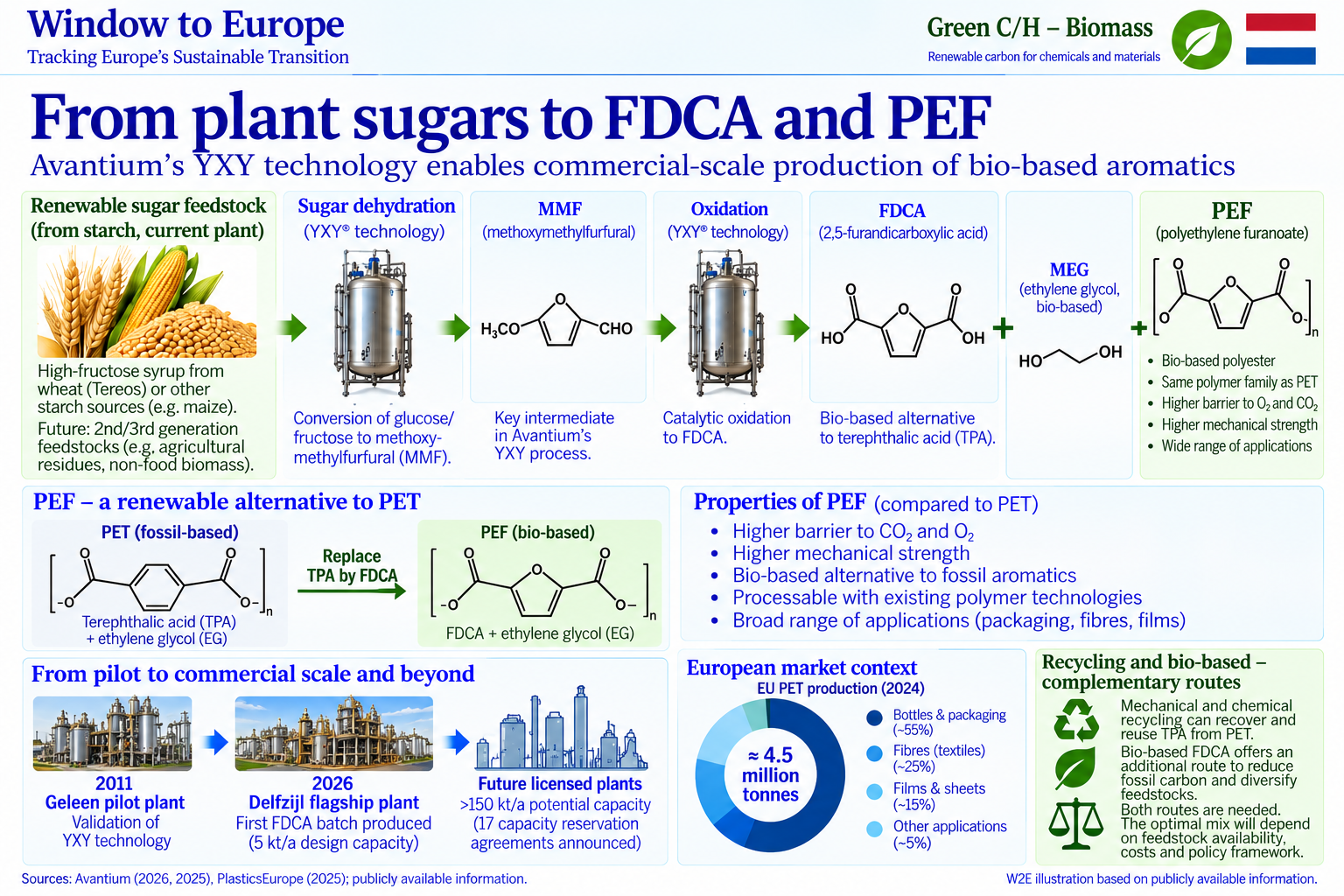
Avantium’s YXY® technology reaches commercial scale for a renewable polyester building block.
The first production of 2,5-furandicarboxylic acid (FDCA) at Avantium’s 5,000 t/a flagship plant in Delfzijl marks an important scale-up step for renewable carbon in polymer chemistry. The plant converts carbohydrate feedstocks into a furan-based dicarboxylic acid that can replace petrochemical terephthalic acid (TPA) in polyester production.
From sugar to FDCA
The current process uses commercially available glucose/fructose derived from starch. For the Delfzijl plant, Avantium has sourced high-fructose syrup from Tereos, based on wheat; other starch-derived sugars can also be used.
In Avantium’s YXY® process, glucose/fructose is first dehydrated in an alcohol-containing process to form methoxymethylfurfural (MMF). Catalytic oxidation subsequently converts the furan intermediate into FDCA, followed by purification to polymer-grade product.
The industrial sequence can therefore be simplified as:
starch-derived sugars → glucose/fructose → MMF → oxidation → FDCA
Avantium is also developing routes towards second- and third-generation carbohydrate feedstocks, including non-food biomass and agricultural residues. These are, however, not the principal feedstocks of the present Delfzijl plant.
FDCA instead of fossil TPA
The significance of FDCA lies in its function as a renewable-carbon alternative to terephthalic acid (TPA), one of the major petrochemical building blocks for polyester production.
Polycondensation of FDCA with ethylene glycol produces polyethylene furanoate (PEF), whereas TPA and ethylene glycol produce PET. Avantium currently combines its FDCA with bio-based monoethylene glycol (MEG), allowing PEF to be produced entirely from renewable carbon.
PEF can be processed into bottles, films and fibres and shows several technically interesting differences from PET, particularly higher oxygen and carbon-dioxide barrier performance and higher mechanical strength. FDCA also has potential beyond PEF in other polyesters, polyamides, polyurethanes and coating resins.
Scale-up rather than laboratory chemistry
The key development in Delfzijl is not the discovery of FDCA chemistry itself. Avantium has operated its YXY pilot plant in Geleen since 2011. The new plant demonstrates that the integrated process can now be operated at a 5 kt/a design scale.
Following successful commissioning of the principal process units, the first FDCA batch was produced on 28 September 2026. The plant remains in start-up: additional batches, product qualification and process optimisation are planned before ramp-up to continuous operation.
The 5 kt/a facility is therefore best regarded as a commercial-scale technology platform rather than evidence of mature bulk production. Avantium intends to license the technology for substantially larger plants and has announced capacity-reservation agreements representing more than 150 kt/a of potential future FDCA capacity.
Bio-based or recycled?
FDCA/PEF should not be viewed simply as a competitor to PET recycling. PET already has an established mechanical recycling infrastructure, while chemical recycling can recover TPA or related intermediates for reuse. Recycling retains carbon already circulating in the technosphere and is therefore an important route to reducing virgin fossil feedstock demand.
FDCA addresses a different part of the problem: where new carbon must enter the materials system, it provides a route for introducing renewable rather than fossil carbon.
A future sustainable polyester system could therefore combine both approaches:
recycle existing polymer carbon as long as practicable + replace necessary virgin fossil carbon with renewable carbon.
Which route ultimately proves more economical will depend on feedstock prices, collection and recycling efficiency, energy demand, process scale and the value attributed to PEF’s material properties. At present, conventional PET benefits from enormous production scale and established recycling systems; FDCA/PEF must still demonstrate competitive economics at much larger capacities.
For Green C/H, Delfzijl is therefore particularly interesting not because PEF has already displaced PET, but because a renewable-carbon route to a major class of polymer building blocks has crossed from pilot development into commercial-scale operation.
Sources: Avantium, 28 September 2026; Avantium Annual Report 2025; Avantium YXY®/releaf® technology information; PlasticsEurope 2025.