
In brief
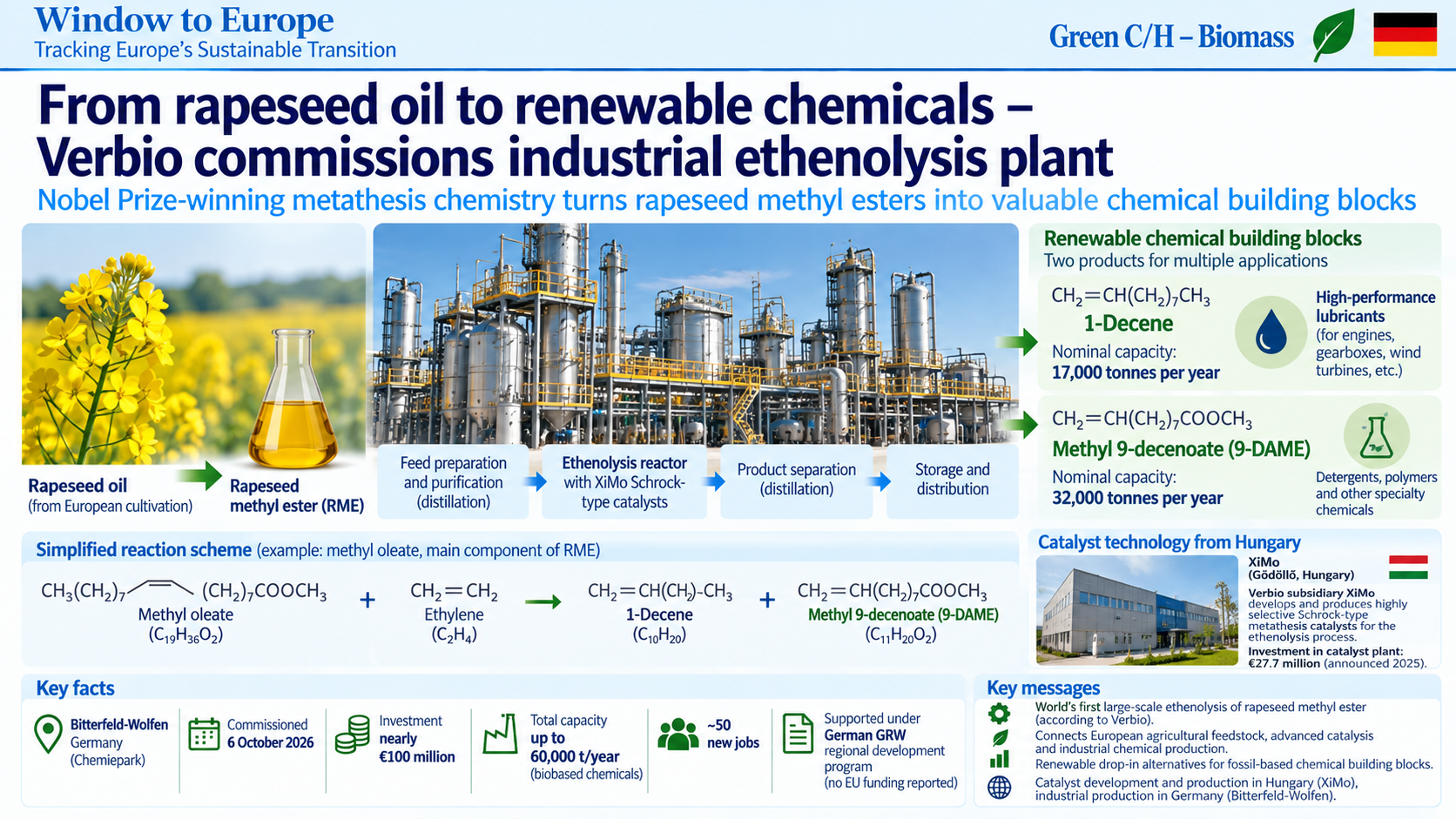
An industrial milestone for renewable carbon: Verbio has commissioned a large-scale ethenolysis plant in Bitterfeld-Wolfen, converting rapeseed-derived methyl esters into valuable chemical building blocks. The project combines industrial biorefining in Germany with advanced catalyst technology developed by Verbio’s Hungarian subsidiary XiMo.
On 6 October 2026, German bioeconomy company Verbio officially commissioned its new production facility for bio-based chemicals at the Bitterfeld-Wolfen Chemical Park in Saxony-Anhalt. With an investment of nearly €100 million, the plant is designed to produce up to 60,000 tonnes of renewable chemicals annually and create approximately 50 new jobs.
According to Verbio, this is the world’s first large-scale industrial ethenolysis plant using rapeseed methyl ester as feedstock.
From biodiesel feedstock to chemical building blocks
Rapeseed methyl ester (RME), commonly used as biodiesel, contains unsaturated fatty acid methyl esters that can be converted into valuable chemical intermediates.
The key technology is ethenolysis, a form of olefin cross-metathesis in which ethylene reacts with carbon–carbon double bonds in the fatty acid chains.
Using methyl oleate as a representative example, the reaction produces two principal products:
Methyl oleate + ethylene → 1-decene + methyl 9-decenoate (9-DAME)
Both products offer alternatives to fossil-derived chemical building blocks:
- 1-Decene is an important starting material for polyalphaolefins (PAOs), used in high-performance synthetic lubricants for engines, industrial gearboxes and wind turbines. Verbio specifies a nominal annual production capacity of 17,000 tonnes.
- Methyl 9-decenoate (9-DAME) contains both a terminal carbon–carbon double bond and an ester group, making it a versatile intermediate for specialty chemicals, polymers, surfactants and lubricant components. The nominal capacity is 32,000 tonnes annually.
These are design capacities rather than verified annual production volumes. Commercial output will depend on the plant’s ramp-up and customer qualification.
From catalytic chemistry to industrial production
Olefin metathesis is a well-established chemical reaction. Its scientific foundations were recognised with the 2005 Nobel Prize in Chemistry, awarded to Yves Chauvin, Robert H. Grubbs and Richard R. Schrock.
The Verbio process employs highly selective Schrock-type metathesis catalysts, enabling the conversion of unsaturated methyl esters with ethylene under comparatively mild reaction conditions.
The industrial process includes feedstock preparation and purification, catalytic ethenolysis, product separation and downstream purification. Distillation plays an important role in preparing the methyl ester feedstock and recovering the chemical products.
The plant therefore represents more than the industrial application of an individual chemical reaction: it integrates advanced catalysis with large-scale chemical processing and product purification.
Catalyst technology from Hungary
An important European dimension is the catalyst technology supplied by XiMo, Verbio’s Hungarian subsidiary, acquired in 2018.
Based in Gödöllő, Hungary, XiMo specialises in the development and manufacture of advanced metathesis catalysts. Verbio has invested €27.7 million in a dedicated catalyst production facility intended to support the Bitterfeld process and other industrial applications.
The project thus connects specialised organometallic catalyst technology in Hungary with renewable chemical production in Germany. It illustrates how industrial innovation can emerge from complementary technological capabilities across Europe.
Renewable carbon instead of fossil feedstocks
The new plant demonstrates a transition from using agricultural biomass primarily as an energy source towards its use as a renewable carbon feedstock for chemical manufacturing.
Unlike biofuels, which release their carbon during combustion, renewable chemical intermediates can incorporate biogenic carbon into products with a wide range of applications and service lives.
However, bio-based production does not automatically guarantee a lower overall environmental footprint. Its benefits depend on agricultural feedstock production, land use, process energy requirements, conversion efficiency and the fossil-derived materials actually replaced.
Verbio’s production performance, commercial uptake and independently verified life-cycle assessments will therefore be important indicators of the plant’s long-term contribution to defossilisation.
W2E perspective
The Bitterfeld project is a significant example of Europe’s progress towards a renewable-carbon chemical industry.
Its importance lies in combining three elements: European agricultural feedstocks, advanced catalyst technology from Hungary and industrial-scale chemical manufacturing in Germany.
Unlike many announced bioeconomy projects, Verbio has already reached the commissioning stage. The next challenge will be to establish reliable commercial production and demonstrate that renewable chemical building blocks can compete with their fossil-derived counterparts in established industrial markets.
Category: Green C/H – Biomass
Location: Bitterfeld-Wolfen, Germany
Technology: Olefin metathesis / Ethenolysis
Development stage: Industrial commissioning, October 2026
Investment: Nearly €100 million
Planned capacity: Up to 60,000 tonnes annually
Catalyst technology: XiMo, Gödöllő, Hungary
Sources
- Verbio Life Chemicals – Commissioning of the world’s first large-scale ethenolysis plant, 6 October 2026.
- Verbio – Company press releases, including earlier information on plant construction, process technology and production capacities.
- The Nobel Prize in Chemistry 2005 – Olefin metathesis.