
In brief
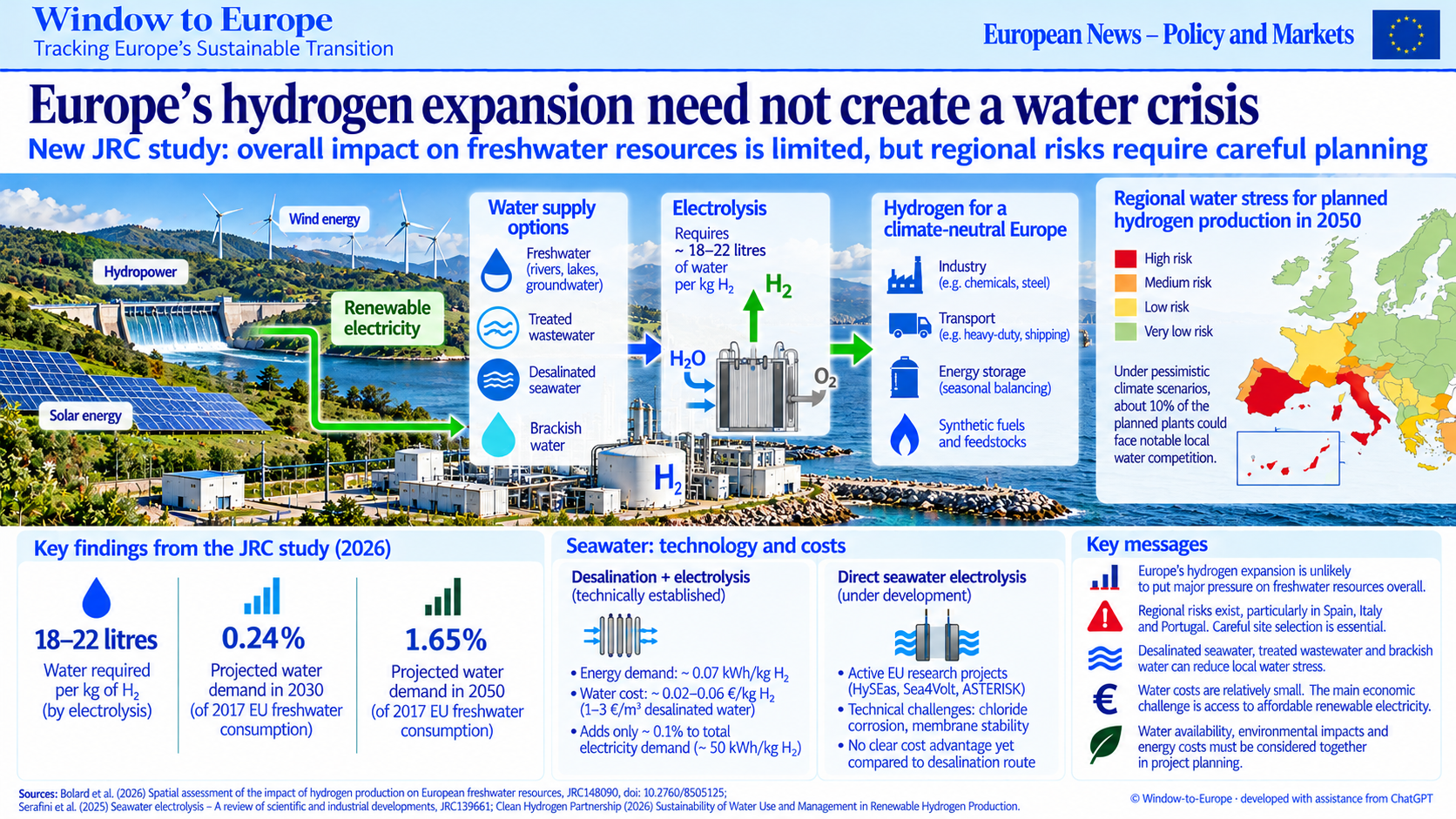
New European studies find that hydrogen production is unlikely to put major pressure on freshwater resources overall. Regional water scarcity remains a challenge, but seawater desalination offers a technically established and comparatively inexpensive alternative. Affordable renewable electricity is likely to be the greater economic challenge.
Hydrogen production and Europe’s freshwater resources
On 8 October 2026, the European Commission’s Joint Research Centre (JRC) published a spatial assessment of the potential impact of hydrogen production on European freshwater resources.
The study concludes that the expansion of renewable hydrogen production is unlikely to cause major freshwater shortages at the European level. However, regional differences are substantial, particularly in Southern Europe.
Water demand for hydrogen production by electrolysis is estimated at approximately 18–22 litres per kilogram of hydrogen, including requirements beyond the theoretical minimum of 9 litres.
According to the JRC assessment, water demand associated with Europe’s hydrogen production objectives could correspond to approximately 0.24% of European freshwater consumption in 2017 by 2030, potentially increasing to 1.65% by 2050.
These figures are projections based on specified hydrogen development scenarios, not forecasts of actual water consumption.
Regional water scarcity matters
The European average conceals important geographical differences.
Most planned hydrogen production facilities are located in regions with relatively low or moderate water stress. Under pessimistic climate scenarios, however, approximately 10% of the assessed plants could face significant local competition for freshwater.
Spain, Italy and Portugal are among the countries requiring particular attention.
The challenge is therefore not simply the total amount of water needed, but the geographical concentration of hydrogen production, seasonal water availability and competition with agriculture, households and other industries.
A complementary study published by the Clean Hydrogen Partnership in October 2026 examines sustainable water management in five European Hydrogen Valleys. It emphasises the importance of integrating water supply, treatment and reuse into hydrogen project planning from the outset.
Seawater: a technically viable alternative
For coastal hydrogen production facilities, seawater offers an important alternative to freshwater abstraction.
Two technological approaches must be distinguished.
Desalination followed by conventional electrolysis is technically established. Seawater is treated, generally using reverse osmosis and subsequent purification, before being supplied to a conventional electrolyser.
Direct seawater electrolysis, including systems with integrated water purification, remains an active research and development field. European projects such as HySEas, Sea4Volt and ASTERISK are investigating improved membranes, corrosion resistance and simplified system integration.
The main technical challenges include chloride-related side reactions, corrosion, membrane stability and long-term operational reliability.
Although recent international demonstrations show considerable progress, direct seawater electrolysis has not yet demonstrated a general economic advantage over conventional desalination followed by electrolysis.
The economics of seawater hydrogen
A previous JRC technology review provides an important economic perspective.
The additional electricity required for seawater desalination is estimated at approximately 0.07 kWh per kilogram of hydrogen, compared with roughly 50 kWh for the subsequent electrolysis.
Desalination therefore adds only a small fraction to the overall electricity demand.
Depending on local water-treatment costs and system assumptions, the additional cost of desalinated water may amount to only a few euro cents per kilogram of hydrogen.
For example, at an assumed electricity consumption of 50 kWh per kilogram of hydrogen, electricity costs alone would amount to:
| Electricity price | Electricity cost per kg H₂ |
|---|---|
| €30/MWh | €1.50 |
| €50/MWh | €2.50 |
| €80/MWh | €4.00 |
| €100/MWh | €5.00 |
These figures exclude capital expenditure, maintenance, compression, transport and other operating costs. They illustrate why electricity prices have a much greater influence on hydrogen production costs than seawater desalination.
The economic assessment must nevertheless consider the complete water supply system, including intake infrastructure, treatment, brine disposal, environmental requirements and local permitting.
Renewable electricity: the decisive economic factor
Europe’s hydrogen economy can draw on several renewable electricity sources, including onshore and offshore wind, solar photovoltaics and hydropower.
Their availability, generation profiles and costs differ considerably across European regions.
Solar-rich Southern Europe offers attractive conditions for photovoltaic hydrogen production, while Northern Europe has substantial wind resources. Hydropower can provide valuable renewable electricity in suitable locations.
However, low-cost renewable generation does not automatically translate into low hydrogen production costs. Electrolyser utilisation, grid connection, storage requirements, electricity procurement and the integration of variable renewable generation must also be considered.
For European industry, access to reliable and competitively priced renewable electricity remains a central challenge.
W2E perspective
The new European studies provide a cautiously positive message: Hydrogen expansion and sustainable water management are compatible, provided regional water constraints are incorporated into project development.
Where freshwater resources are scarce, treated wastewater, brackish water and desalinated seawater can reduce competition with other users. The choice must reflect local environmental and economic conditions.
Direct seawater electrolysis remains scientifically attractive, but its economic advantages over established desalination technologies have yet to be demonstrated convincingly.
For Europe’s sustainable industrial transformation, the larger economic issue is the availability of affordable renewable electricity.
This extends well beyond hydrogen production. Electricity costs also influence industrial electrification, renewable chemical feedstocks, synthetic fuels and other technologies essential to Europe’s transition away from fossil resources.
The central conclusion: Freshwater availability is primarily a regional sustainability challenge; affordable renewable electricity remains a major economic challenge for Europe’s hydrogen economy.
Sources
- European Commission, Joint Research Centre (2026). Spatial assessment of the impact of hydrogen production on European freshwater resources. JRC148090. DOI: 10.2760/8505125.
https://publications.jrc.ec.europa.eu/repository/handle/JRC148090 - European Commission, Joint Research Centre (8 October 2026). EU hydrogen expansion unlikely to strain most water supplies.
https://joint-research-centre.ec.europa.eu/jrc-news-and-updates/eu-hydrogen-expansion-unlikely-strain-most-water-supplies-2026-10-08_en - Clean Hydrogen Partnership (2026). Sustainability of Water Use and Management in Renewable Hydrogen Production.
https://www.clean-hydrogen.europa.eu/media/publications/new-study-explores-water-sustainability-renewable-hydrogen-production_en - Serafini, M., Weidner, E. and Bolard, J. (2025). Hydrogen Production via Direct Seawater Electrolysis. European Commission, Joint Research Centre, JRC139661. JRC publication and full report.
- European research projects on seawater electrolysis and related technologies: HySEas (CORDIS), Sea4Volt (Clean Hydrogen Partnership) and ASTERISK (project website).