
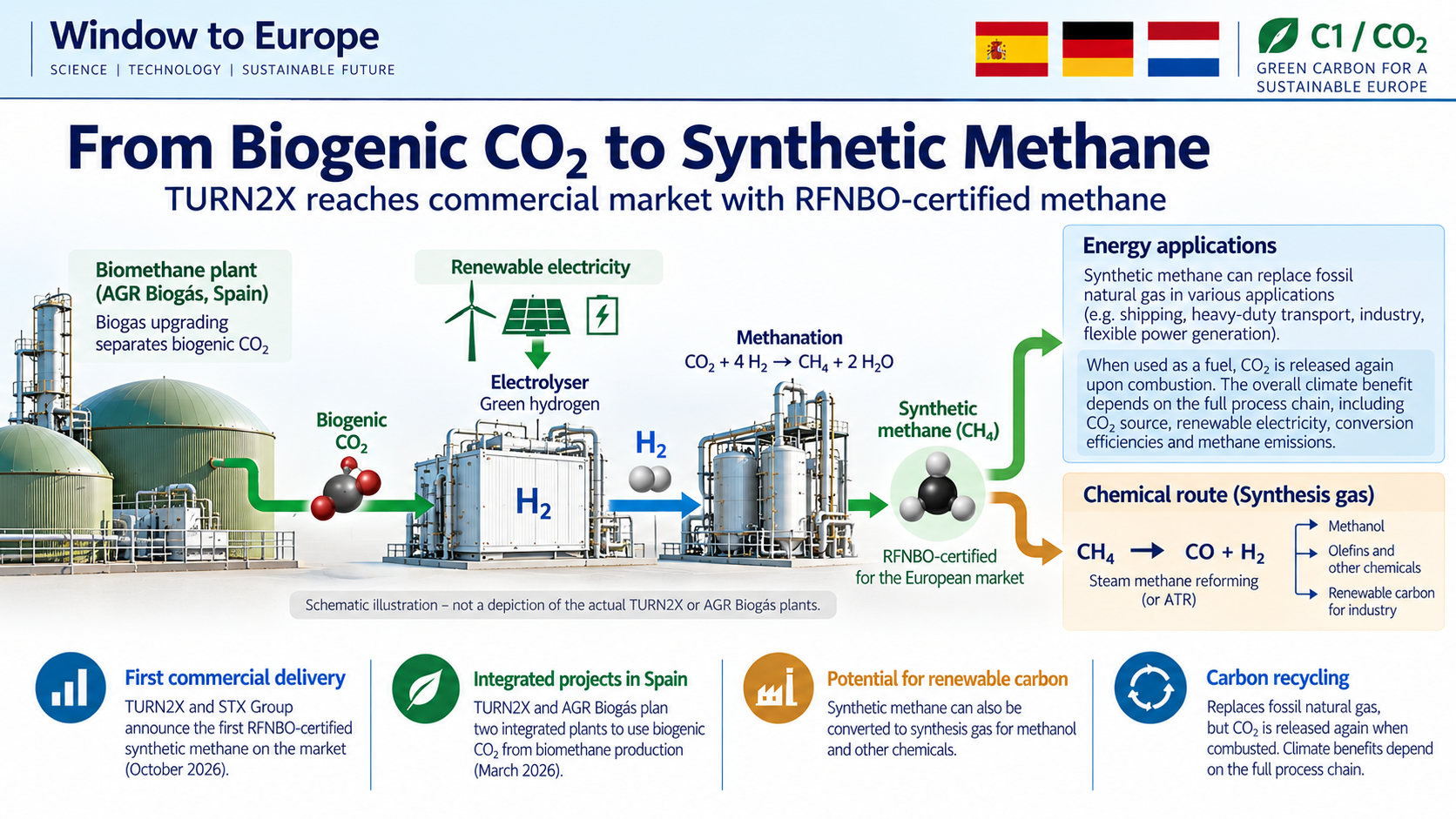
In brief
German technology company TURN2X has announced its first commercial delivery of RFNBO-certified synthetic methane to Dutch energy trading company STX Group. Produced at TURN2X’s demonstration facility in Miajadas, Spain, the renewable gas combines green hydrogen with CO₂ to create a substitute for fossil natural gas. Beyond its use as an energy carrier, synthetic methane could also serve as a renewable carbon feedstock for the chemical industry.
From renewable electricity and CO₂ to methane
TURN2X operates a power-to-methane facility in Miajadas, Extremadura, equipped with a 1 MW electrolyser. Renewable electricity is used to produce hydrogen, which reacts with CO₂ through catalytic methanation:
CO₂ + 4 H₂ → CH₄ + 2 H₂O
The resulting synthetic methane is chemically equivalent to natural gas and can use existing gas infrastructure. In October 2026, TURN2X and STX Group announced the first commercial delivery of methane certified under the European Renewable Fuels of Non-Biological Origin (RFNBO) framework.
The announcement marks a transition from demonstrating the technology to supplying a commercially traded product. However, the companies have not disclosed the quantity delivered or the final industrial consumers.
Integrating biomethane production and CO₂ utilisation
In March 2026, TURN2X and Spanish biomethane developer AGR Biogás announced plans to integrate their technologies at two projects in Spain.
Biomethane upgrading separates CO₂ from raw biogas to obtain methane suitable for injection into the gas grid. Instead of treating the separated biogenic CO₂ solely as a residual stream, TURN2X proposes using it as feedstock for additional methane production with renewable hydrogen.
The integration could also allow waste heat from methanation to support biomethane production. The announced projects represent a prospective industrial integration; their operation has not yet been demonstrated.
A potential renewable carbon feedstock for chemicals
Synthetic methane is primarily marketed as a renewable gaseous fuel. However, methane is also an established chemical feedstock.
Through steam methane reforming or related processes, methane can be converted into synthesis gas, a mixture of carbon monoxide and hydrogen. Synthesis gas is a major intermediate for methanol and other chemical products.
This offers a potential route from biogenic CO₂ and renewable hydrogen to chemical carbon:
Biogenic CO₂ → Synthetic CH₄ → Synthesis gas → Methanol and other chemicals
Such use would extend the role of power-to-methane technology beyond energy supply. TURN2X has not, however, announced a verified delivery of its synthetic methane for synthesis-gas or chemical production.
Carbon recycling, not permanent carbon storage
Synthetic methane can replace fossil natural gas, but its climate benefits depend on the origin of the CO₂, the electricity used, methane losses and the efficiency of the process.
When synthetic methane is burned, its carbon is released again as CO₂. Conversion into chemicals may retain the carbon for a longer period, depending on the products and their end-of-life treatment.
The commercial delivery demonstrates that CO₂-based methane can enter the European energy market. Its potential contribution to defossilising chemical feedstocks remains an interesting next step.