
In Brief
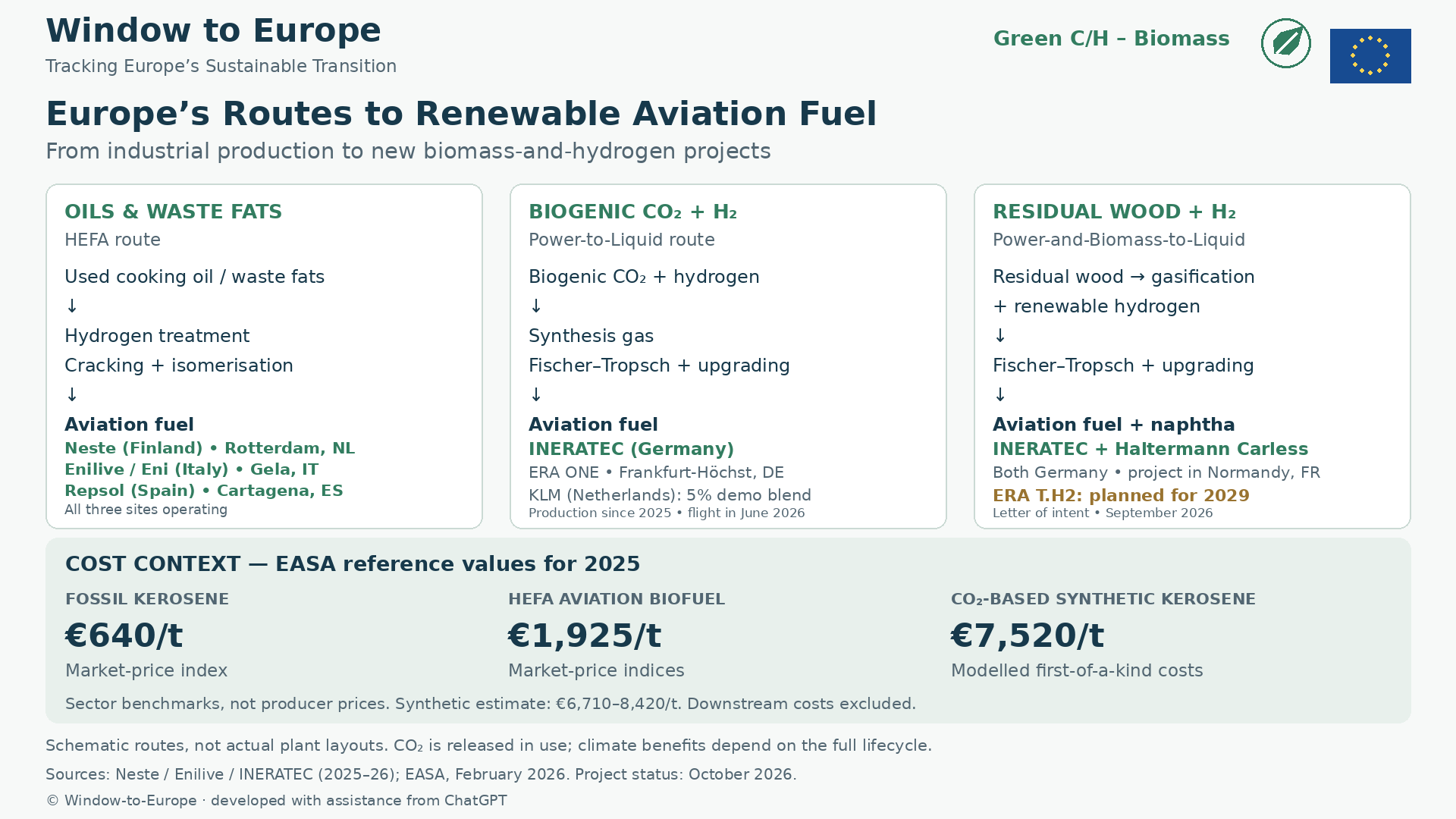
Europe is turning renewable carbon into aviation fuel through complementary routes. Fuels made from used cooking oils and waste fats are already produced at industrial scale. Synthetic kerosene made from CO₂ and hydrogen has reached passenger-flight demonstrations, while new projects aim to combine residual wood with renewable hydrogen. Costs remain higher than those of fossil kerosene, with substantial differences between production routes.
Used Cooking Oils and Waste Fats: Industrial Production and Actual Deliveries
In September 2026, Neste announced an extension of its sustainable aviation fuel (SAF) supply agreement with United Airlines. Under this contract, SAF blended with conventional kerosene was delivered at Amsterdam Schiphol from June to August 2026.
Neste began SAF production at its Rotterdam renewables refinery in April 2025, establishing a production capability of up to 500,000 tonnes annually. Its SAF feedstocks include used cooking oil and animal fat waste.
Other European producers have also entered industrial production. Enilive started SAF production at Gela in Sicily in January 2025, with a capacity of 400,000 tonnes per year. Repsol’s Cartagena plant began producing renewable fuels in 2024, with a combined annual capacity of 250,000 tonnes of renewable diesel and SAF. These figures are capacities, not reported annual output.
The oil-and-fat route uses hydrogen to remove oxygen from the feedstock and further catalytic processing to obtain suitable fuel properties. Known as HEFA—hydroprocessed esters and fatty acids—it uses the carbon chains already present in oils and fats.
Sources: Neste–United supply agreement, September 2026; Neste Rotterdam production; Enilive Gela; Repsol Cartagena; Honeywell: renewable-fuel technology.
CO₂ and Hydrogen: From Synthesis to Passenger Flight
INERATEC’s ERA ONE plant in Frankfurt-Höchst uses biogenic CO₂ and hydrogen to produce synthetic hydrocarbons through Fischer–Tropsch synthesis. According to the European Investment Bank, the site receives CO₂ from a waste-processing biogas plant and hydrogen as a by-product of existing chlorine production.
On 8 June 2026, a KLM Cityhopper passenger flight from Amsterdam to Hamburg used a blend containing 5% synthetic kerosene originating from ERA ONE. Production, fuel preparation and use were connected through existing aviation infrastructure.
In September, INERATEC and Ramboll announced engineering work to add on-site upgrading. Hydrocracking, isomerisation and distillation would convert synthetic intermediates into aviation fuel. This expansion remains in the planning stage.
Sources: EIB: ERA ONE feedstocks and financing; KLM demonstration flight, June 2026; INERATEC–Ramboll, September 2026.
Residual Wood and Renewable Hydrogen: A Further Route
In September 2026, INERATEC and Haltermann Carless signed a letter of intent concerning the planned ERA T.H2 project in Normandy.
The plant would combine residual wood and renewable energy. Gasification would produce synthesis gas for conversion into Fischer–Tropsch products, including aviation fuel and naphtha for chemical applications. Planned output is at least 13,000 tonnes of Fischer–Tropsch products annually. Commissioning is scheduled for 2029; the facility is not yet operating.
Source: INERATEC–Haltermann Carless: ERA T.H2, September 2026.
Costs: HEFA Is Cheaper Than CO₂-Based Kerosene, but Both Carry a Premium
EASA’s February 2026 briefing gives the following reference values for 2025:
| Fuel | Reference value | Basis |
|---|---|---|
| Conventional fossil kerosene | €640/t | Average market-price indices |
| Aviation biofuels represented by HEFA indices | €1,925/t | Average market-price indices |
| Synthetic aviation fuel from biogenic CO₂ | €7,520/t; estimated range €6,710–8,420/t | Modelled production costs |
The HEFA market benchmark was approximately three times the fossil kerosene price. The modelled value for CO₂-based synthetic kerosene was approximately twelve times the fossil benchmark.
These comparisons require care: EASA had no market-price index for synthetic kerosene in 2025 and therefore modelled first-of-a-kind plants. Its figures are sector-wide references, not disclosed prices from Neste or INERATEC, and exclude downstream cost components. They also do not establish the costs of the planned biomass-and-hydrogen project in Normandy.
Source: EASA: 2025 Aviation Fuels Reference Prices, Table 1 and methodology explanation.
Renewable aviation fuels still release CO₂ during combustion; their climate benefit depends on lifecycle emissions. Europe’s progress nevertheless now includes operating factories, actual deliveries and passenger-flight use, alongside projects designed to widen the renewable feedstock base.