
In brief
How can Europe prevent fresh food from being discarded while maintaining high standards of quality and safety?
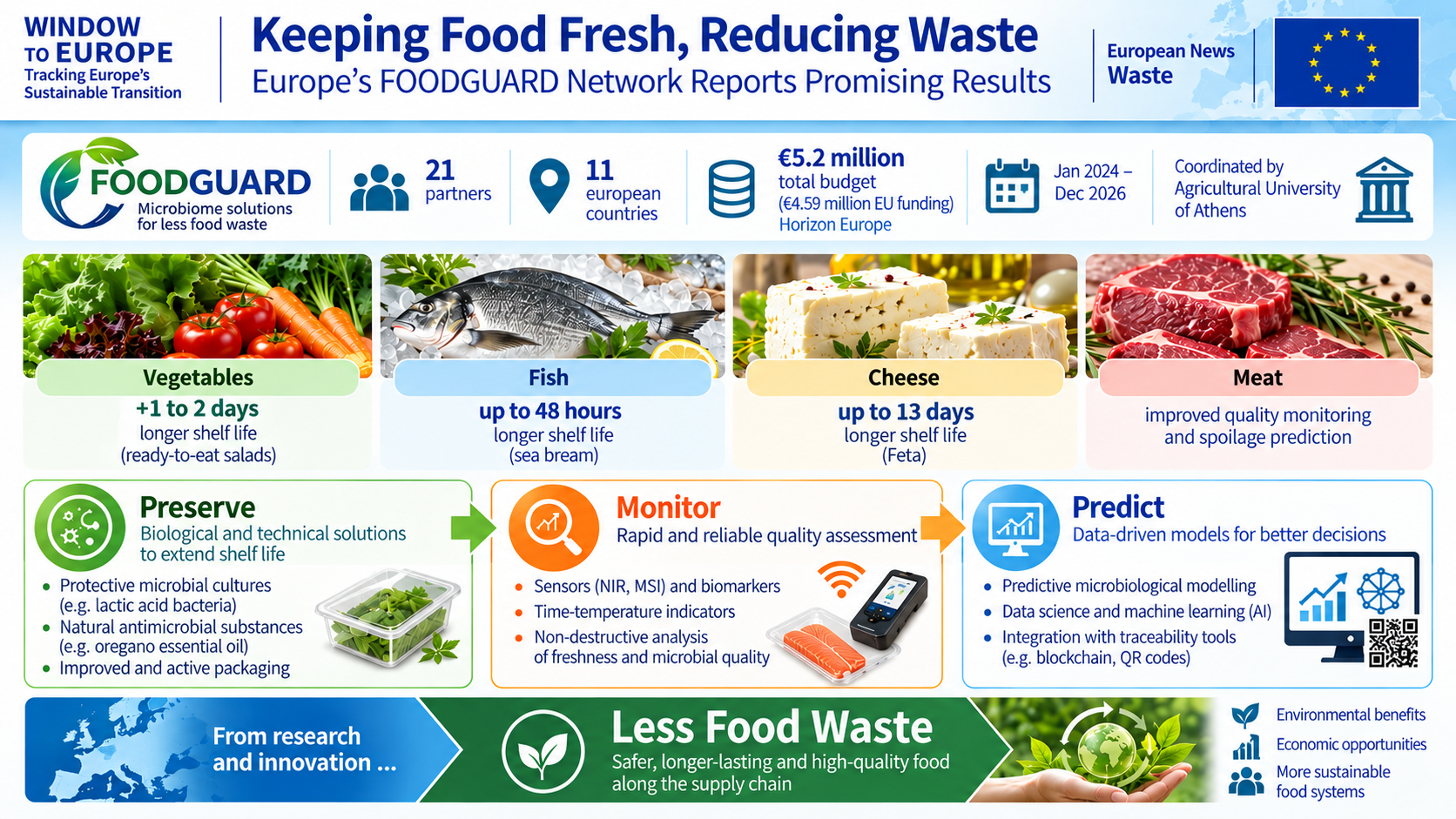
The Horizon Europe project FOODGUARD is addressing this question through a network of 21 partners from 11 European countries. Coordinated by the Agricultural University of Athens, the €5.2 million initiative brings together research institutes, universities, technology developers and food-sector stakeholders.
Its approach combines improved food preservation and packaging with rapid quality monitoring and predictive digital technologies. Published studies already report promising results for Feta cheese, fresh fish and ready-to-eat vegetables, while new sensor systems are being developed to assess food quality more accurately.
The objective is practical: keep perishable food safe and usable for longer, and thereby reduce avoidable waste.
Sources: FOODGUARD project website | European Commission – CORDIS project record
A European Network Tackling Food Waste
FOODGUARD (Microbiome Applications and Technological Hubs as Solutions to Minimize Food Loss and Waste) started in January 2024 and will run until December 2026.
The project has a total budget of approximately €5.2 million, supported by the EU’s Horizon Europe programme. Its 21 partners represent eleven European countries and bring together expertise in food microbiology, packaging, analytical technology, data science, risk assessment and food production.
The consortium is developing solutions for four groups of perishable products: vegetables, meat, fish and cheese.
Its strategy rests on three complementary approaches:
- Preserve: Extend shelf life through protective microbial cultures, natural antimicrobial substances and improved packaging.
- Monitor: Assess freshness, microbial quality and safety through sensors, spectroscopy and other rapid analytical methods.
- Predict: Combine experimental data with mathematical models and artificial intelligence to estimate remaining shelf life and support better decisions along the food supply chain.
The technologies are being evaluated through four pilot demonstrations involving different foods and countries.
Rather than focusing on microbiome research as an end in itself, FOODGUARD uses knowledge of microbial activity to address a practical challenge: reducing the unnecessary disposal of valuable food.
Sources: FOODGUARD – Project objectives | CORDIS – Periodic project report
Feta Cheese: Protective Cultures Extend Shelf Life
One of the project’s most encouraging experimental results concerns Feta cheese.
Researchers investigated selected lactic acid bacteria that can inhibit undesirable microorganisms and delay quality deterioration during storage.
According to results reported through the EU CAP Network, two strains — Lactiplantibacillus pentosus L33 and Lactiplantibacillus plantarum L125 — extended Feta shelf life by up to 13 days under the tested aerobic storage conditions at 10°C. The cultures also showed activity against Listeria monocytogenes.
This result illustrates the potential of biopreservation: beneficial microorganisms can help maintain product quality without relying exclusively on conventional preservatives.
The researchers also investigated edible sodium-alginate films containing oregano essential oil.
A peer-reviewed study published in Pathogens in 2026 found that these films had moderate antimicrobial effects under selected storage conditions, including reduced survival of Listeria monocytogenes in some experiments. However, the effects on general spoilage microorganisms were limited and depended on packaging and temperature.
The two approaches should therefore be distinguished: the reported 13-day extension concerns selected protective cultures, not the oregano-containing films.
Together, the studies show how biological preservation and improved packaging may help reduce premature disposal of cheese, provided food safety and sensory quality are maintained.
Source: EU CAP Network – Bio-protective microbial cultures in food preservation
Scientific publication: Antimicrobial Effect of Oregano Essential Oil in Na-Alginate Edible Films for Shelf-Life Extension and Safety of Feta Cheese, Pathogens, 2026
Fresh Fish: Packaging and Storage Conditions Make a Difference
Fresh fish is particularly vulnerable to microbial spoilage, making it an important target for improved preservation.
FOODGUARD researchers have investigated the combination of modified-atmosphere packaging, natural antimicrobial substances and low-temperature storage.
For fresh sea bream (Sparus aurata), results reported by the EU CAP Network indicate that oregano essential oil combined with modified-atmosphere packaging reduced selected spoilage bacteria by approximately 0.5–2 log CFU/g.
Under the tested conditions, the shelf life of fresh sea bream could be extended by up to 48 hours, with particularly promising results at 0°C.
The project has also published a 2026 scientific study examining oregano essential oil in active packaging for sea bream fillets, together with spectroscopic sensors for monitoring microbiological quality.
These findings are relevant to seafood processing, distribution and retail, where even modest improvements in shelf life may help reduce losses.
The reported improvements remain dependent on the specific product, packaging composition and storage temperature. They should not be interpreted as universal extensions of fish shelf life.
Source: EU CAP Network – FOODGUARD preservation results
Source: FOODGUARD – Published scientific articles, including the 2026 sea bream study in Chemosensors
Ready-to-Eat Vegetables: One or Two Additional Days
Pre-cut salads and vegetables present another challenge. Processing increases their susceptibility to microbial and sensory deterioration, while short remaining shelf lives can lead to substantial retail and household waste.
FOODGUARD researchers have tested selected protective cultures on ready-to-eat lettuce, cabbage and rocket.
The EU CAP Network reports that Lactiplantibacillus pentosus FMCC-B281, or its cell-free supernatant, extended acceptable shelf life by approximately one to two days in selected experiments.
The treatment helped delay undesirable changes in appearance and aroma.
A peer-reviewed study published in Pathogens in 2024 examined the effects of a bioprotective culture on microbial safety and shelf life in ready-to-eat salads stored under modified-atmosphere packaging.
These studies suggest that targeted biological preservation may complement refrigeration and packaging, potentially helping retailers and consumers make better use of fresh vegetables.
Source: EU CAP Network – Bio-protective microbial cultures
Source: FOODGUARD – Scientific publications
Measuring Freshness Instead of Relying on Time Alone
FOODGUARD is also developing methods to assess food quality more rapidly and accurately.
Conventional microbiological testing can be time-consuming and may require destructive sampling. Spectroscopic and imaging technologies offer the possibility of monitoring selected quality indicators without opening or destroying every sample.
The project combines techniques such as near-infrared spectroscopy, multispectral imaging and microbial analysis with data-driven prediction models.
A 2025 study in Foods, entitled Fusion vs. Isolation: Evaluating the Performance of Multi-Sensor Integration for Meat Spoilage Prediction, investigated whether combining information from multiple sensors could improve the prediction of meat spoilage.
Other FOODGUARD publications address predictive microbial growth modelling, food traceability and the integration of spectroscopy, artificial intelligence and blockchain technologies.
The longer-term objective is to estimate the remaining usable life of food more accurately while respecting safety requirements.
This could help avoid unnecessary disposal of products that remain acceptable, although large-scale reductions in waste have yet to be demonstrated.
Source: FOODGUARD – Scientific publications, 2024–2026
Source: European Commission – FOODGUARD periodic report
German Research Partners: Food Safety and Microbial Expertise
Two German institutions participate in the European consortium.
The German Federal Institute for Risk Assessment (BfR), Berlin, contributes expertise relevant to food safety, mathematical modelling and digital risk assessment. Its involvement is particularly important because extending shelf life must never compromise microbiological safety.
The BfR describes FOODGUARD as a project developing tools to modify and monitor food microbiomes, improve packaging and predict quality, safety and shelf life.
The Leibniz Institute for Natural Product Research and Infection Biology – Hans Knöll Institute (HKI), Jena, is another German consortium partner.
The project’s publication and conference records also identify HKI in connection with presentations on protective cultures and microbiological quality assessment of ready-to-eat lettuce and Feta cheese.
However, the available publication records do not yet allow all individual experimental findings to be assigned unequivocally to the two German institutions. In particular, the published Feta and fish studies are principally associated with the Greek research groups.
The German contribution therefore illustrates the broader collaborative character of FOODGUARD, rather than providing grounds for attributing specific shelf-life improvements to German laboratories without further evidence.
Source: BfR – FOODGUARD project description
Source: FOODGUARD – Publications and conference contributions
Source: European Commission – Consortium and participating organisations
From Experimental Shelf-Life Extension to Less Food Waste
The results published so far demonstrate several promising technical approaches:
Protective cultures can extend the acceptable shelf life of selected dairy and vegetable products. Active packaging can suppress certain spoilage microorganisms in fish. Spectroscopic sensors and predictive models can provide additional information about food quality.
However, longer shelf life is not automatically equivalent to a measured reduction in food waste.
The actual environmental and economic benefits depend on how these technologies perform in commercial processing, transport, retail and household use.
They must also be evaluated against the resources required for packaging, refrigeration and monitoring.
FOODGUARD’s contribution is to bring these different technologies together within a large European network and test their practical application.
With its combination of food science, industrial participation and digital technologies, the project demonstrates how European research can move from understanding food deterioration towards preventing avoidable losses.
The next challenge is to translate the promising experimental results into reliable, economically viable solutions for Europe’s food supply chains.