From Egyptian power grids and green ammonia to Tunisian solar plants – Europe strengthens clean-energy cooperation with its southern neighbours.
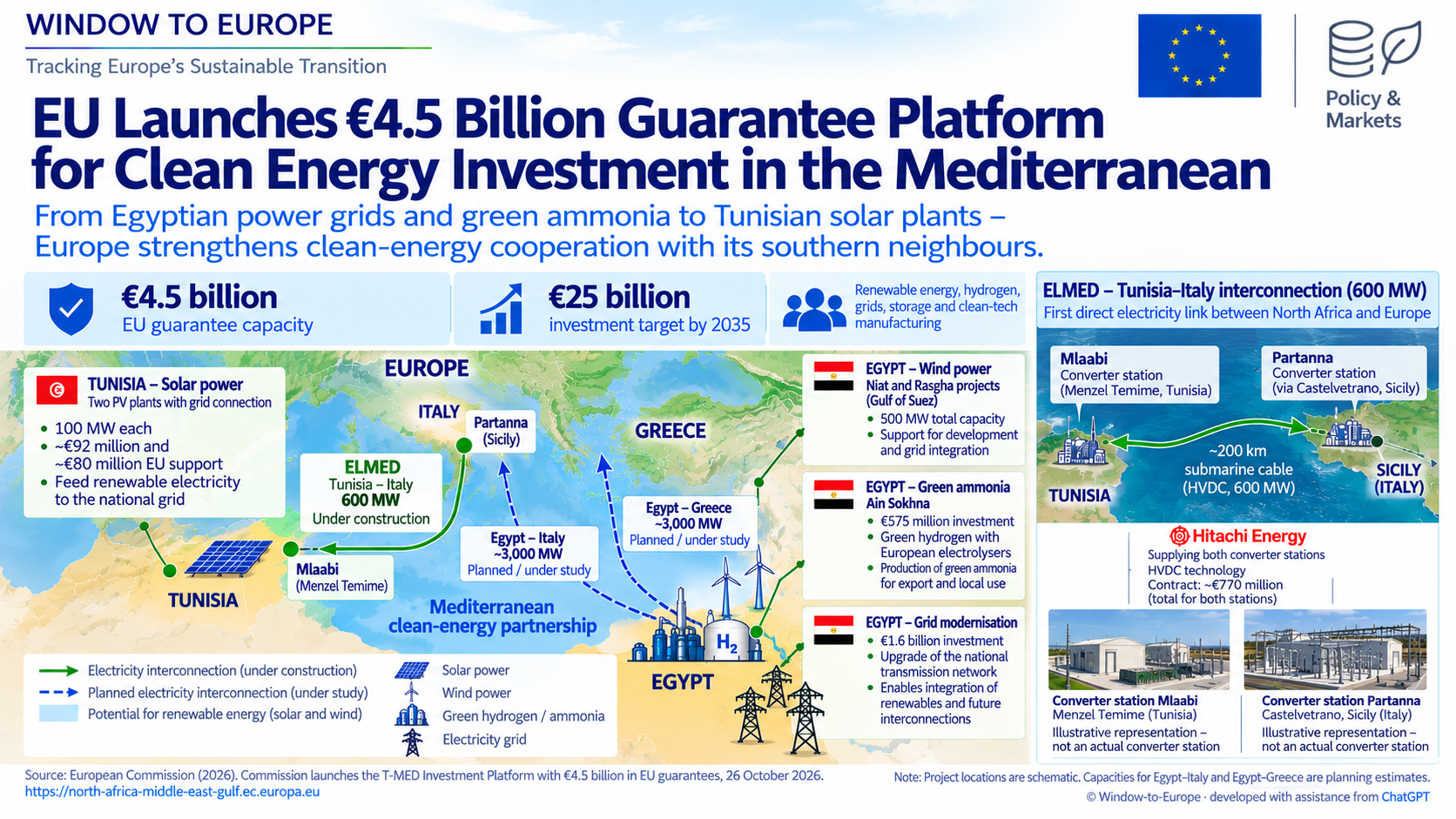
In brief: The European Commission has launched the T-MED Investment Platform to mobilise clean-energy investments across the Mediterranean. With €4.5 billion in EU guarantee capacity, the initiative aims to support up to €25 billion in investments by 2035, including renewable electricity, hydrogen, power grids and cross-border connections.
From investment guarantees to industrial projects
On 26 October 2026, the European Commission announced the T-MED Investment Platform, designed to bring together financial institutions, investors and project developers. Rather than providing €4.5 billion in direct grants, the EU will use guarantees to help mobilise larger volumes of investment.
Several projects illustrate the scope of this cooperation:
- Egypt: Modernisation of the national electricity transmission network, representing an investment volume of approximately €1.6 billion.
- Egypt: A €575 million green ammonia project at Ain Sokhna, using renewable hydrogen and European electrolysis technology.
- Egypt: The Niat and Rasgha wind projects at the Gulf of Suez, with a combined capacity of 500 MW.
- Tunisia: Two solar photovoltaic projects of 100 MW each, accompanied by grid infrastructure and EU financial support.
These projects combine renewable electricity generation with industrial applications and the infrastructure required to integrate new capacity into national power systems.
Connecting North Africa and Europe
Cross-Mediterranean electricity connections are another important part of this strategy. The 600 MW ELMED interconnector between Tunisia and Italy is being developed to establish a direct electricity link between the two countries. Further proposed connections, including the approximately 3 GW GREGY project between Egypt and Greece, could eventually enable large-scale electricity exchange between North Africa and Europe.
Such connections would support renewable electricity integration and closer cooperation between electricity markets. However, planned interconnectors should be distinguished from operational infrastructure, and the new T-MED announcement does not itself constitute a financing commitment for every proposed cable.
A shared energy transition
T-MED illustrates a broader dimension of Europe’s energy transition: cooperation with neighbouring countries through investment, technology transfer and interconnected infrastructure. Its success will depend on the implementation of projects, the mobilisation of private capital and the development of reliable electricity networks on both sides of the Mediterranean.
Sources