
In brief
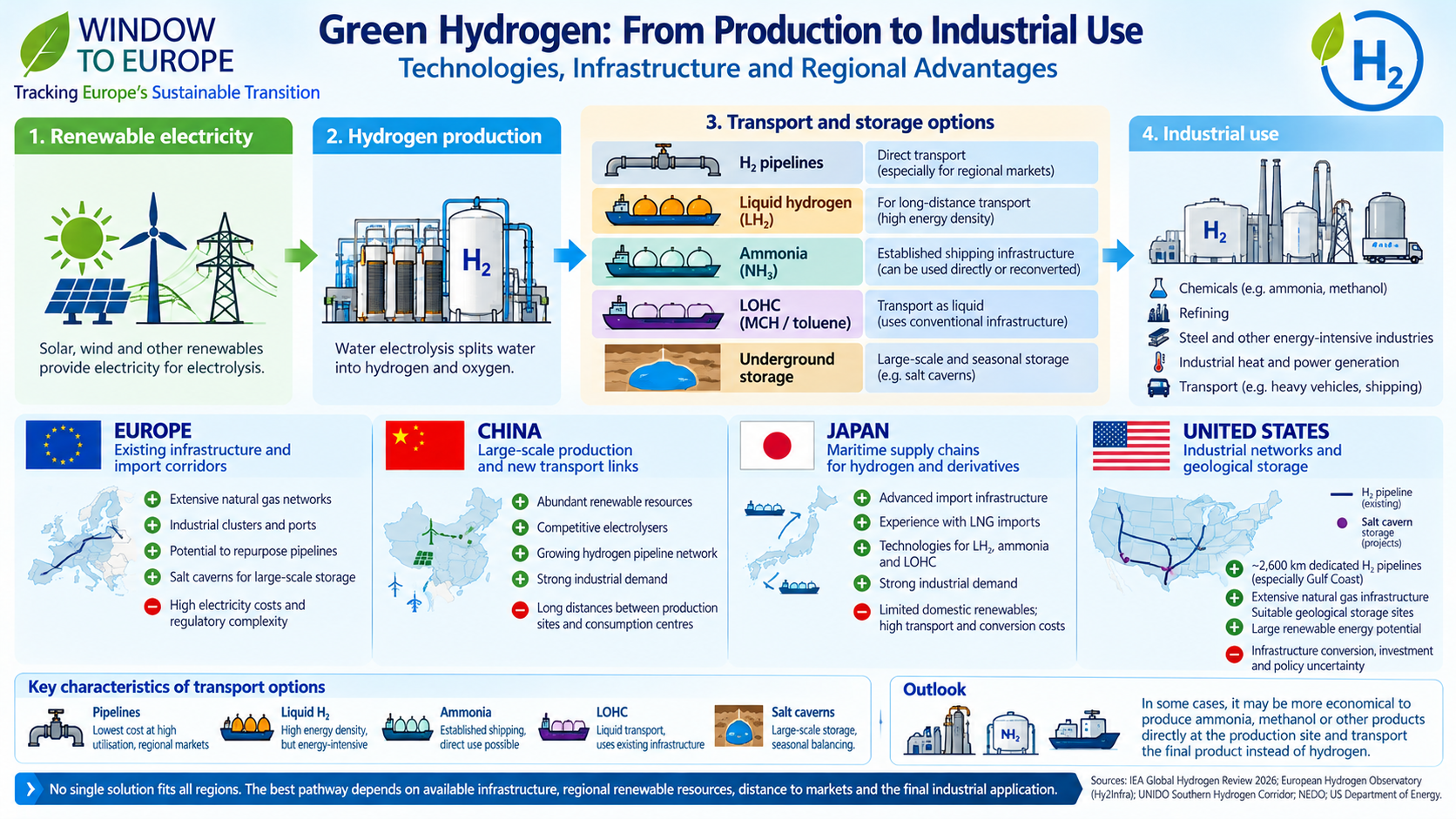
Renewable hydrogen must not only be produced economically but also transported and stored efficiently. Pipelines, liquid hydrogen, ammonia and liquid organic hydrogen carriers (LOHC) offer different solutions. The most suitable technology depends on distance, infrastructure and industrial demand.
Transport and storage technologies
| Technology | Main advantage | Main limitation |
|---|---|---|
| H₂ pipelines | Direct transport; efficient at high utilisation | Investment costs; material compatibility |
| Liquid H₂ | High volumetric density compared with gaseous H₂ | Liquefaction at −253 °C; energy losses |
| Ammonia | Established shipping infrastructure | Energy-intensive reconversion if pure H₂ is required |
| LOHC (MCH/toluene cycle) | Liquid transport using conventional infrastructure | Energy required for hydrogen release |
| Salt caverns | Large-scale seasonal storage | Suitable geological formations required |
Sources: IEA – Global Hydrogen Review 2026; IEA – Global Hydrogen Review 2024.
Four regions, different advantages
Europe – Existing infrastructure. Extensive natural-gas networks, industrial clusters and salt caverns offer opportunities for hydrogen transport and storage. Repurposing existing pipelines could reduce investment costs. The Southern Hydrogen Corridor illustrates planned connections to Mediterranean renewable-hydrogen production.
Source: UNIDO – Southern Hydrogen Corridor.
China – Production scale. Large renewable-energy resources and competitive electrolyser manufacturing favour hydrogen production. However, production sites in western China are often far from industrial consumers, creating demand for new transport infrastructure.
Source: IEA – Global Hydrogen Review 2026.
Japan – Maritime supply chains. Limited domestic renewable-energy resources encourage hydrogen imports. Japan is developing transport technologies involving liquid hydrogen, ammonia and LOHC. Their competitiveness depends strongly on conversion losses and shipping costs.
Source: NEDO – Green Innovation Fund.
View from the US
The United States combines extensive natural-gas infrastructure with existing industrial hydrogen networks, particularly along the Gulf Coast. Approximately 2,600 km of dedicated hydrogen pipelines and geological salt-cavern storage provide a foundation for industrial hydrogen clusters. However, converting natural-gas infrastructure to hydrogen requires technical assessment and investment.
Source: US Department of Energy – Hydrogen Pipelines.
Outlook: Transport hydrogen or its products?
Transporting hydrogen is not always the most economical solution. Producing ammonia, methanol or other industrial products directly at locations with inexpensive renewable electricity may avoid costly hydrogen transport and reconversion.
The central conclusion: No single hydrogen transport technology is optimal everywhere. Existing infrastructure, regional energy resources and the final industrial application determine the most suitable pathway.
Source: IEA – Global Hydrogen Review 2026.
Related article
Green Hydrogen in Europe, China and Japan – Three Different Paths to a Hydrogen Economy