
From global mineral resources to advanced magnet manufacturing and recycling: How China, Europe, Japan and other regions are shaping the future of rare-earth permanent magnets.
In brief
Rare-earth mineral resources are distributed across many parts of the world. China has the largest reported reserves, but substantial deposits also exist in Brazil, Australia, Russia, Vietnam, North America, Greenland and Africa.
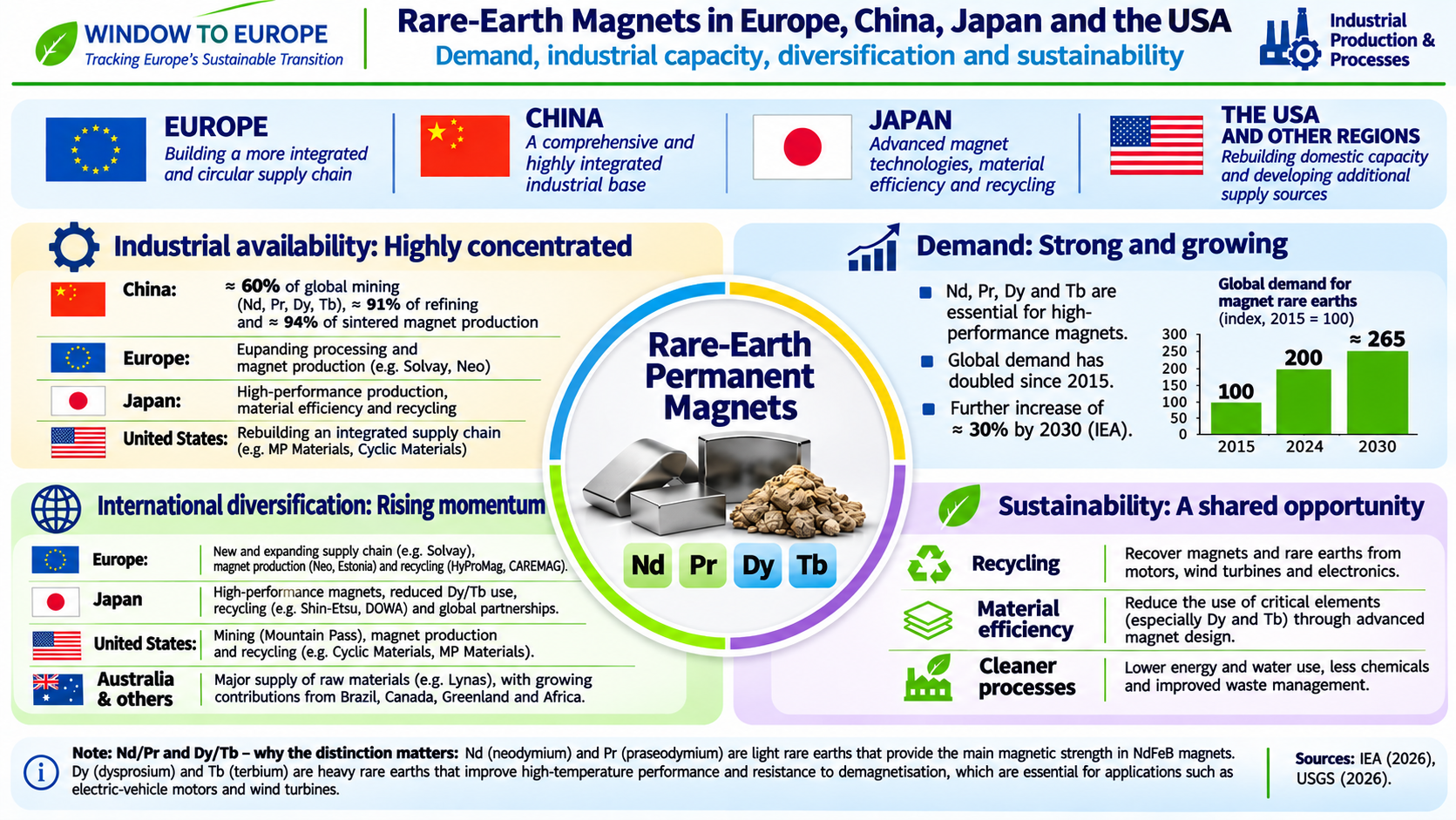
Nevertheless, China dominates the industrial processing and manufacturing stages. In 2024, it accounted for approximately 60% of global mining of magnet rare-earth elements, 91% of refining and 94% of sintered permanent-magnet production.
The four elements of particular importance for high-performance NdFeB magnets are neodymium (Nd), praseodymium (Pr), dysprosium (Dy) and terbium (Tb).
China, Europe and Japan illustrate three different approaches to rare-earth magnet supply. China has developed a comprehensive and highly integrated industrial production system. Europe is establishing additional processing, magnet manufacturing and recycling capacity. Japan combines advanced magnet technologies, material efficiency and international supply partnerships.
The United States and resource-rich countries such as Australia, Brazil and Canada contribute further opportunities for diversification.
The objective is not to replace China, but to establish more resilient international supply chains while improving material efficiency and environmental sustainability.
1. Rare-earth resources are widely distributed
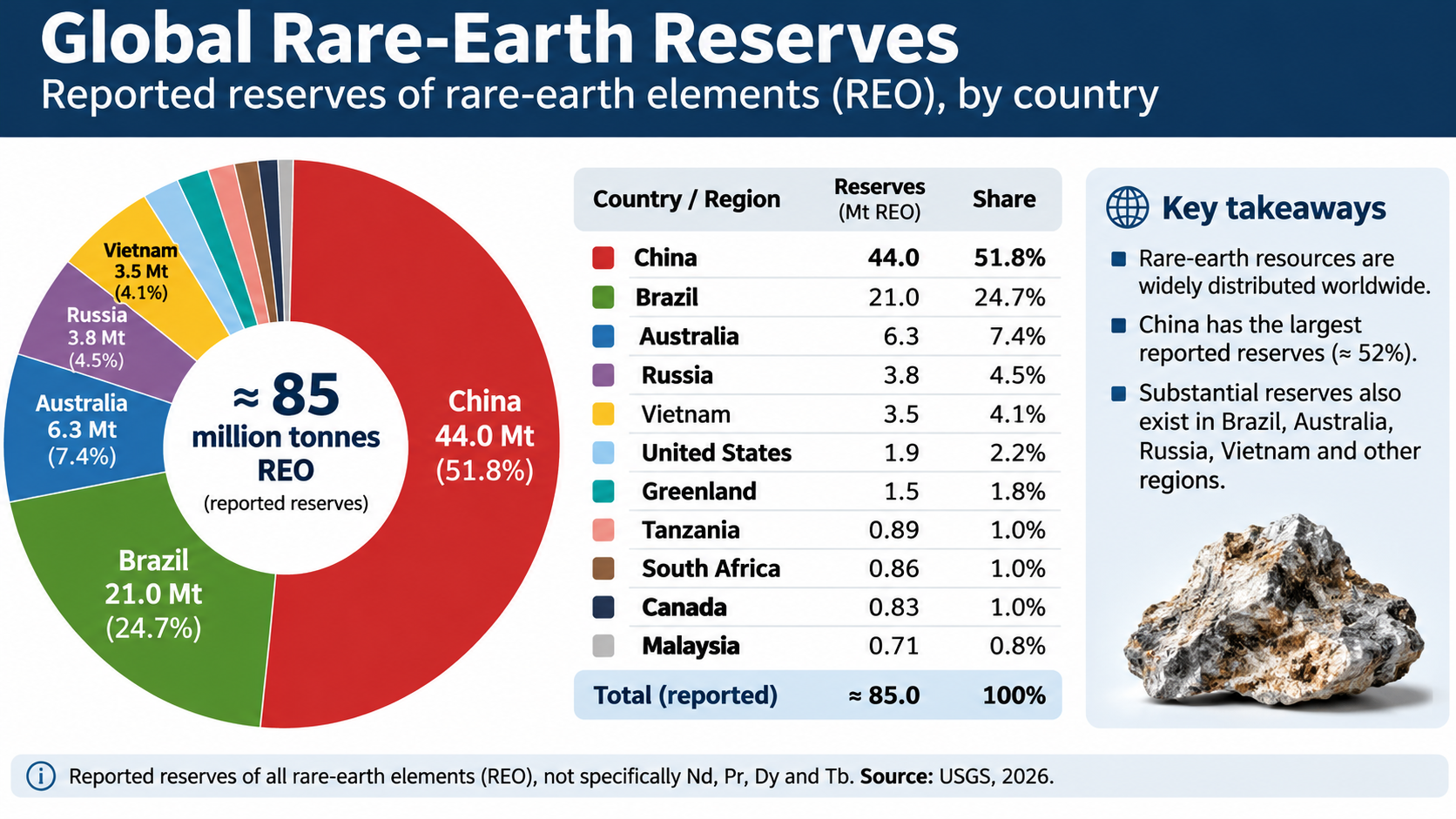
China possesses the world’s largest reported rare-earth reserves, estimated by the US Geological Survey (USGS) at approximately 44 million tonnes of rare-earth oxides (REO).
However, substantial reserves are also reported in other regions.
Brazil has an estimated 21 million tonnes, followed by Australia with 6.3 million tonnes, Russia with 3.8 million tonnes and Vietnam with 3.5 million tonnes. The United States, Greenland, Tanzania, South Africa and Canada also possess significant reserves or geological resources.
These figures describe reported reserves of all rare-earth elements, not specifically the four elements required for high-performance permanent magnets.
This distinction is important. Rare-earth deposits differ considerably in composition. Many contain large quantities of cerium and lanthanum, while the concentrations of neodymium, praseodymium, dysprosium and terbium vary substantially.
The availability of heavy rare earths, particularly dysprosium and terbium, deserves special attention because these elements are important for maintaining magnet performance at elevated temperatures.
Note – Why distinguish Nd/Pr from Dy/Tb?
Neodymium and praseodymium are light rare-earth elements that provide the principal magnetic properties of NdFeB permanent magnets. Dysprosium and terbium are heavy rare-earth elements that can improve resistance to demagnetisation, particularly at elevated operating temperatures.
Not all NdFeB magnets require Dy or Tb. Their use depends on the performance requirements of the application.
The distinction is also important for supply security: geological occurrence, production volumes, processing routes and market conditions differ considerably between light and heavy rare-earth elements. An adequate supply of Nd/Pr therefore does not automatically guarantee access to Dy/Tb.
Furthermore, geological resources, economically recoverable reserves, annual mining production and processing capacity are fundamentally different measures.
A country may possess substantial reserves without operating a commercial mine. Similarly, mineral concentrates may be exported for processing abroad rather than converted into individual rare-earth oxides, metals and magnets in the country of origin.
Source: USGS – Mineral Commodity Summaries 2026, Rare Earths chapter.
2. New mining regions: Australia, the Americas, Africa and Northern Eurasia
Several regions could contribute to a more diversified international supply of magnet rare-earth elements.
Australia already plays a significant role in rare-earth mining. Lynas operates the Mount Weld mine and has established a processing chain extending to Malaysia. This represents one of the most important existing alternatives to Chinese rare-earth production.
Brazil combines extensive reported reserves with emerging commercial production. The Serra Verde project is particularly interesting because its ionic-clay deposits contain both light and heavy rare-earth elements. Brazil could therefore become an important supplier of dysprosium and terbium as well as neodymium and praseodymium.
Canada possesses substantial geological resources and is involved in rare-earth development and processing initiatives. Canadian companies also contribute capital and industrial expertise to projects outside Canada, including European separation and magnet-manufacturing facilities.
The United States already operates significant rare-earth mining at Mountain Pass, California, and is expanding domestic separation, metallisation and magnet production.
Greenland has important deposits, including projects with potentially valuable heavy rare-earth content. However, commercial development remains subject to technical, economic, environmental and political considerations.
Russia and Northern Eurasia contain substantial mineral resources, but their contribution to internationally diversified magnet supply chains remains limited by the scale and accessibility of industrial processing facilities.
Africa offers additional opportunities. Projects in Tanzania and South Africa, alongside production and development activities elsewhere on the continent, could expand future supply. Many projects still require financing, infrastructure, processing facilities and reliable commercial customers.
Southeast Asia is especially important for heavy rare-earth supply. Myanmar contributes substantially to the production of dysprosium- and terbium-bearing materials, much of which enters Chinese processing chains. Malaysia, meanwhile, already hosts major rare-earth separation operations.
These examples demonstrate that additional sources of raw materials are available or under development. However, mining alone cannot establish a complete magnet supply chain.
Sources: USGS – Mineral Commodity Summaries 2026; IEA – Rare Earth Elements.
3. From mining to magnets: The real industrial bottleneck
Rare-earth magnet production involves several specialised stages:
Mining and mineral concentration → chemical separation → individual rare-earth oxides → metals → alloys → magnet manufacturing.
China’s industrial strength becomes progressively more pronounced along this value chain.
According to the International Energy Agency, China accounted for approximately 60% of global mining of the four magnet rare-earth elements in 2024, but 91% of refining and 94% of sintered permanent-magnet manufacturing.
These figures reveal why the discovery or development of new mineral deposits cannot, by itself, guarantee supply security.
The IEA estimates that existing and announced projects outside China could provide more than 50,000 tonnes of annual mining capacity for magnet rare-earth elements by 2035.
However, announced refining capacity remains below 40,000 tonnes, while downstream metal, alloy and magnet projects account for only around 18,000 tonnes on a rare-earth-content basis.
These figures describe potential capacity rather than guaranteed production. The downstream capacities are expressed in rare-earth content, not gross weight of finished magnets.
The greatest challenge is therefore to establish competitive processing and manufacturing capabilities alongside new sources of raw materials.
Source: IEA – Rare Earth Elements.
4. China: An integrated industrial supply chain
China’s leading position in rare-earth magnets is based on decades of industrial investment, technological development and the integration of successive processing stages.
Its industrial strength extends well beyond access to mineral resources. China has developed extensive capabilities in chemical separation, rare-earth metal production, alloy manufacturing and the production of high-performance magnets.
Large domestic markets for electric vehicles, industrial motors, wind turbines and advanced electronics support this integrated manufacturing system.
China also faces the environmental challenges associated with rare-earth mining and processing. Improvements in energy efficiency, chemical separation, waste management and recycling are therefore important for the sustainability of its established industrial base.
For international manufacturers, China will remain an essential supplier and technological partner. The development of additional supply chains should complement this industrial capacity rather than be understood as an attempt to replace it.
Source: IEA – Rare Earth Elements.
5. Europe: Connecting resources, processing and magnet manufacturing
Europe is gradually developing an industrial supply chain extending from mineral resources to permanent magnets and recycling.
Important deposits have been identified in Norway, Sweden and Finland. However, most European mining projects remain under development.
Further downstream, Solvay operates an established rare-earth separation facility in La Rochelle, France, while Neo Performance Materials operates processing facilities in Sillamäe, Estonia.
In September 2026, Neo began commercial magnet production at its new factory in Narva, Estonia. The first phase has a nominal annual capacity of approximately 2,000 tonnes of magnets, although installed capacity should not be confused with actual annual output.
Another important development is the CAREMAG project in Lacq, France, which combines the processing of mineral concentrates with recycling of end-of-life magnets.
In Germany, HyProMag is commissioning an industrial facility using hydrogen processing of magnet scrap, while European research programmes such as HARMONY are developing complementary recycling technologies.
Europe’s remaining challenges include access to competitively priced feedstocks, the production of rare-earth metals and alloys, industrial scale-up and the integration of geographically dispersed facilities.
Source: Window-to-Europe – Europe Builds Its Rare-Earth Magnet Supply Chain.
6. Japan: Advanced magnet technologies, material efficiency and recycling
Japan has extensive industrial experience in high-performance rare-earth permanent magnets, particularly for automotive, electronic and industrial applications.
Its strategy combines advanced magnet manufacturing, reduced consumption of critical elements, recycling technologies and international partnerships.
An important technological objective is to reduce the use of dysprosium and terbium in magnets designed for elevated operating temperatures. These heavy rare-earth elements are particularly important for applications requiring high resistance to demagnetisation.
Japan is also developing industrial systems for recovering valuable magnet materials from end-of-life products.
Shin-Etsu Chemical has established technologies for recycling rare-earth magnet materials. In April 2026, the company announced a collaboration with Daikin Industries, Hitachi and Tokyo Eco Recycle to recover magnets from compressors used in commercial air-conditioning systems.
The partners intend to use AI-based image recognition and robotics to automate disassembly, demagnetisation and magnet extraction. Development of the equipment is planned during 2026, with full-scale operation of the recycling system scheduled to begin in 2027.
DOWA Eco-System is pursuing another approach. In September 2026, the company announced that its demonstration project for recovering rare-earth magnets from electric-vehicle drive motors had been selected for support by Japan’s Ministry of the Environment.
The project builds on earlier work recovering magnets from used household appliances and addresses an increasingly important future source of secondary rare-earth materials.
International cooperation is another central element of Japan’s supply strategy.
Through JOGMEC and Iwatani, Japanese partners are participating in the CAREMAG rare-earth separation and recycling project in Lacq, France.
The partners have committed up to €110 million in equity and debt financing and secured a long-term agreement covering 50% of CAREMAG’s planned heavy rare-earth oxide production.
According to Japan’s Ministry of Economy, Trade and Industry, the expected deliveries of dysprosium and terbium would correspond to approximately 20% of Japan’s future demand for these elements.
The project illustrates how Japanese financing and industrial expertise can contribute to European processing capacity while simultaneously diversifying Japan’s supply.
Japan’s contribution to a more sustainable magnet industry therefore extends beyond securing raw materials. It includes material-efficient magnet design, advanced recycling technologies and international cooperation linking industrial production with resource recovery.
Sources:
- Shin-Etsu Chemical – Resource Saving and Magnet Recycling
- Daikin – Joint Recycling Initiative, 14 April 2026 (Japanese)
- DOWA Eco-System – Recycling Demonstration, 10 September 2026 (Japanese)
- JOGMEC – Investment in CAREMAG, 17 March 2025
- METI – Japan-France Heavy Rare Earth Cooperation
7. View from the USA and Other Regions
The United States is investing in a more integrated rare-earth magnet supply chain.
MP Materials operates the Mountain Pass mine in California and has expanded domestic production of separated rare-earth oxides.
At its Independence facility in Texas, the company has begun manufacturing NdFeB magnets using commercial production equipment.
Additional capacity is planned, but announced production targets must be distinguished from established commercial output.
The United States is also developing new recycling technologies.
In September 2026, Cyclic Materials opened a facility in Mesa, Arizona, designed to process up to 25,000 tonnes of magnet-bearing end-of-life products annually.
This capacity refers to incoming products, not recovered rare-earth quantities.
American research institutions and industrial companies are also investigating alternative separation processes, recovery from industrial residues and more efficient recycling routes.
Beyond the United States, several resource-rich countries are becoming increasingly important for international supply diversification.
Australia already provides a major alternative source of rare-earth materials through the mining and processing activities of Lynas, including its operations in Malaysia.
Brazil has substantial mineral reserves and emerging commercial production, including deposits containing valuable heavy rare-earth elements.
Canada contributes geological resources, industrial expertise and investment in international processing and magnet-manufacturing projects.
Greenland, Africa and Northern Eurasia offer additional geological potential, although many projects still face considerable technical, financial, infrastructural and environmental challenges.
Together, these developments demonstrate that diversification will depend on international industrial networks rather than isolated national supply chains.
Sources: MP Materials – Company News and Results; Cyclic Materials – Commercial Magnet Recovery Facility; USGS – Mineral Commodity Summaries 2026.
8. Sustainability: An opportunity for all producing regions
Rare-earth mining and processing can have substantial environmental impacts.
Potential challenges include energy consumption, water use, chemical reagents, waste generation and the management of naturally occurring radioactive materials in certain deposits.
These environmental issues are not confined to China.
China has accumulated extensive industrial expertise and is developing improved processing and recycling technologies. Europe, Japan and the United States are pursuing complementary approaches.
Europe is emphasising industrial recycling, environmental management and the development of more circular material flows.
Japan contributes advanced magnet technologies, reduced consumption of critical elements and specialised recycling processes.
The United States is investing in automated magnet recovery, new separation technologies and the integration of recycled materials into domestic magnet manufacturing.
China combines large-scale industrial processing with experience in improving existing production technologies and developing recycling systems.
Recycling can reduce dependence on primary mineral resources, but its environmental benefits depend on the specific process.
Direct magnet-to-magnet recycling may avoid several energy- and chemical-intensive separation stages. Other processes recover individual rare-earth elements and allow their reuse in different applications.
A meaningful international comparison requires life-cycle assessments with consistent system boundaries, including energy supply, chemical consumption, waste treatment, transport and the quality of the recovered materials.
European production is therefore not automatically more sustainable than Chinese production. Environmental performance must be demonstrated through comparable operating data.
International cooperation could also accelerate the development of more sustainable production technologies.
China’s extensive industrial experience, Europe’s growing recycling infrastructure, Japan’s expertise in material-efficient magnets and the United States‘ investment in alternative processing and recovery technologies offer complementary strengths.
The environmental benefits of these approaches must ultimately be assessed using comparable life-cycle data.
The objective should be to reduce the environmental footprint of rare-earth magnets across the entire value chain, irrespective of where individual production stages are located.
9. Supply security requires more than additional mines
For manufacturers of electric vehicles, wind turbines and industrial equipment, access to a reliable second supplier can be more important than complete national self-sufficiency.
However, diversification must extend beyond mineral extraction.
A second source of rare-earth concentrate is insufficient if separation, metal production or magnet manufacturing remains concentrated in a single country.
The emerging international network already demonstrates several promising forms of cooperation.
Australian rare-earth materials are processed in Malaysia. Canadian companies are investing in European facilities. Japanese financing supports French separation and recycling capacity. American companies are establishing domestic processing and magnet manufacturing.
Such partnerships can combine different regional strengths while creating additional supply options.
Economic competitiveness remains essential. New facilities must achieve reliable quality, sufficient production volumes and costs that industrial customers can support.
10. Outlook: Diversification and sustainability belong together
China’s leading position in rare-earth magnets reflects decades of industrial investment, technical expertise and the successful integration of complex production stages.
The development of additional supply chains should not be understood as an attempt to eliminate China from international trade.
Instead, Europe, Japan, the United States and resource-rich partner countries have an opportunity to establish complementary industrial capacities.
Australia and Brazil may become increasingly important raw-material suppliers. Canada, Africa, Greenland and other regions offer additional development potential.
Europe is expanding processing, magnet production and recycling. Japan contributes advanced magnet technologies and international partnerships, while the United States is rebuilding domestic manufacturing capacity.
The central challenge for the coming decade is to convert these opportunities into commercially competitive and environmentally responsible industrial production.
A more diversified rare-earth magnet industry could improve supply security while accelerating the development of cleaner processing technologies, more efficient magnets and economically viable recycling.
The objective is not to replace China, but to build several reliable and increasingly sustainable supply chains.