
From waste cooking oils and advanced catalysts to non-food crops, microalgae and synthetic fuels – with a view from the United States.
In brief
Sustainable aviation fuels (SAF) are essential to reducing the climate impact of aviation, particularly on long-distance routes where battery-electric propulsion is unlikely to become practical in the foreseeable future.
However, Europe, China and Japan are pursuing different approaches. Europe has established a regulatory framework that creates demand for SAF but remains heavily dependent on imported feedstocks. China is advancing catalytic technologies and large-scale biofuel production. Japan is exploring additional feedstocks, including non-food oil plants and microalgae, while investing in international SAF production.
The United States, the world’s largest national aviation fuel market, continues to support domestic SAF production despite the federal government’s renewed emphasis on fossil fuels.
The central challenge is not simply to produce aviation-compatible fuel, but to supply it sustainably, economically and in quantities sufficient to serve a growing global aviation market.
1. Aviation fuel demand: The scale of the challenge
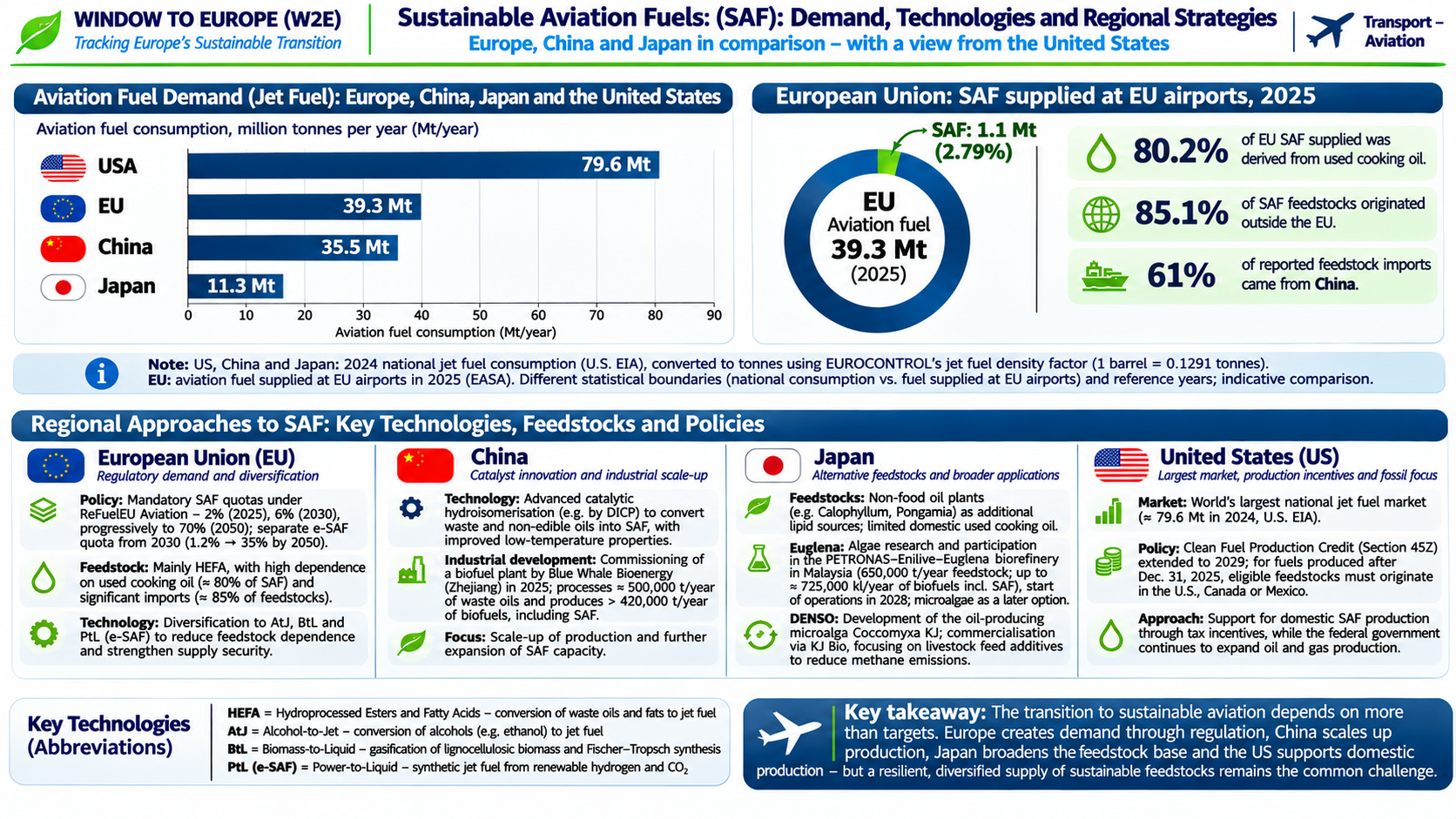
Aviation consumes enormous quantities of liquid hydrocarbon fuels. The United States is the world’s largest individual national aviation fuel market, while China, the European Union and Japan also represent major demand centres.
In 2025, approximately 39.3 million tonnes of aviation fuel were supplied at EU airports, according to the European Union Aviation Safety Agency (EASA). Of this amount, about 1.1 million tonnes consisted of SAF, corresponding to 2.79%.
Globally, SAF represented only around 0.6% of aviation fuel consumption in 2025.
These figures illustrate the enormous challenge facing the industry. Even substantial increases in SAF production capacity will initially replace only a small fraction of conventional kerosene.
Moreover, the geographical distribution of demand differs considerably from that of sustainable feedstock availability and fuel production.
The key question is therefore whether SAF production and its associated supply chains can expand fast enough to meet regulatory targets without creating new dependencies or environmental problems.
Sources: EASA, ReFuelEU Aviation Annual Technical Report 2026; Nature Reviews Clean Technology, 2026.
2. Europe: Regulatory leadership meets feedstock dependence
Europe has established one of the world’s most ambitious regulatory frameworks for sustainable aviation fuels.
Under ReFuelEU Aviation, fuel suppliers must ensure that SAF represents at least 2% of aviation fuel supplied at designated EU airports from 2025. The required share increases to 6% in 2030 and progressively to 70% by 2050.
A separate requirement for synthetic aviation fuels begins in 2030.
This policy provides investors and producers with a predictable market. However, creating demand does not automatically ensure the availability of sustainable raw materials.
The dependence on used cooking oil
Most SAF currently supplied in Europe is produced through the HEFA process (Hydroprocessed Esters and Fatty Acids), which converts waste oils and fats into aviation-compatible hydrocarbons through hydrogenation, oxygen removal, hydroisomerisation and fractionation.
According to EASA, 80.2% of the SAF supplied at EU airports in 2025 was derived from used cooking oil.
More importantly, approximately 85.1% of SAF feedstocks originated outside the European Union, with China accounting for 61% of the reported imported feedstock origins.
These figures reveal a structural vulnerability: Europe has created a rapidly expanding market for SAF but relies heavily on international feedstock supply chains.
The dependency concerns primarily the raw materials used in HEFA production, rather than exclusively imports of finished SAF.
A disruption of these supplies, or a sharp increase in waste-oil prices, could seriously affect the utilisation of European SAF production facilities.
Sources: EASA, ReFuelEU Aviation Annual Technical Report 2026; European Commission, September 2026.
How can Europe reduce this vulnerability?
Several complementary approaches are being pursued.
First, the collection and recovery of domestic waste oils can be improved. However, the total amount of sustainably available used cooking oil is limited, and these materials are also needed for other applications.
Second, alternative biomass resources can be converted into aviation fuels through Alcohol-to-Jet (AtJ) or Biomass-to-Liquid (BtL) technologies.
Third, Power-to-Liquid (PtL) technologies offer a fundamentally different route by combining renewable hydrogen with suitable CO₂ sources to produce synthetic hydrocarbons.
PtL is particularly attractive from a supply-security perspective because it does not depend on lipid feedstocks. However, it creates different requirements: substantial quantities of low-cost renewable electricity, electrolytic hydrogen production capacity and sustainable carbon sources.
The separate EU requirement for synthetic aviation fuels, beginning at 1.2% in 2030 and increasing to 35% by 2050, is intended to stimulate this technological diversification.
Nevertheless, synthetic aviation fuels remain substantially more expensive than conventional kerosene, and large-scale production is still at an early stage.
Europe’s strategic challenge is therefore to move beyond a predominantly HEFA-based SAF industry towards a diversified production system combining sustainable biomass conversion and synthetic fuels.
Europe’s regulatory leadership will translate into industrial resilience only if alternative SAF production pathways can be scaled up alongside the mandated increase in demand.
Sources: European Commission, ReFuelEU Aviation; Nature Reviews Clean Technology, 2026.
3. China: Catalytic innovation and industrial scale-up
China has become an important supplier of waste oils to international biofuel markets while simultaneously developing its own SAF industry.
A particularly interesting technological development comes from the Dalian Institute of Chemical Physics (DICP) of the Chinese Academy of Sciences.
Researchers led by Tian Zhijian and Wang Congxin developed catalytic technologies for the hydroisomerisation of non-edible and waste oils.
Hydroisomerisation is a crucial step in producing aviation fuels because it improves low-temperature properties, enabling the fuel to remain suitable for operation at the extremely low temperatures encountered during flight.
The DICP technology allows production to be adjusted between sustainable aviation fuel and ultra-low-pour-point biodiesel, including simultaneous production of both products.
From laboratory research to industrial production
In December 2025, DICP reported the successful commissioning of a biofuel production facility operated by Blue Whale Bioenergy in Zhejiang Province.
The plant was designed to process approximately 500,000 tonnes of waste oils annually and produce more than 420,000 tonnes of biofuels, including SAF.
The distinction is important: the 500,000-tonne figure refers to feedstock processing capacity, while the projected biofuel output includes products other than SAF. It should not be interpreted as verified annual SAF production.
Nevertheless, the project demonstrates how Chinese catalyst research can progress through pilot development to industrial implementation.
China’s growing SAF industry also creates an interesting relationship with Europe: Chinese waste oils are used in European SAF supply chains, while Chinese companies increasingly develop their own conversion technologies and fuel-production capacity.
This may intensify competition for sustainable lipid feedstocks.
Sources: Chinese Academy of Sciences, December 2025; Earlier Window-to-China report.
4. Japan: New oil plants, microalgae and international cooperation
Japan faces a particularly difficult SAF feedstock challenge because its domestic availability of used cooking oil is limited.
NEDO has estimated that the quantity of domestically available used cooking oil suitable for fuel production is no more than approximately 130,000 tonnes annually.
Japan is therefore investigating alternative sources of lipids, including non-food plants and microalgae, while also participating in international biofuel production projects.
Non-food oil plants from Okinawa
J-Oil Mills and its partners have investigated oils extracted from the seeds of Calophyllum inophyllum and Pongamia pinnata, subtropical plants found in Okinawa.
The extracted oils were converted into aviation-compatible fuel through hydrogenation, isomerisation and distillation.
The resulting neat SAF met the requirements of ASTM D7566 Annex A2.
In March 2025, a Japan Transocean Air flight between Naha and Miyakojima used fuel containing SAF produced from these alternative plant oils.
The project demonstrated technical feasibility, but the establishment of a commercially competitive supply chain will require solutions for cultivation, harvesting, oil extraction, land use and logistics.
Sources: NEDO, March 2025; Science Japan, March 2025; Earlier Window-to-Japan report.
Microalgae: A promising but commercially challenging feedstock
Japan has also been a pioneer in developing aviation fuels from microalgae.
Euglena demonstrated the conversion of microalgal oils and waste oils into aviation-compatible fuels at its demonstration facility in Yokohama.
However, the high cost of producing microalgal oils has remained a major obstacle to commercialisation.
Euglena is now participating in a large-scale biorefinery project in Pengerang, Malaysia, together with PETRONAS and the Italian energy company Enilive.
The joint venture, Pengerang Biorefinery Sdn. Bhd., is constructing a facility designed to process approximately 650,000 tonnes of renewable feedstocks annually.
According to project information presented by Euglena, the plant has a planned total biofuel production capacity of up to approximately 725,000 kilolitres annually, including SAF, hydrogenated vegetable oil (HVO) and bio-naphtha. This figure must not be interpreted as SAF output alone.
The facility is scheduled to begin operations in the second half of 2028.
The project will employ Ecofining technology, developed by Eni in cooperation with Honeywell UOP, together with feedstock pretreatment facilities. This technology provides flexibility in converting different lipid feedstocks into renewable fuels.
Initially, the plant will mainly process used vegetable oils, animal fats and residues from vegetable-oil processing.
PETRONAS explicitly identifies microalgae-derived oils as a feedstock option to be explored in the medium term.
The project therefore represents an important step towards industrial SAF production, but not yet a breakthrough in the large-scale cultivation of microalgae for aviation fuel.
It also demonstrates international industrial cooperation involving a Japanese biotechnology company, an Italian energy company and Malaysia’s national energy company.
Sources: PETRONAS, Final Investment Decision, 26 July 2024; PETRONAS, Enilive and Euglena, Groundbreaking Ceremony, 10 November 2025; Euglena project information published by Japan’s Ministry of Economy, Trade and Industry, 2025; Earlier Window-to-Japan report.
DENSO: From algae-based fuels to other applications
The Japanese automotive supplier DENSO has investigated oil-producing microalgae for many years, including Coccomyxa KJ, previously known as Pseudochoricystis ellipsoidea.
DENSO established a demonstration cultivation facility in Amakusa and subsequently cooperated with Euglena on biofuel-related research.
However, in February 2024, DENSO and the Kamichiku Group established KJ Bio to pursue another application of the microalga: livestock feed additives intended to reduce methane emissions from cattle.
The company’s activities include further development of microalgae cultivation technology and the commercialisation of algae-derived materials for animal feed.
Scientific research has provided encouraging initial evidence. A study published in PLOS ONE in August 2024 reported reductions in methane production in laboratory experiments simulating rumen fermentation when selected Coccomyxapreparations were added.
These in-vitro results should not be interpreted as proof of equivalent methane reductions under commercial cattle-farming conditions.
DENSO’s diversification does not necessarily mean that all fuel-related research has ended.
It does illustrate a broader commercial challenge: producing microalgae for higher-value applications may currently offer more attractive opportunities than producing large quantities of low-cost aviation fuel.
Japan’s experience therefore highlights the distinction between scientific feasibility and industrial competitiveness.
The diversification of feedstocks is essential, but alternative feedstocks must ultimately be produced at a scale and cost compatible with aviation fuel markets.
Sources: DENSO, establishment of KJ Bio, 1 March 2024; Sato et al., PLOS ONE, 2024, DOI: 10.1371/journal.pone.0308646; Kamichiku Group, KJ Bio update, October 2025.
5. Beyond HEFA: The main technological pathways
Although HEFA is currently the most established commercial SAF pathway, its dependence on limited lipid feedstocks makes technological diversification necessary.
Four principal conversion routes are particularly relevant.
| Technology | Main feedstocks | Conversion principle | Principal limitation |
|---|---|---|---|
| HEFA – Hydroprocessed Esters and Fatty Acids | Waste cooking oils, fats and non-food plant oils | Hydrogenation, deoxygenation, hydroisomerisation and fractionation | Limited availability of sustainable lipid feedstocks |
| AtJ – Alcohol-to-Jet | Ethanol and other suitable alcohols | Alcohol dehydration, oligomerisation and hydrogenation | Sustainable alcohol supply and conversion costs |
| BtL – Biomass-to-Liquid | Agricultural residues, forestry residues and other lignocellulosic biomass | Gasification followed by Fischer–Tropsch synthesis | Capital investment, feedstock logistics and process integration |
| PtL – Power-to-Liquid | Renewable electricity, hydrogen and suitable CO₂ | Electrolysis and synthesis of liquid hydrocarbons | Electricity demand, hydrogen costs and carbon sourcing |
These pathways differ not only in their feedstocks but also in their technological maturity, energy requirements and potential environmental impacts.
HEFA is commercially established. AtJ is entering industrial implementation, while BtL and PtL require further large-scale demonstration and investment.
The overall greenhouse-gas benefits depend on the complete production chain, including feedstock origin, electricity supply, hydrogen production, transport and potential land-use effects.
A comprehensive review published in Nature Reviews Clean Technology in 2026 examined 26 SAF synthesis pathways, underlining the importance of developing a broader technological portfolio.
6. Supply-chain resilience: A challenge beyond production capacity
The European experience illustrates a fundamental problem in the global SAF transition.
Expanding refining capacity does not automatically increase the availability of sustainable feedstocks.
New HEFA facilities may compete for the same limited quantities of used cooking oil, animal fats and other residual lipids.
This could increase raw-material prices, create supply bottlenecks and encourage the misclassification of virgin oils as waste materials.
Reliable certification and traceability are therefore essential.
The EU’s Union Database is intended to improve the documentation and traceability of renewable fuel transactions and feedstocks.
However, digital documentation must be complemented by effective verification of actual material flows.
A resilient SAF supply system will require a combination of diversified feedstocks, alternative conversion technologies, transparent certification and geographically distributed production facilities.
The United States has introduced an additional approach to supply security through domestic feedstock requirements for its Clean Fuel Production Credit. Although this strengthens regional sourcing incentives, it does not eliminate the need for sustainability verification or technological diversification.
Supply security and sustainability cannot be treated as separate objectives.
Sources: European Commission, renewable fuel certification and voluntary schemes; EASA, ReFuelEU Aviation Annual Technical Report 2026; US Internal Revenue Service, Clean Fuel Production Credit.
7. View from the United States: Fossil fuel expansion and SAF development in parallel
The United States represents the world’s largest individual national aviation fuel market.
Its approach differs considerably from that of the European Union.
While the Trump administration prioritises domestic oil and gas production, sustainable aviation fuels continue to receive federal support through the Clean Fuel Production Credit, Section 45Z, which has been extended until the end of 2029.
Unlike the EU, the United States has no nationwide SAF blending mandate.
Instead, production incentives and commercial investment play a central role.
Under Section 45Z, qualifying domestically produced transportation fuels, including SAF, can receive tax credits linked to their lifecycle greenhouse-gas emissions performance.
For fuels produced after December 31, 2025, eligibility is restricted to feedstocks originating in the United States, Canada or Mexico.
This policy supports North American agricultural and biofuel supply chains while reducing incentives to rely on imported feedstocks from other regions.
The Internal Revenue Service issued additional guidance in September 2026, including emissions-rate provisions and the treatment of certain agricultural practices in the calculation of fuel-related greenhouse-gas emissions.
The United States is therefore pursuing two approaches simultaneously: expanding conventional fossil fuel production while encouraging domestic low-carbon fuel manufacturing.
Its substantial biomass resources and existing refining infrastructure offer important advantages for industrial SAF production.
However, the expansion of production capacity does not by itself guarantee substantial reductions in aviation emissions. Actual SAF volumes, lifecycle greenhouse-gas performance and commercial competitiveness remain decisive.
The American approach therefore provides an interesting contrast to Europe’s regulatory strategy: domestic production incentives rather than mandatory blending requirements.
Sources: US Internal Revenue Service, Clean Fuel Production Credit; IRS, Section 45Z guidance, 8 September 2026; IRS, Notice 2026-53.
8. Outlook: Four regions, different strengths – one global challenge
Europe, China, Japan and the United States illustrate different dimensions of the transition towards sustainable aviation fuels.
Europe has created a regulated SAF market, but its dependence on imported lipid feedstocks raises serious questions about supply-chain resilience.
China is demonstrating the industrial implementation of advanced catalytic technologies while becoming an increasingly important participant in international biofuel supply chains.
Japan is investigating new feedstocks, including non-food plants and microalgae, and is participating in international industrial projects. Its experience also illustrates the economic challenges of alternative biological feedstocks.
The United States combines the world’s largest national aviation fuel market with substantial domestic feedstock resources and production incentives, while continuing to prioritise fossil fuel development.
No single region or technology currently provides a complete solution.
HEFA offers an established industrial starting point, but sustainable waste oils are limited.
AtJ and BtL can expand the range of usable biomass resources, while PtL offers a pathway independent of lipid feedstocks, although it requires substantial renewable electricity, hydrogen production capacity and sustainable carbon sources.
Ultimately, the transition will depend on the successful integration of technological innovation, industrial investment, sustainable feedstock supply and reliable international cooperation.
The future of sustainable aviation will be determined not only by how much SAF governments require, but by how much sustainable fuel industry can actually produce – and from which resources.