
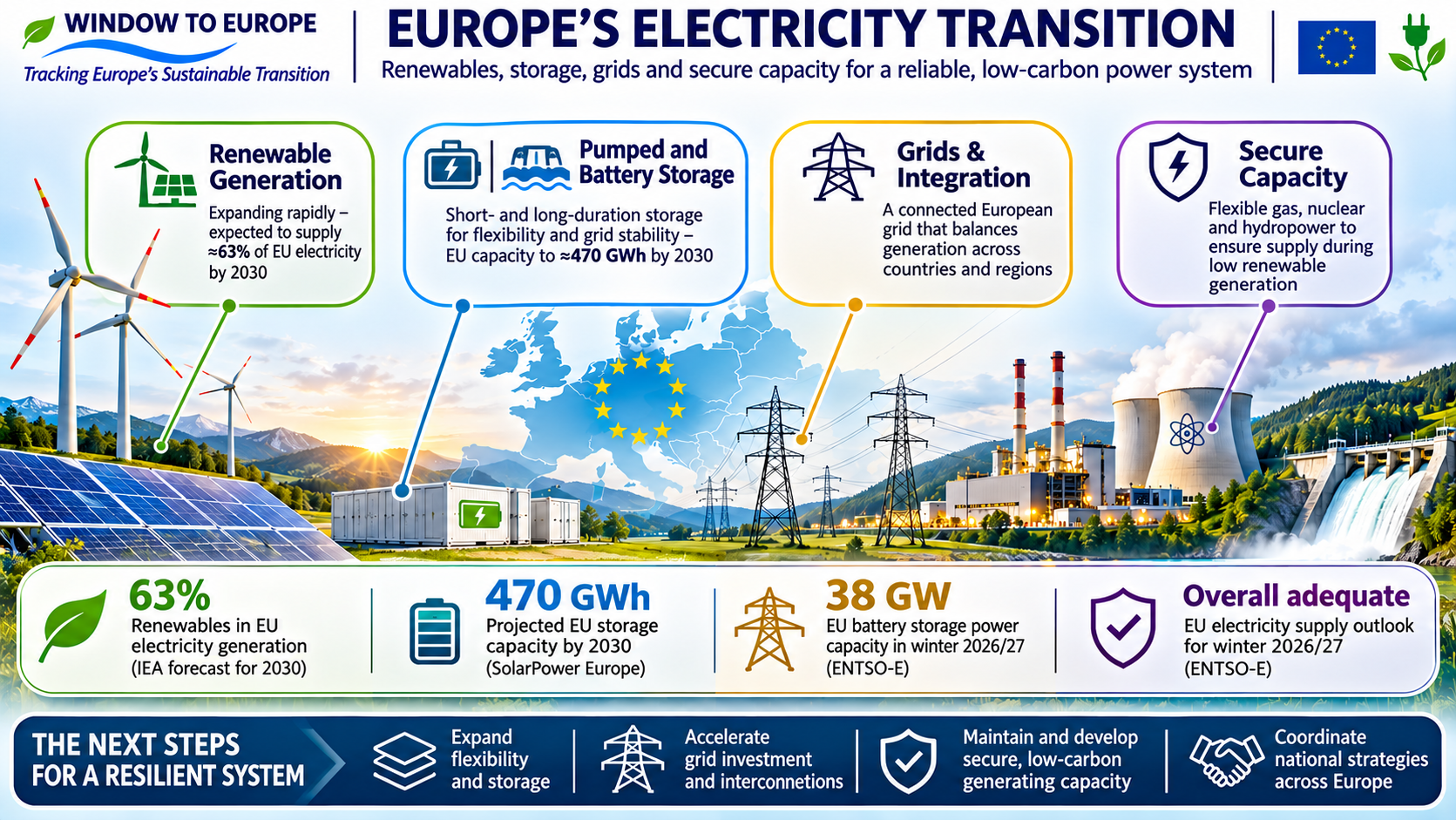
How Europe is building a flexible, low-carbon electricity system – and preparing for periods when renewable generation is insufficient
In brief
Europe’s electricity transition is entering a decisive phase. Renewable generation and battery storage are expanding rapidly, while interconnected electricity networks provide opportunities to balance supply and demand across national borders. Yet reliable electricity supply requires more than wind, solar and batteries.
According to ENTSO-E’s Winter Outlook 2026–2027, Europe’s installed renewable capacity increased by approximately 134 GW over the previous winter, while battery storage power capacity more than doubled to 38 GW. At the same time, hard coal and lignite capacity declined by nearly 6 GW.
The outlook assesses Europe’s overall electricity adequacy for the coming winter as favourable, while identifying specific regional risks, particularly in systems with limited interconnection.
Europe’s electricity security therefore depends on four complementary elements: renewable and dispatchable generation, electricity storage, strong networks and flexible demand. Gas-fired generation, nuclear power, reservoir hydropower and strategic reserves continue to provide important safeguards.
Europe is making substantial progress. The central challenge is to ensure that electricity remains available at every critical moment – not merely that sufficient energy is generated over the course of a year.
Source: ENTSO-E, Winter Outlook 2026–2027, 13 November 2026.
Further reading
1. Europe’s changing electricity system
Europe is moving towards an electricity system with a much larger share of weather-dependent generation. Wind and solar electricity reduce dependence on fossil fuels but create additional requirements for flexibility, storage and network capacity.
These requirements extend beyond daily fluctuations. Periods of weak wind and solar generation may last several days, while electricity demand can rise sharply during winter cold spells.
Electricity supply must therefore be assessed in terms of both energy and power. Annual electricity production is measured in terawatt-hours (TWh), whereas the ability to meet demand at a particular moment depends on available generating and storage power, measured in gigawatts (GW).
The distinction is essential: a country can produce sufficient electricity over a year and still face shortages during individual periods of high demand or low generation.
2. Battery storage: Rapid growth, clearly defined limits
Battery energy storage systems (BESS) have become one of Europe’s fastest-growing electricity infrastructure segments.
According to SolarPower Europe’s European Battery Market Outlook 2026–2030, the EU installed approximately 27 GWh of new battery storage in 2025, bringing its cumulative capacity to around 77 GWh. Under the medium scenario, EU capacity could reach approximately 470 GWh by 2030.
Large grid-connected systems are becoming increasingly important. They can absorb electricity during periods of high renewable generation, return it to the network during peak demand and provide fast grid-support services.
However, batteries do not generate additional energy. A 100 MW / 400 MWh battery can theoretically supply its rated power for four hours, disregarding conversion losses and operational restrictions.
Consequently, battery expansion alone cannot guarantee electricity supply during prolonged periods of low renewable generation.
Source: SolarPower Europe, European Battery Market Outlook 2026–2030.
3. European projects: From storage capacity to system services
Several recent projects illustrate the increasing diversity of European electricity storage and backup technologies.
Greece: Large-scale operational battery storage
In October 2026, Greece inaugurated a 330 MW / 790 MWh battery storage facility in Thessaly, developed by METLEN and Karatzis Group. The approximately €170 million project received financial support through the EU Recovery and Resilience Facility.
With a nominal discharge duration of approximately 2.4 hours, the installation is particularly relevant for short-term balancing and renewable electricity integration.
Read the W2E project analysis: Greece’s 790 MWh battery facility.
Netherlands: Commercial grid integration
Return’s Antares battery facility in Waddinxveen entered commercial operation in October 2026. The 100 MW / 200 MWh system is directly connected to TenneT’s 150 kV high-voltage network.
The project demonstrates how battery storage can become a commercially integrated element of electricity infrastructure, providing flexibility and participating in electricity markets.
Read the W2E project analysis: Antares battery storage.
Germany: Grid-forming battery technology
At Bertikow in Brandenburg, construction began in October 2026 on a 200 MW / 840 MWh battery system.
The project is particularly noteworthy for its planned grid-forming inverter technology, supplied by SMA Solar Technology. Beyond shifting electricity over time, the system is intended to provide grid-support services and contribute to restoration capabilities.
Commercial operation is targeted for the first half of 2028. These advanced functions therefore represent planned capabilities rather than demonstrated operational performance.
Read the W2E project analysis: Bertikow’s grid-forming battery system.
Germany: Hydrogen-compatible power generation
At RWE’s Lingen Energy Hub, RWE and Kawasaki Heavy Industries began trial operations of a 34 MW hydrogen-compatible gas turbine in November 2026.
The turbine is designed to operate with natural gas, hydrogen or mixtures of both. Hydrogen for the trials is supplied by nearby electrolysers.
The project illustrates the potential future role of hydrogen in dispatchable electricity generation. However, the technical and economic viability of large-scale hydrogen-to-power operation still requires further demonstration.
RWE and Kawasaki, project announcement, 6 November 2026.
European perspective: These projects are not individually large enough to determine Europe’s overall electricity balance. Their significance lies in the different functions they demonstrate: short-term storage, commercial grid integration, advanced system stability and dispatchable generation.
4. Beyond batteries: Europe’s wider storage portfolio
Europe possesses substantial experience with pumped-storage hydropower, particularly in mountainous regions. Pumped-storage plants can shift large quantities of electricity over several hours and, depending on reservoir capacity, longer periods.
Other technologies under development include compressed-air energy storage (CAES), liquid-air energy storage (LAES) and hydrogen-based storage.
These approaches may eventually complement lithium-ion batteries, especially where longer storage durations are required. However, their commercial maturity, efficiency, siting requirements and costs differ substantially.
Hydrogen is particularly relevant to seasonal energy storage and industrial energy supply. Yet converting electricity into hydrogen and subsequently back into electricity involves substantial energy losses. Its use for electricity security therefore requires careful economic assessment.
5. Electricity networks: Europe’s integrating infrastructure
Europe’s interconnected electricity system allows regions with different generation structures and weather conditions to support one another.
Nordic and Alpine hydropower, French nuclear generation, southern European solar electricity and northern European wind power can contribute to a geographically diversified system.
However, electricity networks must be sufficiently developed to transport available power to where it is needed.
Grid congestion, delayed connections and lengthy permitting procedures remain major obstacles to the energy transition.
In its 2026 infrastructure monitoring report, ACER highlights growing network investment needs, congestion and increasing physical, cyber and climate-related risks.
Interconnection also has limits. During widespread low-wind conditions, several neighbouring countries may experience shortages simultaneously. Imports cannot therefore be regarded as guaranteed backup capacity.
Source: ACER, Energy Infrastructure Development in Europe, 2026.
6. Dispatchable generation: The essential backup
Renewable electricity and storage must be complemented by resources that can provide power when weather-dependent generation is insufficient.
Gas-fired power plants, reservoir hydropower, nuclear generation and, in some countries, remaining coal-fired power stations fulfil different roles in this system.
Gas turbines and combined-cycle power plants provide controllable generation. Reservoir hydropower can often respond rapidly, provided sufficient water is available. Nuclear power stations supply large quantities of weather-independent electricity, although their operational flexibility varies.
Coal-fired power stations remain part of the generation mix in several countries, but their greenhouse-gas emissions and national phase-out policies limit their long-term role.
A distinction must be made between generation and storage. Nuclear power and gas-fired power plants do not store electricity. They provide generation capacity that may reduce the need to discharge stored electricity during shortages.
Germany: Investment commitments for new gas capacity
On 3 November 2026, Germany’s Federal Network Agency announced the results of its first auction for long-term capacity under the Electricity Supply Security and Capacity Act.
Eleven bids were awarded, representing approximately 5,160 MW of capacity as assessed under the tender rules.
RWE secured awards for three hydrogen-compatible combined-cycle power projects at Voerde, Weisweiler and Werne, representing approximately 2,130 MW of assessed capacity.
The projects are intended to provide dispatchable generation during extended periods of insufficient wind and solar output.
The awards represent a significant investment commitment, but the plants are not yet operational. Hydrogen compatibility should also not be confused with immediate operation on renewable hydrogen.
Sources: Bundesnetzagentur, 3 November 2026; RWE, 3 November 2026.
7. Different national strategies – one European electricity system
EU member states follow different electricity strategies reflecting their natural resources, historical investments and political priorities.
| Strategic emphasis | Examples of EU countries | Main contribution |
|---|---|---|
| Nuclear generation | France, Slovakia, Czechia, Hungary, Bulgaria | Weather-independent, low-carbon electricity generation |
| Hydropower and pumped storage | Austria, Sweden, Finland, Portugal | Flexible generation and electricity storage |
| Renewables with flexible gas generation | Germany, Italy, Spain, Netherlands, Greece | Variable renewable electricity supported by dispatchable generation |
| Wind power and interconnection | Denmark, Ireland | Wind integration, supplemented by imports or domestic backup |
| Coal-to-low-carbon transition | Poland, Czechia, Germany | Replacement of existing dispatchable fossil generation |
Illustrative classification, not an exclusive grouping. Several countries combine multiple strategies, and existing generation mixes differ from future investment priorities.
France and several Central European countries maintain nuclear generation as a major pillar of electricity supply. Sweden and Finland combine nuclear power with substantial renewable generation, while Austria relies strongly on hydropower.
Germany, Italy, Spain and the Netherlands are expanding renewable electricity while maintaining different levels of gas-fired generation and investing in flexibility.
Poland and Czechia face the additional challenge of replacing coal-fired generation without compromising security of supply.
Denmark demonstrates the value of strong interconnection for a wind-rich electricity system. Ireland also has substantial wind resources but faces greater constraints because of its geographical position and more limited interconnection.
These differences can strengthen the European electricity system. However, their benefits depend on coordinated planning, sufficient transmission capacity and the availability of generation during regional shortages.
Background: European Commission, National Energy and Climate Plans.
8. Europe’s electricity safety net: Different resources for different timescales
Electricity-system resilience depends on matching different resources to different operational requirements.
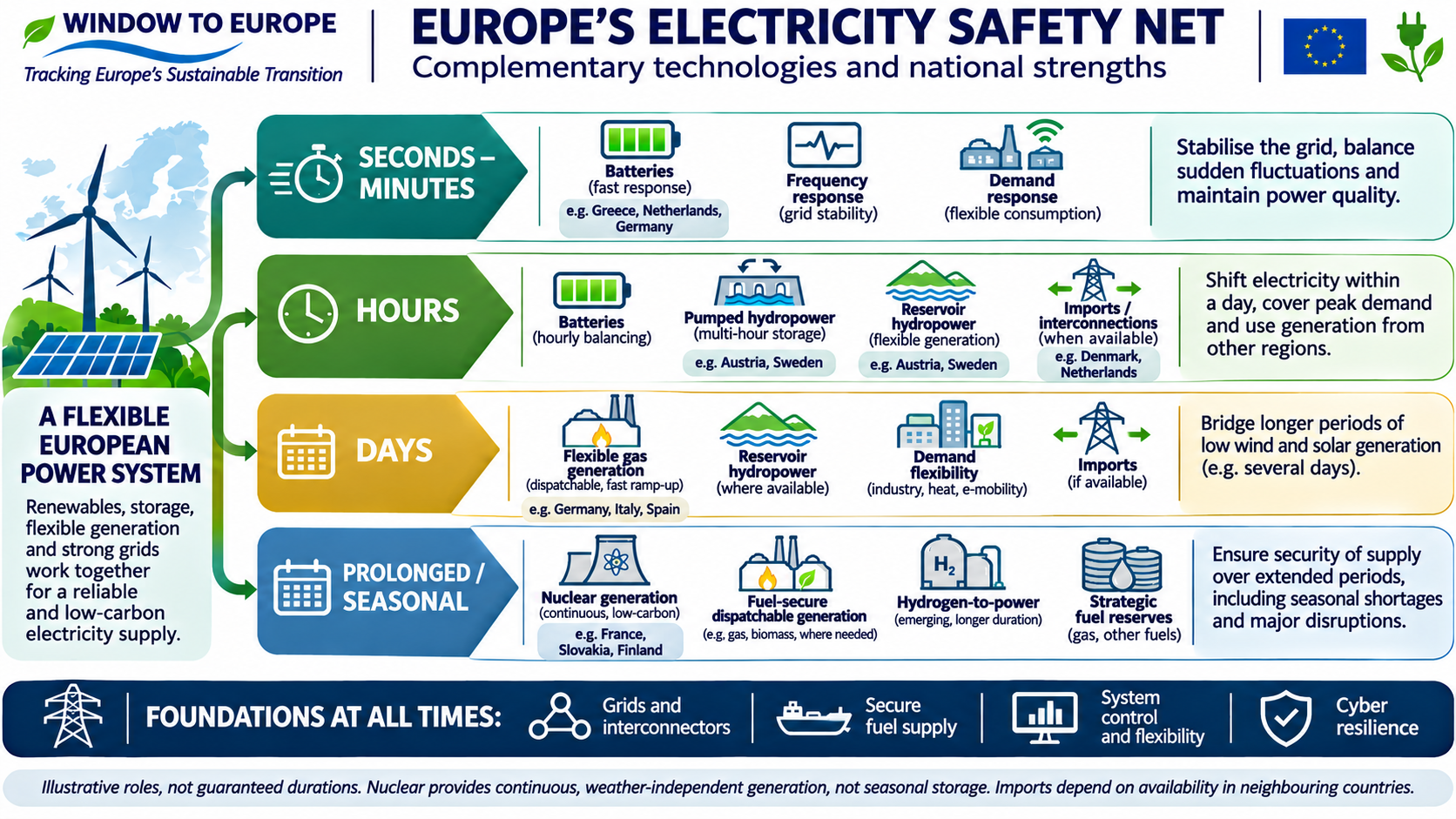
During sudden disturbances, batteries, frequency-control systems and demand response can react within seconds or minutes.
Over several hours, batteries, pumped-storage hydropower, reservoir hydropower and electricity exchange can shift supply and demand.
During longer shortages, dispatchable generation, available hydropower, sustained demand flexibility and imports become increasingly important.
For prolonged emergencies, fuel availability, strategic reserves, operational coordination and functioning infrastructure are essential. Hydrogen-to-power may provide an additional option where suitable technology and fuel supplies are available.
Figure: Europe’s electricity safety net. Illustrative national examples include battery storage in Greece, the Netherlands and Germany; hydropower in Austria and Sweden; flexible gas generation in Germany, Italy and Spain; and nuclear generation in France, Slovakia and Finland. The time horizons are indicative rather than guaranteed operating durations. Nuclear power provides generation, not seasonal electricity storage. Imports depend on neighbouring countries‘ availability.
9. Security during prolonged low renewable generation
A prolonged period of weak wind and solar generation, sometimes described in Germany as a „Dunkelflaute“, is an important test for a renewable-rich electricity system.
Short-duration batteries can help bridge hourly imbalances, but they cannot independently compensate for a multi-day electricity deficit without opportunities for recharging.
A resilient system therefore requires a combination of available dispatchable generation, longer-duration flexibility, demand response and regional cooperation.
Fuel security is also critical. Gas-fired power stations cannot provide reliable backup without adequate fuel supplies and transport infrastructure.
Similarly, nuclear and thermal power plants depend on cooling systems, maintenance and functioning transmission networks. Hydropower availability may be constrained by drought or reservoir conditions.
Physical security, cybersecurity and operational recovery procedures must therefore be considered alongside installed generating and storage capacity.
These are distinct dimensions of resilience: supply adequacy, infrastructure reliability and the ability to recover from disruptions.
Electricity security also depends on demand patterns: industrial loads, growing electrification of heating and summer cooling create different daily and seasonal peaks, increasing the importance of flexible generation, storage and demand-side management.
10. The investment and market-design challenge
Reliable electricity supply has an economic cost, including the cost of maintaining generating capacity that may operate only occasionally.
ACER reports that approximately €11 billion was spent across the EU in 2024 on security-of-supply support measures.
Capacity mechanisms compensate resources for being available when needed, rather than solely for the electricity they produce.
Such mechanisms can help finance dispatchable power plants, storage and other flexibility resources. However, their design must avoid unnecessary costs and should allow technologies to compete according to the services they can reliably provide.
Europe must also consider the distribution of costs between electricity consumers, network users and public budgets.
The objective is not to maximise backup capacity regardless of cost, but to achieve an appropriate level of reliability through a cost-effective combination of generation, storage, networks and flexibility.
Source: ACER, Security of EU Electricity Supply, 2025 Monitoring Report.
11. Outlook: Is Europe on the right path?
Europe has important strengths: expanding renewable electricity generation, rapidly growing battery storage, established hydropower resources, substantial nuclear generation in several countries and a highly interconnected electricity system.
Recent industrial projects demonstrate that new technologies are progressing from research and planning towards construction and commercial operation.
Nevertheless, implementation remains challenging. Grid expansion, permitting, investment incentives and the replacement of retiring dispatchable generation must keep pace with changes in electricity supply and demand.
The ENTSO-E Winter Outlook 2026–2027 offers a reassuring short-term assessment: Europe’s electricity supply is expected to remain adequate overall during the coming winter.
However, this does not eliminate longer-term challenges or regional vulnerabilities.
Europe’s national diversity is potentially an important strategic advantage. Nuclear generation, hydropower, flexible thermal plants, batteries and interconnected networks provide complementary capabilities.
Europe is on a promising path, but its electricity transition will ultimately be judged not only by renewable capacity or battery installations, but by its ability to deliver reliable, affordable and increasingly low-carbon electricity under both normal and adverse conditions.
The next challenge is to strengthen this resilience while reducing industrial and geopolitical dependencies – a question that requires comparison with the strategies pursued in China, the United States, Japan and other major electricity systems.
Sources: ENTSO-E, Winter Outlook 2026–2027; European Commission, Electricity Coordination Group, 16 November 2026.