In brief
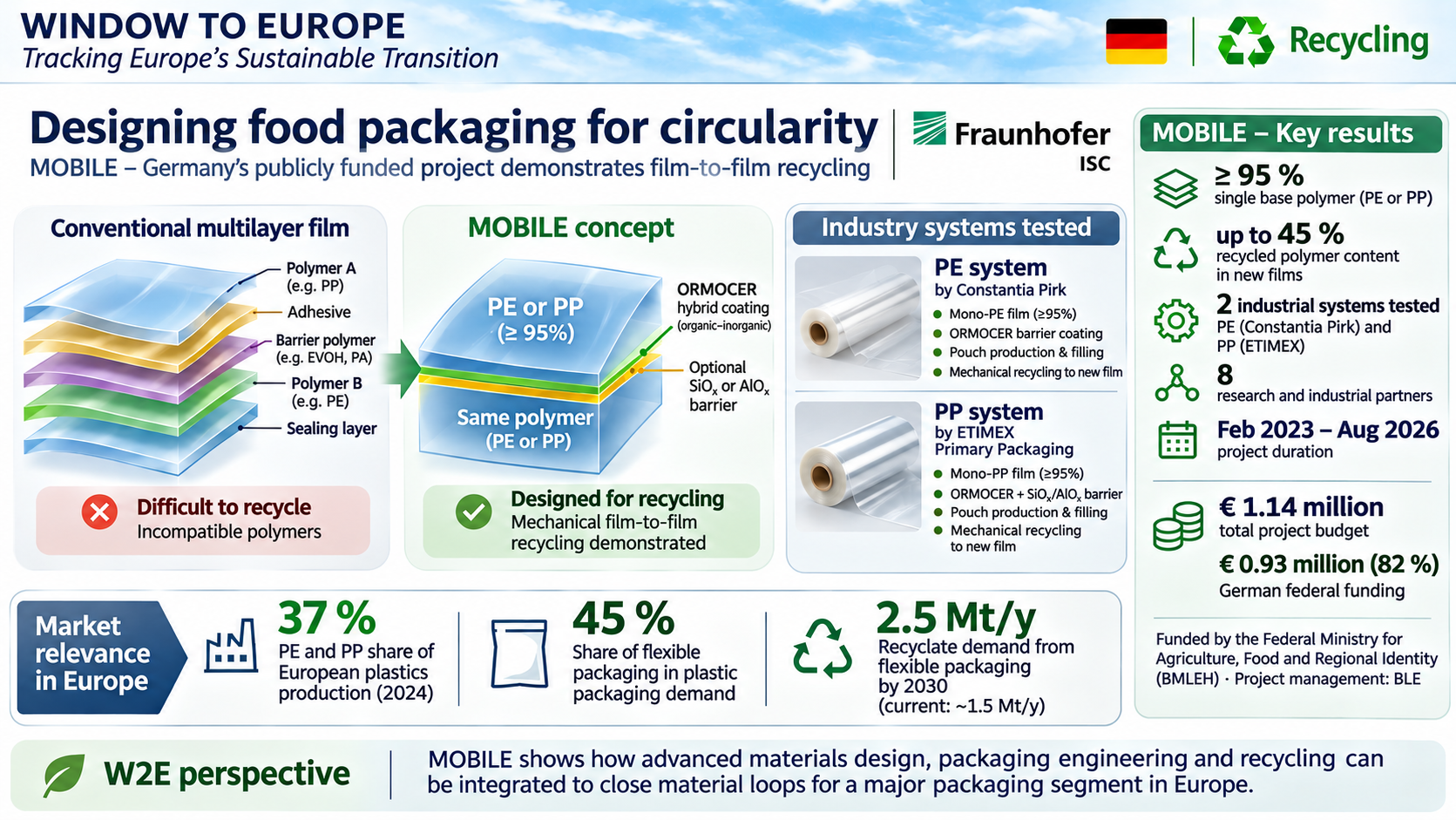
Germany’s publicly funded MOBILE project demonstrates film-to-film recycling of flexible food packaging. Thin ORMOCER barrier coatings enable packaging structures containing at least 95% of a single polymer (PE or PP), with recycled contents of up to 45% in experimental films. The two polymer families account for approximately 37% of European plastics production. Supported by EUR 0.93 million in federal funding, MOBILE demonstrates technical feasibility, while commercial implementation and food-contact compliance remain open challenges.
Read the full technology analysis
The challenge: protecting food without compromising recyclability
Flexible plastic packaging reduces transport weight, extends product shelf life and helps prevent food waste. However, conventional multilayer films frequently combine different polymers, adhesives and barrier materials to achieve the required mechanical, optical and protective properties. These combinations complicate mechanical recycling and frequently result in recycled materials of limited quality.
The European Packaging and Packaging Waste Regulation (PPWR), generally applicable since August 2026, is increasing pressure on manufacturers to address recyclability at the product design stage.
Hybrid barrier materials: the MOBILE approach
The MOBILE project investigated two widely used polyolefin systems, polyethylene (PE) and polypropylene (PP). Its central innovation involves ORMOCER coatings, developed by Fraunhofer ISC. These organically modified ceramic materials combine chemically interconnected organic and inorganic structures, providing flexibility and barrier functionality. Additional thin inorganic layers, such as silicon oxide (SiOx) or aluminium oxide (AlOx), can further enhance protection against oxygen and water vapour.
By replacing substantial layers of incompatible barrier polymers with very thin functional coatings, the researchers developed packaging structures containing at least 95% of a single base polymer. This approach aims to reconcile food protection requirements with compatibility with existing mechanical recycling processes.
Source: Fraunhofer ISC – MOBILE project and ORMOCER technology.
From used packaging to new films
The project addressed the entire material value chain, from film manufacture and coating to lamination, packaging production, filling trials and mechanical recycling. Industrial partners converted the materials into pouches, which were subsequently processed by Fraunhofer IVV to recover polymer material for renewed film production.
Recycled polymer contents of up to 45% were achieved in experimental films. Mechanical properties were satisfactory, although residual contamination and microscopic surface defects can affect optical quality and barrier performance.
These experiments demonstrate the technical feasibility of film-to-film recycling. They do not yet establish a commercial recycling rate or demonstrate unrestricted suitability of the recycled materials for direct food contact.
Industrial relevance: a major segment of the plastics market
Polyethylene and polypropylene are the two largest polymer families in European plastics production. Together, they accounted for approximately 37% of total European plastics production in 2024, corresponding to around 20 million tonnes of primary polymers. Additional quantities of recycled PE and PP are not included in this estimate.
Flexible packaging represents approximately 45% of plastic packaging demand. According to industry estimates from CEFLEX, European demand for recyclates derived from flexible packaging could reach approximately 2.5 million tonnes annually by 2030, compared with around 1.5 million tonnes currently used.
MOBILE therefore addresses a significant technological obstacle to expanding mechanical recycling: the limited compatibility of conventional multilayer barrier films with existing polymer recycling streams. However, the proportion of the flexible packaging market that could ultimately be converted to MOBILE-type structures has not yet been quantified.
Sources: Plastics Europe – European plastics production and circular economy statistics; CEFLEX – Circular Economy for Flexible Packaging.
Industrial cooperation and public funding
MOBILE brought together eight German research and industry organisations, covering the principal stages of the flexible packaging value chain:
- Fraunhofer ISC – project coordination and hybrid barrier materials
- Fraunhofer IVV – recycling and material characterisation
- Constantia Pirk – PE films
- ETIMEX Primary Packaging – PP films
- JenCAPS Technology – inorganic barrier coatings
- LEEB – lamination
- EurA – environmental assessment
- ZLV – application trials and communication
The project ran from February 2023 to August 2026, with a total budget of approximately EUR 1.14 million. German federal funding amounted to EUR 0.93 million, corresponding to approximately 82% of total project costs. The funding was provided through the federal ministry responsible for agriculture and food, with the Federal Office for Agriculture and Food (BLE) acting as project management agency.
The funding framework is noteworthy: the development of advanced polymer materials was supported from the perspective of improving the sustainability of the food value chain.
Source: RePack – research network for sustainable food packaging.
Environmental benefits and remaining challenges
The project’s environmental assessment indicated potential reductions in greenhouse gas emissions and resource consumption compared with conventional reference films. Detailed quantitative results were not disclosed in the public announcement.
Further evaluation will need to address coating and manufacturing costs, contamination control, barrier performance after repeated recycling cycles and regulatory requirements for food-contact applications. An additional challenge is the availability of collection and sorting infrastructure capable of supplying sufficiently clean PE and PP fractions.
The environmental benefits must also be assessed in the context of food preservation. A reduction in packaging-related emissions should not come at the expense of shorter product shelf life or increased food waste.
W2E perspective
MOBILE illustrates why circular plastics strategies must extend beyond the development of new recycling processes. Product architecture itself can determine whether a polymer remains a valuable industrial resource after use.
For suitable packaging applications, preserving the polymer through mechanical recycling can offer a less energy-intensive route than breaking it down into chemical feedstocks. Chemical recycling may nevertheless remain complementary for contaminated or heterogeneous waste streams that cannot be mechanically recycled to the required quality.
The next milestone for MOBILE will be commercial implementation, supported by quantitative environmental, manufacturing and economic data. Its broader significance lies in demonstrating how material science, packaging engineering and recycling technology can be integrated at the product design stage.
Further reading
Fraunhofer ISC – MOBILE project results and hybrid barrier materials
Fraunhofer ISC – ORMOCER technology
RePack – sustainable food packaging research network
Plastics Europe – The Circular Economy for Plastics: A European Analysis
CEFLEX – Circular Economy for Flexible Packaging
European Union – Regulation (EU) 2025/40 on packaging and packaging waste (PPWR)