https://daures2.green/project-overview/?utm_source=chatgpt.com
Europe’s hydrogen partnerships with Africa are often discussed in terms of future energy imports. Namibia’s Dâures project demonstrates another pathway: using renewable electricity and green hydrogen to build local industrial value chains – from ammonia and fertiliser to agriculture.
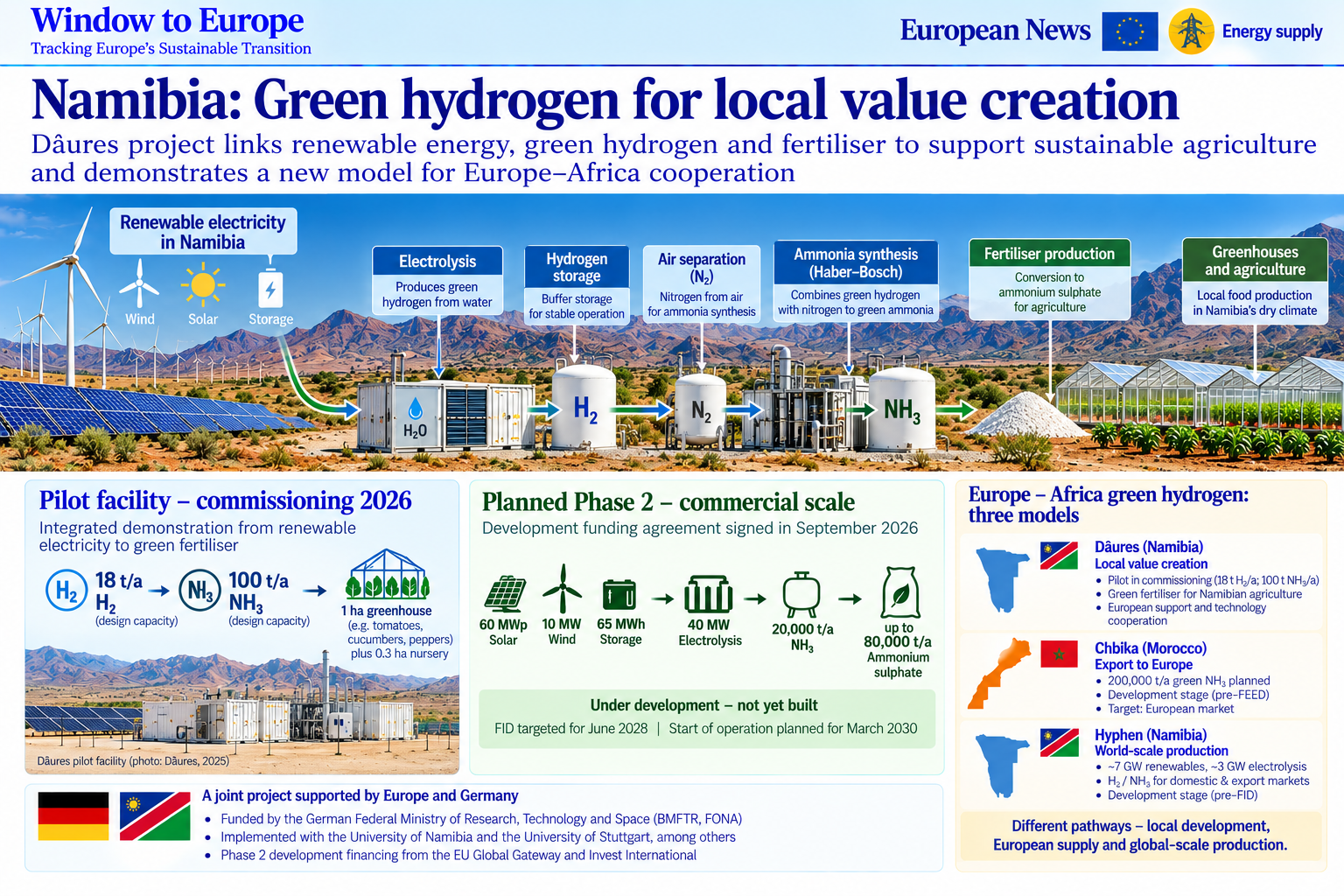
In Namibia’s arid Erongo Region, the Dâures Green Hydrogen Village is developing an integrated chain from solar and wind power via electrolysis to green hydrogen, ammonia and fertiliser. A pilot facility with a design capacity of around 18 tonnes of green hydrogen and 100 tonnes of green ammonia per year has been established; commissioning and production of Namibia’s first locally manufactured green fertiliser are expected in late 2026. The demonstration also includes greenhouse agriculture, linking green industrial production directly with local food production.
The next step is considerably larger. A development agreement signed in September 2026 envisages an off-grid system comprising 60 MWp solar power, 10 MW wind, 65 MWh battery storage and 40 MW electrolysis. Green hydrogen would be converted into up to 20,000 tonnes of ammonia and 80,000 tonnes of ammonium sulphate fertiliser annually, primarily for Namibia and regional markets. The commercial plant is still under development: final investment decision is targeted for 2028 and operation for 2030.
For Window to Europe, Dâures is particularly interesting because it illustrates a model of Europe–Africa hydrogen cooperation based on local value creation rather than simply exporting hydrogen to Europe. The pilot has received German support and involves the University of Namibia and the University of Stuttgart; development of the commercial phase is supported through the EU’s Global Gateway and Invest International.
Erica Gerretsen of the European Commission describes the underlying idea succinctly:
“green hydrogen can become a driver of agricultural development and food security.”
Dâures therefore provides an interesting counterpoint to other African hydrogen concepts. Morocco’s Chbika is being developed primarily around green-ammonia exports to Europe, while Namibia’s much larger Hyphen project represents a future world-scale hydrogen and ammonia industry. Dâures starts from the opposite end: a comparatively small demonstrator linking renewable energy, industrial production and agriculture within Namibia itself.