
In brief
Estonian company Fibenol has demonstrated the fractionation of residual hardwood into high-purity lignin and C5/C6 sugars at its SWEETWOODS biorefinery in Imavere. The follow-up WOODCELL project will add industrial-scale production of specialty crystalline cellulose. A planned €700 million commercial biorefinery in Latvia could now take the technology to a substantially larger scale. cbe.europa.eu
Making better use of hardwood residues
Wood is much more than a source of cellulose or energy. Its three major components – cellulose, hemicellulose and lignin – provide different carbon streams that can be converted into chemicals and materials.
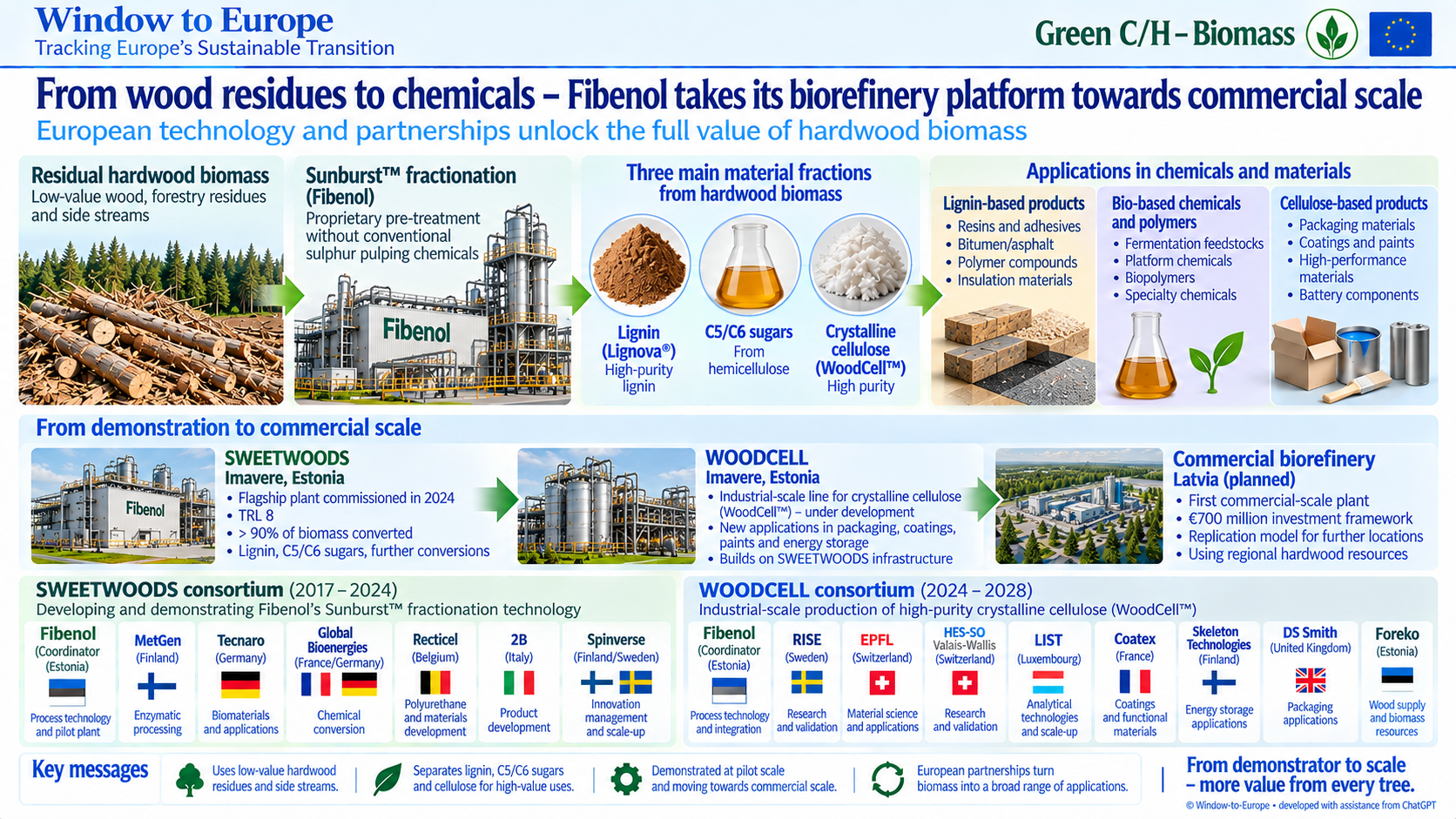
This is the principle behind Fibenol’s SWEETWOODS biorefinery in Imavere, Estonia. Its Sunburst™ technology fractionates low-value hardwood and residues from forestry and wood processing. Mechanical force, pressure and heat first break down the wood. The Sunburst™ pre-treatment opens the lignocellulosic structure; subsequent processing, including enzymatic steps, enables the recovery of high-purity lignin and wood-derived sugars. According to CBE JU, more than 90% of the woody feedstock can be converted into valuable materials. cbe.europa.eu
The industrial plant started scaling up production in 2024. Its reported annual capacity is around 6,500 tonnes of lignin and 20,000 tonnes of sugars. cbe.europa.eu
Lignin and sugars instead of fossil carbon
The resulting streams open several chemical value chains. Fibenol markets its high-purity lignin as Lignova®. Applications investigated or demonstrated include replacement of fossil phenol in resins and bitumen in asphalt as well as use in coatings, adhesives, polymer compounds and insulation materials. cbe.europa.eu
The C5/C6 sugar stream provides another route. Instead of using food crops as a source of fermentable carbon, sugars derived from residual wood can serve as feedstocks for fermentation and chemical conversion. Fibenol is already working with companies using these sugars for products including oils and fatty acids and bio-based surfactants. cbe.europa.eu
SWEETWOODS – a European value chain
SWEETWOODS was not developed by Fibenol alone. The project brought together partners covering different stages from fractionation to conversion and material applications.
Fibenol Imavere (Estonia) coordinated the project. The consortium included MetGen (Finland) for enzymatic processing, Tecnaro (Germany) for biomaterials, Global Bioenergies (France/Germany) for chemical conversion, Recticel (Belgium) for polyurethane and materials development, 2B (Italy) for product development and Spinverse (Finland/Sweden) for innovation management and scale-up. cbe.europa.eu
The consortium illustrates an important feature of emerging biorefineries: separating biomass into useful fractions is only the first step. Industrial partners are needed downstream to turn each fraction into products with defined applications and markets.
WOODCELL adds specialty cellulose
The next step is WOODCELL, another CBE JU-funded project coordinated by Fibenol. Rather than representing a second completed biorefinery, WOODCELL is a 2024–2029 industrial scale-up project that builds on the existing SWEETWOODS platform in Imavere. Its objective is to design, build and operate an industrial-scale production line for specialty microcrystalline cellulose (MCC), marketed as WoodCell™ cbe.europa.eu
This adds a third high-value material stream to the Fibenol platform:
residual hardwood → lignin + C5/C6 sugars + specialty cellulose
WOODCELL targets applications in packaging, coatings and paints, construction materials and energy storage. Its consortium therefore deliberately combines research organisations with industrial users: Fibenol (Estonia) coordinates; RISE (Sweden), EPFL and HES-SO Valais-Wallis (Switzerland), and LIST (Luxembourg) provide research, validation and assessment; Coatex (France) develops coating applications; Skeleton Technologies (Finland) energy-storage applications; DS Smith (UK) packaging applications; and Foreko (Estonia) contributes forestry and raw-material sourcing. WoodCell™ Crystalline Cellulose
From Imavere to commercial scale
Fibenol is already looking beyond the Estonian development site. In March 2024 it reached an agreement with the Latvian government on a €700 million investment framework for a commercial-scale biorefinery based on Sunburst™ technology. CBE JU describes the planned Latvian facility as a larger-scale replication of the SWEETWOODS model. cbe.europa.eu
The sequence is therefore noteworthy:
SWEETWOODS → industrial demonstration in Imavere → WOODCELL expansion → planned commercial-scale biorefinery in Latvia.
For Green C/H, the underlying message is broader than Fibenol itself. Instead of burning low-value wood residues for energy, lignocellulosic biomass can first be fractionated into several carbon streams and used as feedstock for chemicals and materials.
From demonstrator to scale – more value from every tree.
Sources
CBE JU – Fibenol builds on SWEETWOODS, 6 October 2026
CBE JU – SWEETWOODS project and consortium
CBE JU – WOODCELL project
Fibenol – WOODCELL project and partners