
In brief
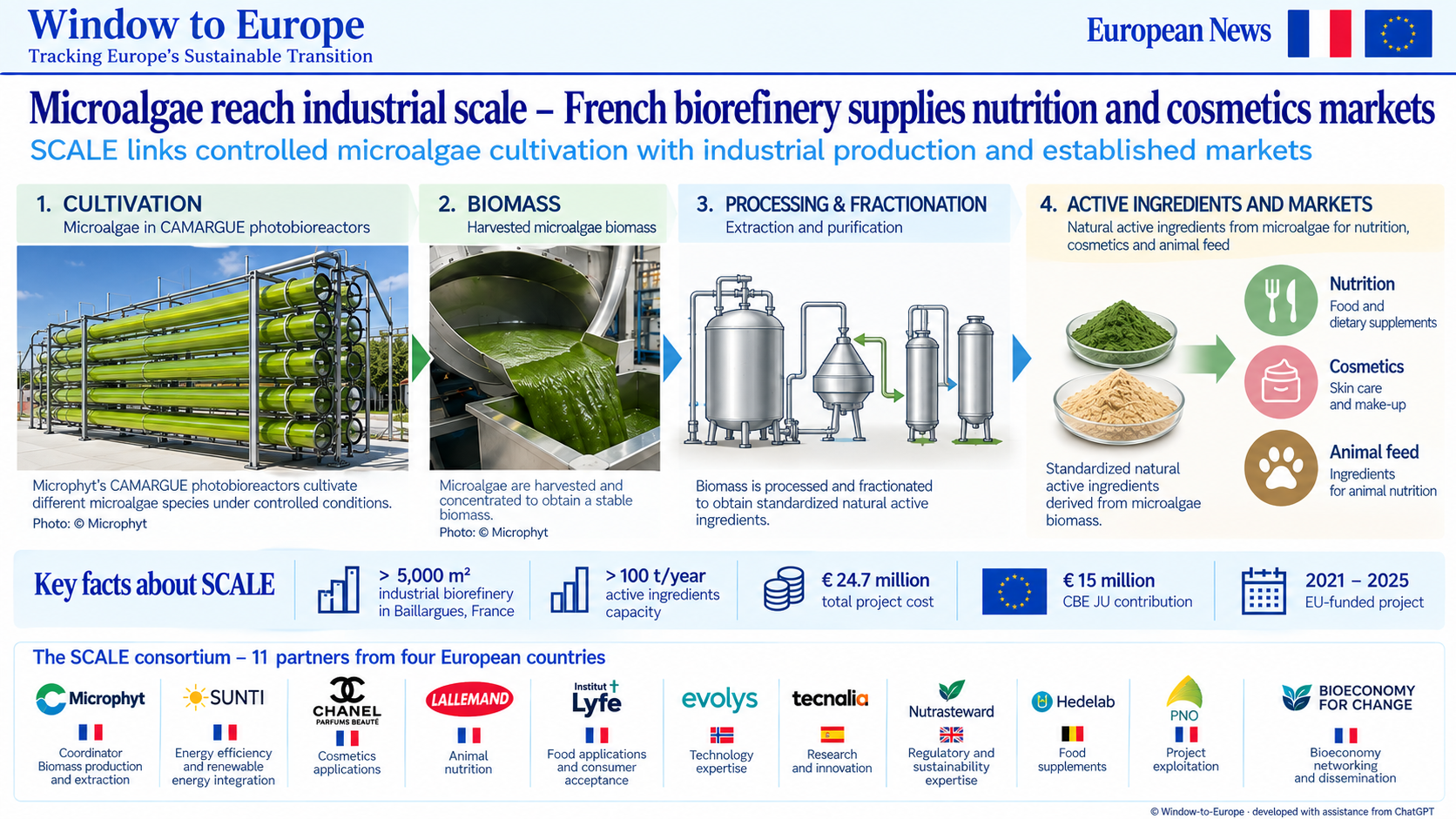
Microphyt’s SCALE flagship near Montpellier has moved microalgae biotechnology from demonstration to industrial production. Inaugurated in July 2025, the integrated biorefinery can produce around 100 tonnes of natural active ingredients annually for nutrition, cosmetics and animal feed. Products are already on international markets, linking European research and industrial scale-up with commercial applications. Circular Bio-based Europe
1. From demonstration to industrial production
Microalgae have long been regarded as promising sources of proteins, lipids, pigments and other bioactive compounds. Industrial production, however, remains concentrated on relatively few species: spirulina and chlorella alone account for around 70% of the existing market.
The CBE JU-funded SCALE project set out to broaden this industrial base. Between 2021 and 2025, a European consortium led by French SME Microphyt scaled the company’s CAMARGUE photobioreactor technology from demonstration level to an integrated industrial biorefinery at Baillargues, near Montpellier in southern France. The plant was officially inaugurated in July 2025. Circular Bio-based Europe
SCALE had a total budget of €24.7 million, including €15 million in EU/BBI JU funding. The new facility has a production capacity of around 100 tonnes of natural active ingredients per year. Circular Bio-based Europe
2. From microalgae to marketable ingredients
The technical principle is straightforward. Microphyt cultivates different microalgae species under controlled conditions in its proprietary CAMARGUE photobioreactors and processes the biomass into standardized natural active ingredients.
The important advance is therefore less the cultivation technology itself than its industrialisation and connection to established markets. SCALE targets nutrition, food supplements, animal feed and cosmetics. The latest CBE JU assessment reports a growing portfolio of commercial products, including ingredients for nutrition and skin-care applications. Circular Bio-based Europe
One prominent industrial partner is Chanel Parfums Beauté. Its researchers tested Microphyt ingredients for incorporation into skincare and make-up formulations, including regulatory requirements, stability, safety and efficacy. The collaboration between Chanel and Microphyt predates SCALE and has now lasted for around a decade. Circular Bio-based Europe
3. Eleven partners connect technology with applications
SCALE deliberately assembled partners along the value chain. Microphyt (France) coordinated the project and was responsible for plant construction, biomass production and extraction. SUNTI (France) worked on energy efficiency and renewable energy integration, while Evolys (Norway) contributed technology expertise. scaleproject.eu
Application and market partners included Chanel Parfums Beauté (France) for cosmetics, Lallemand (France) for animal nutrition, Hedelab (Belgium) for food supplements and the Institut Lyfe Research and Innovation Center (France) for food applications and consumer acceptance. Tecnalia (Spain), Nutrasteward (UK), PNO Consultants (France) and Bioeconomy for Change (France) contributed expertise ranging from sustainability and regulatory issues to project exploitation and bioeconomy networking. Circular Bio-based Europe
That consortium structure was important: scaling microalgae production alone would not have created a market. SCALE simultaneously connected production with product development, testing, regulation and potential customers.
4. From flagship plant to an industrial platform
The Baillargues plant is now operating beyond the formal end of the SCALE project in May 2025. CBE JU reported in September 2026 that the Baillargues plant is now operating beyond the formal end of the SCALE project in May 2025. According to CBE JU’s October 2026 assessment, the biorefinery has a production capacity of more than 100 tonnes of ingredients per year.. The project has therefore progressed beyond a conventional pilot or demonstration facility into continuing industrial production. Circular Bio-based Europe
For Europe, SCALE provides an example of how a relatively small biotechnology company can use a publicly supported flagship project to bridge the difficult transition between demonstration and commercial manufacturing. It also illustrates a broader development in the bioeconomy: biomass platforms become industrially relevant when production technology, downstream processing, product validation and markets are developed together.