
In brief
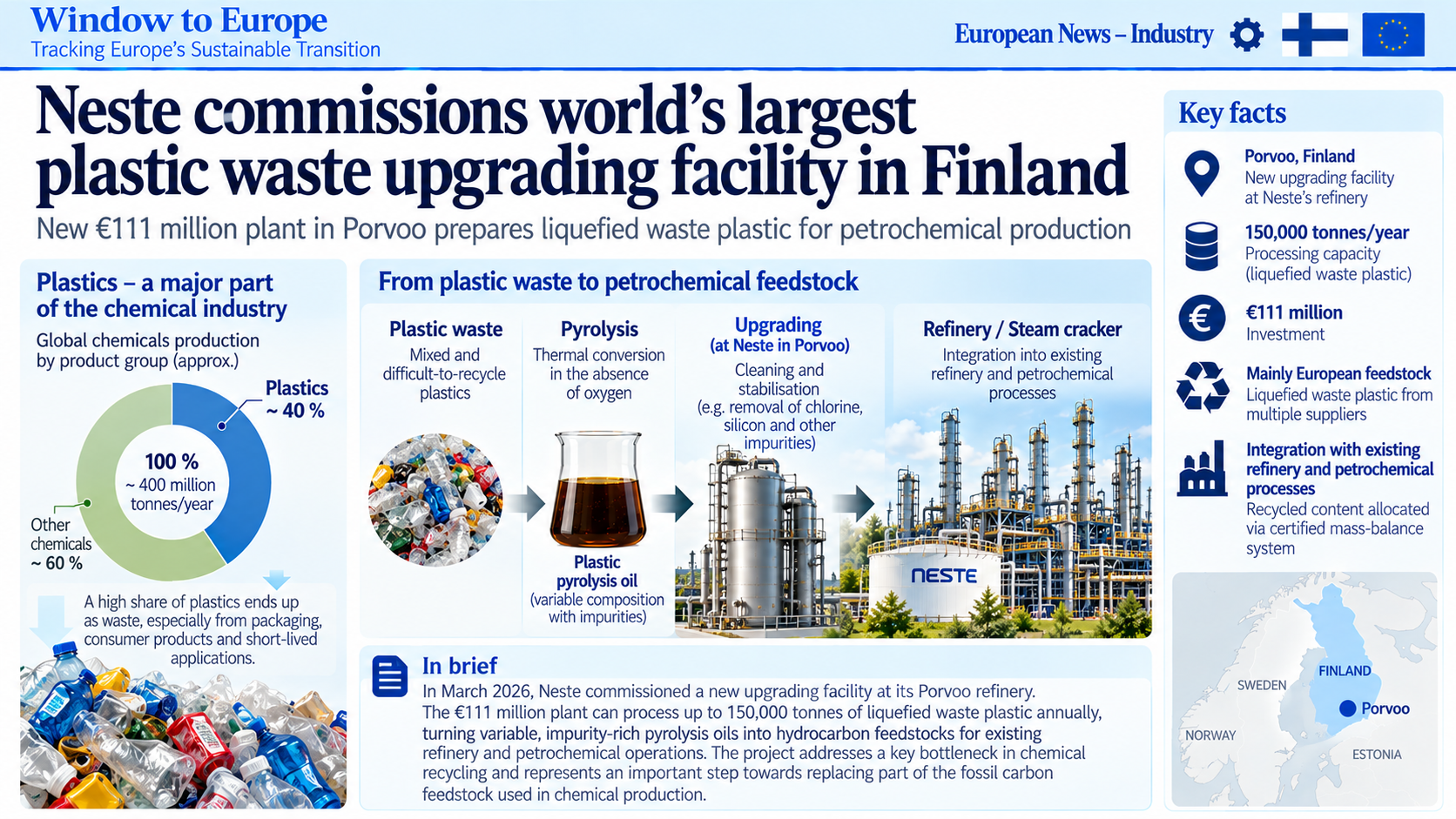
Finland is expanding its industrial capacity for chemical recycling. In March 2026, Neste commissioned a €111 million facility at its Porvoo refinery, designed to upgrade up to 150,000 tonnes of liquefied waste plastic annually. The new plant converts variable, impurity-rich plastic pyrolysis oils into hydrocarbon feedstocks suitable for further processing in existing refinery and petrochemical operations.
The facility addresses a key bottleneck in chemical recycling: making waste-derived hydrocarbons sufficiently clean and stable for industrial use. It represents an important step towards replacing part of the fossil carbon feedstock used in chemical production, although actual recycling volumes and environmental performance still depend on the production ramp-up.
An Industrial Link in the Recycling Chain
Plastic pyrolysis can recover hydrocarbons from mixed or difficult-to-recycle plastic waste. However, the resulting oils often contain chlorine, silicon compounds and reactive hydrocarbons that complicate their direct use in conventional processing facilities.
Neste’s new upgrading facility is designed to remove problematic impurities and improve feedstock quality, allowing recycled carbon to enter established industrial production chains.
The company sources liquefied waste plastic from several suppliers, predominantly in Europe. The upgraded material can be processed alongside fossil-derived feedstocks, with recycled content attributed to products through certified mass-balance accounting.
W2E Perspective
The Porvoo investment demonstrates how existing industrial infrastructure can support the transition towards circular carbon use without requiring an entirely new petrochemical production system.
However, commissioning is not equivalent to full-scale commercial operation. Neste is gradually increasing production, while plant-specific energy consumption, hydrogen demand, operating costs and net greenhouse gas savings have not yet been publicly quantified.
The project is therefore an important industrial milestone, but its long-term economic and environmental performance remains to be demonstrated.
Sources
- Neste (16 March 2026). Neste commissions the world’s largest upgrading facility for liquefied waste plastic and scales up chemical recycling. Press release.
- Window to Europe (9 October 2026). Making Plastic Pyrolysis Oil Fit for Petrochemistry – Neste Starts Industrial Upgrading in Finland. Detailed technical analysis – Green C/H.