
In brief
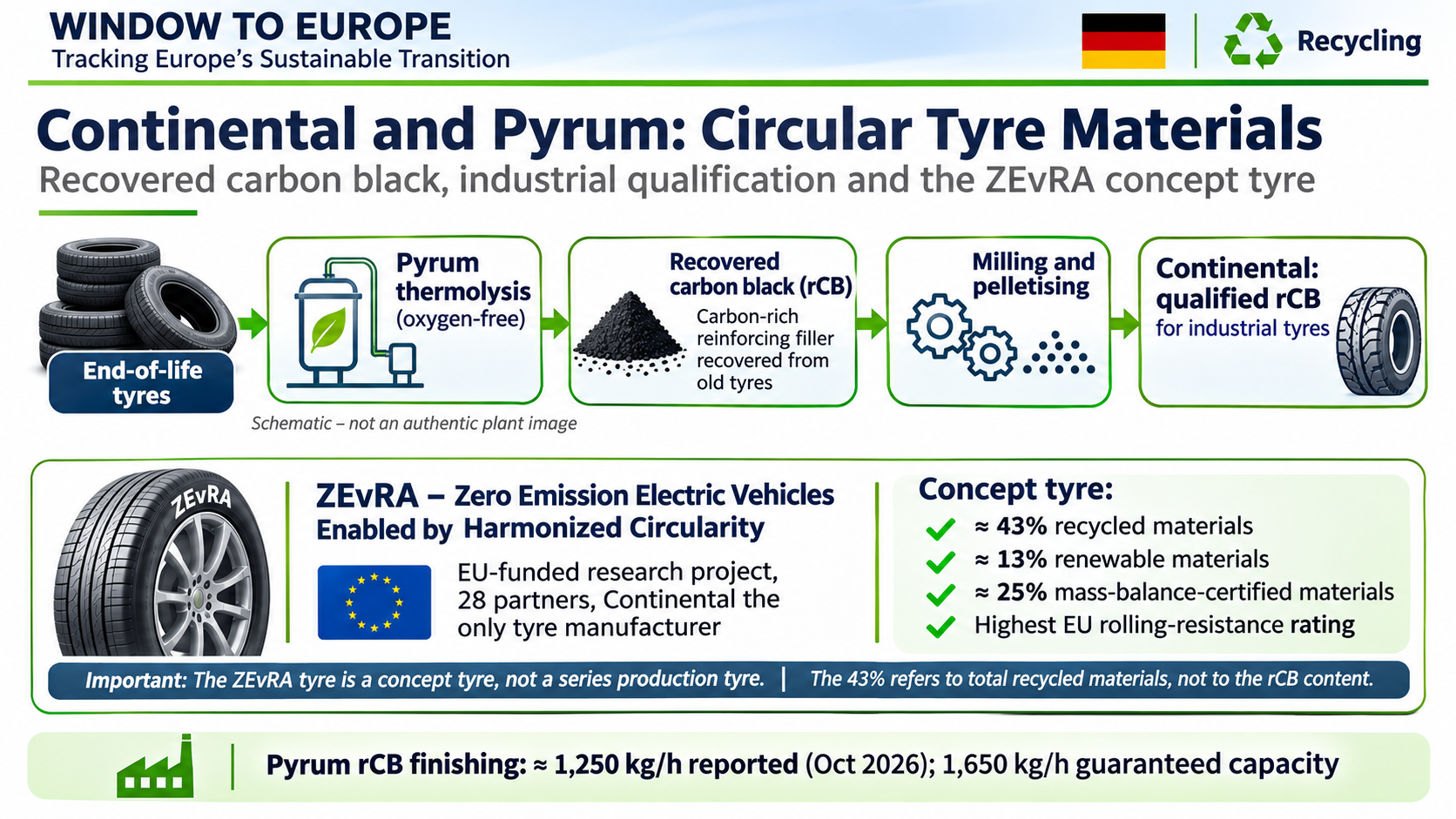
Germany’s Continental and Pyrum Innovations are demonstrating two complementary steps towards circular tyre manufacturing: the industrial recovery of carbon black from end-of-life tyres and its qualification for use in new tyres.
- Industrial application: Continental has used recovered carbon black (rCB) from Pyrum in solid rubber tyres manufactured at Korbach, Germany, since 2023. These tyres are used primarily in forklifts and other industrial vehicles. Continental, 2023.
- Quality qualification: In May 2026, Continental granted unrestricted supply approval for ThermoTireBlack from Pyrum’s new milling and pelletising plant in Dillingen/Saar. The audit confirmed reproducible material quality. Pyrum, May 2026.
- Scale-up: Pyrum increased the processing rate of its rCB finishing plant from 750 kg/h in April to approximately 1,250 kg/h by October 2026. However, this remained below the guaranteed capacity of 1,650 kg/h because of material-handling bottlenecks. Pyrum, 2026.
- High-performance demonstration: Continental’s ZEvRA concept tyre, presented in 2026, contains approximately 43% physically recycled materials, 13% renewable materials and 25% mass-balance-certified materials. It achieved the highest EU rolling-resistance rating. Continental, 2026.
- Renewable natural rubber: Continental’s Taraxagum programme develops natural rubber from Russian dandelion roots. A bicycle tyre using dandelion rubber entered series production in 2019; wider automotive use remains a scale-up challenge. Continental, Taraxagum.
The significance: Continental demonstrates that recovered materials can meet demanding tyre-performance requirements. Pyrum’s experience also shows that industrial qualification and full-scale production reliability are separate challenges.
Further reading – Technology, industrial implementation and challenges
1. Why recovered carbon black matters
Carbon black is an essential reinforcing filler in tyre compounds. It improves mechanical strength, abrasion resistance and durability.
According to Continental, conventional carbon black represents approximately 15–20% of the mass of a passenger-car tyre, depending on the model.
Most conventional carbon black is manufactured from fossil hydrocarbon feedstocks. Recovering carbon-rich material from end-of-life tyres can therefore reduce demand for virgin raw materials.
However, recovered carbon black is not identical to conventional furnace carbon black. It contains mineral residues and other constituents originating from the original tyre formulation.
Particle characteristics, ash content, surface chemistry and reinforcing properties must be carefully controlled before rCB can be incorporated into demanding rubber compounds.
Source: Continental, July 2024
2. Pyrum’s industrial recycling process
Pyrum operates a tyre thermolysis facility at Dillingen/Saar, Germany. End-of-life tyres are mechanically prepared before thermal decomposition in an oxygen-free environment.
The process produces several material streams:
- Recovered steel, which can be returned to metal recycling.
- Tyre-derived oil, which can serve as a chemical feedstock.
- A carbon-rich solid residue, subsequently milled and pelletised into ThermoTireBlack.
- Process gas, which can contribute to the facility’s energy requirements.
Pyrum reports that its thermolysis process has been in continuous industrial operation at Dillingen since 2020, with additional reactors installed during the site’s expansion.
The company supplies tyre-derived materials to industrial partners including Continental, BASF and Schwalbe.
Source: Pyrum, trading update 2025, published March 2026
3. Continental’s industrial material approval
A key milestone occurred on 20 May 2026. Continental granted unrestricted supply approval for ThermoTireBlack manufactured in Pyrum’s new milling and pelletising plant.
The approval followed an industrial audit and a short-term process capability assessment. According to Pyrum, the assessment demonstrated stable process conditions and reproducible product quality.
Continental had previously approved the tyre-shredding facility and two additional thermolysis reactors in 2024. The new approval therefore covered the complete expanded processing chain at Dillingen.
This is an important step because consistent quality, rather than merely successful material recovery, determines whether secondary raw materials can enter demanding industrial supply chains.
4. The remaining challenge: Industrial throughput
Despite successful material qualification, the ramp-up of Pyrum’s new finishing plant has proved more difficult than expected.
In May 2026, Pyrum reported regular operation at approximately 750 kg/h, with further optimisation planned. By October, the company reported throughput of approximately 1,250 kg/h, still below the guaranteed 1,650 kg/h.
The reported bottleneck was not the thermolysis reaction itself but the transport of ground material from a buffer hopper to downstream processing equipment.
The delayed ramp-up contributed to a downward revision of Pyrum’s 2026 financial forecast.
This illustrates a broader challenge for the recycling industry: reliable continuous operation of the complete process chain can be just as important as the performance of the core recycling reactor.
5. Continental’s ZEvRA concept tyre
Continental is participating in the EU-funded ZEvRA project, Zero Emission Electric Vehicles Enabled by Harmonized Circularity. The project involves 28 partners and addresses circular material solutions across the electric-vehicle value chain. Continental is its only tyre manufacturer.
In 2026, the company presented a concept tyre containing approximately 43% recycled materials.
The recycled inputs include steel, rubber from end-of-life tyres, polyester fibres from recycled PET bottles, recovered carbon black and alternative silica produced from recycled foundry sand.
An additional 13% of the tyre’s materials originate from renewable sources, while approximately 25% are mass-balance-certified.
These categories must be distinguished: not all sustainable materials originate from end-of-life tyres, and mass-balance certification does not necessarily establish physical traceability in the finished product.
Importantly, the concept tyre achieved the highest EU rolling-resistance rating. This demonstrates technical feasibility, although the concept tyre is not evidence of commercial production at the same recycled-material content.
Source: Continental, ZEvRA project, 2026
6. From industrial tyres to passenger-car tyres
Continental’s recovered-carbon-black application in solid rubber tyres is already established. The next challenge is broader incorporation into passenger-car tyres, where material specifications must satisfy multiple performance requirements simultaneously.
Continental and Pyrum concluded a ten-year purchase agreement in July 2024 to strengthen their cooperation. Their longer-term objective includes the use of recovered carbon black in passenger-car tyre series production.
Continental also markets the UltraContact NXT, a production tyre containing up to 65% renewable, recycled and mass-balance-certified materials.
These developments demonstrate several levels of industrial maturity: established use of rCB in industrial tyres, commercially available passenger-car tyres containing alternative materials, and experimental tyres with particularly high physically recycled content.
Source: Continental, July 2024 · Source: Continental, ZEvRA
7. Taraxagum: Natural rubber from dandelions
Continental is pursuing a complementary biological route towards more sustainable tyres: producing natural rubber from Russian dandelion (Taraxacum kok-saghyz).
Unlike synthetic rubber derived from separately produced butadiene or isoprene monomers, dandelion rubber is already synthesised as natural polyisoprene within the plant. The rubber is extracted from its roots.
Since 2011, Continental has worked with research partners including the Fraunhofer Institute for Molecular Biology and Applied Ecology (IME) and the University of Münster to develop plant breeding, cultivation, harvesting, extraction and tyre applications.
In 2018, Continental opened its Taraxagum research laboratory in Anklam, Germany. The Urban Taraxagum bicycle tyre, incorporating dandelion-derived rubber in its tread, entered series production in 2019.
Potential advantages include regional cultivation in Europe, shorter supply routes and diversification away from exclusive reliance on tropical rubber plantations. However, agricultural yields, suitable varieties, mechanised harvesting and cost-effective extraction remain major challenges before dandelion rubber can supply passenger-car or truck tyres at significant scale.
The significance: Taraxagum is not a tyre-recycling technology or microbial isoprene fermentation. It is a renewable raw-material strategy that complements Continental’s recovery of materials from end-of-life tyres.
Source: Continental – Taraxagum · Source: Continental – Sustainable materials
8. Implications for Europe’s circular polymer economy
Continental and Pyrum illustrate how an industrial recycling system must combine several capabilities. First, end-of-life tyres must be converted into usable secondary materials. Second, these materials require further processing and quality assurance. Third, tyre manufacturers must validate them in real rubber formulations. Finally, the complete recycling process must operate reliably and economically at industrial scale.
The Continental–Pyrum partnership has demonstrated significant progress in the first three areas. The remaining challenges concern further production optimisation, increased throughput and expansion into demanding passenger-car tyre applications.
Conclusion
Continental and Pyrum provide a concrete European example of the transition from tyre waste treatment towards circular materials manufacturing.
The qualification of recovered carbon black and its established use in industrial tyres demonstrate that tyre-derived materials can replace part of the virgin feedstock required for new products.
At the same time, Pyrum’s scale-up difficulties underline the importance of reliable industrial process engineering.
Beyond recycling, Continental’s Taraxagum programme demonstrates a complementary route towards renewable natural rubber, although large-scale production for passenger-car tyres remains a research and industrialisation challenge.
The decisive achievement is not simply recovering carbon from old tyres, but producing consistent, high-performance materials that tyre manufacturers can use at commercial scale.