
In brief
Michelin is pursuing several complementary routes to reduce dependence on fossil feedstocks in tyre manufacturing. Its latest prototype demonstrates how recycled materials and renewable raw materials can be combined in a high-performance tyre.
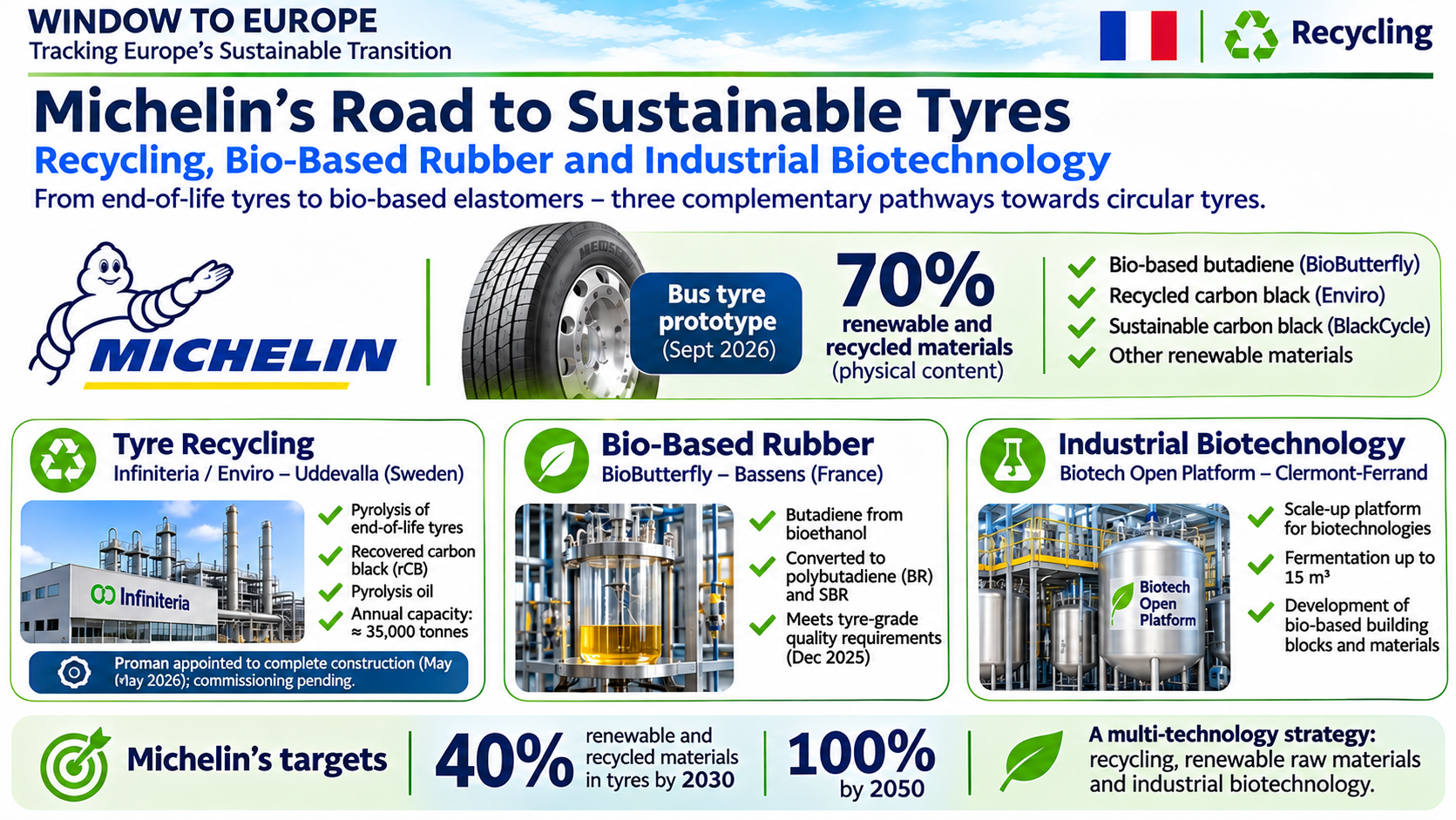
- 70% prototype: In September 2026 Michelin presented a bus tyre prototype containing 70% physically incorporated renewable and recycled materials, independently certified according to the company. It is not a series-production tyre. Michelin, September 2026.
- Bio-based synthetic rubber: The BioButterfly demonstrator at Bassens converts bioethanol into bio-based butadiene. In December 2025 its partners reported successful conversion into polybutadiene (BR) and styrene-butadiene rubber (SBR). Axens / Michelin / IFPEN, December 2025.
- Tyre recycling: Michelin uses recovered carbon black (rCB) from Enviro technology and sustainable carbon black made from tyre pyrolysis oil in the BlackCycle project. Michelin, September 2026.
- Industrial biotechnology: The Biotech Open Platform, co-founded by Michelin and inaugurated in Clermont-Ferrand in September 2026, offers fermentation capacities up to 15 m³ and semi-industrial purification. It is a shared platform, not a dedicated tyre-monomer factory. Michelin, September 2026.
- Industrial scale-up: Infiniteria’s Uddevalla plant in Sweden is designed for about 35,000 tonnes of end-of-life tyres annually, but as of October 2026 it was still preparing for commissioning following delays. Infiniteria, October 2026.
The significance: Michelin’s approach links circular feedstocks, renewable monomers and new bioprocess infrastructure. The key remaining challenge is to turn these technically validated routes into reliable, economically competitive supply chains at commercial scale.
Further reading – Technologies, industrial projects and sources
1. One prototype, several material pathways
Michelin’s September 2026 bus tyre demonstrator (275/70 R 22.5) contains 70% renewable and recycled materials, compared with 58% in its 2022 predecessor. According to Michelin, the materials are physically present in the tyre rather than allocated through mass-balance or book-and-claim accounting. The company states that an independent body certified the material share. This is a technical demonstrator, not evidence that the same composition is already manufactured commercially at scale.
The material portfolio includes natural rubber from deforestation-free sourcing, synthetic rubber derived from bio-based butadiene, recovered carbon black from Enviro, sustainable carbon black from the BlackCycle pathway, silica from rice husks and recycled steel. These inputs represent different kinds of sustainability: renewable origin, material recycling and chemical feedstock recovery should not be conflated.
Source: Michelin, 19 September 2026.
2. BioButterfly: Bioethanol to butadiene and synthetic rubber
BioButterfly is a collaboration between Michelin, IFP Energies nouvelles (IFPEN) and Axens. At Michelin’s Bassens site near Bordeaux, a demonstration plant converts bioethanol into butadiene, a C4 monomer used to make polybutadiene rubber (BR) and styrene-butadiene rubber (SBR). The process uses bio-based ethanol as feedstock and chemical catalytic conversion to produce the monomer; it is not direct microbial fermentation of butadiene.
The demonstrator has a stated capacity of approximately 20–30 tonnes of butadiene per year. In December 2025 the partners reported successful polymerisation of the product into BR and SBR meeting demanding material specifications. This validates a route from renewable feedstock to useful elastomers, but commercial production volumes and cost competitiveness still require scale-up.
Sources: Michelin, January 2024; Axens / Michelin / IFPEN, December 2025.
3. Recycling carbon: Enviro and BlackCycle
Recycling vulcanised tyres requires processes other than simple remelting. Tyre pyrolysis can recover a carbon-rich solid fraction, often processed into recovered carbon black (rCB), as well as pyrolysis oil. Both can serve as secondary raw materials, but require purification and industrial qualification.
Michelin’s 70% prototype includes rCB from Scandinavian Enviro Systems‘ technology. It also includes sustainable carbon black derived from tyre pyrolysis oil via the European BlackCycle research pathway. These are distinct routes: the first upgrades the solid carbon fraction, while the second uses oil as a feedstock to produce new carbon black. Their quality, environmental performance and economics need to be evaluated separately.
Source: Michelin, September 2026.
4. Uddevalla: Industrial scale-up remains unfinished
Infiniteria, backed by Antin Infrastructure Partners and involving Michelin as an industrial partner, is developing a large-scale tyre-recycling facility in Uddevalla, Sweden. Its nominal feedstock capacity is approximately 35,000 tonnes of end-of-life tyres annually. The project is intended to supply recovered carbon black and pyrolysis oil to industrial customers.
However, the plant experienced major construction delays and cost overruns. In May 2026 Infiniteria appointed Proman to complete the facility; an October 2026 announcement still described the company as preparing for commissioning. The announced plant capacity must therefore not be reported as verified commercial output.
Infiniteria has also discussed two prospective French facilities and signed a tyre-supply memorandum with Aliapur in October 2026. These remain plans, not operating recycling capacity.
Sources: Infiniteria, plant overview; Infiniteria, news releases through October 2026.
5. Clermont-Ferrand: A platform for industrial biotechnology
On 29 September 2026, Michelin and its co-founders inaugurated the Biotech Open Platform at the Sustainable Materials Center within Michelin Innovation Park – Cataroux in Clermont-Ferrand. The founding group includes Danone, DMC Biotechnologies, Crédit Agricole Centre France, Clermont Auvergne Innovation and Greentech.
The first phase represents more than €20 million of investment and provides fermentation capacity up to 15 m³, integrated purification and bioprocess development. It aims to bridge the gap between laboratory research and industrial validation across food, chemicals, biomaterials and other sectors. The project has also received support through the European Regional Development Fund.
For Michelin, the platform opens opportunities to investigate bio-based alternatives to petrochemical molecules. Nevertheless, its existence does not demonstrate that Michelin is already producing bio-isoprene or tyre monomers commercially by fermentation.
Source: Michelin, 29 September 2026.
6. What about bio-isoprene?
Isoprene (C5H8) and butadiene (C4H6) are different monomers used in elastomer production. Biotechnological isoprene production has been explored internationally, including earlier US collaborations. It should be distinguished from Michelin’s BioButterfly process, which converts bioethanol to butadiene through a catalytic route.
Microbial production of isoprene, renewable butadiene production, cultivation of natural rubber plants and recycling of existing tyres are complementary strategies. Their industrial maturity differs considerably. A global comparison of bio-isoprene technologies therefore merits a separate article rather than being treated as an established Michelin manufacturing process.
7. The industrial question: From demonstration to supply chain
Michelin’s portfolio illustrates three separate stages of development. The 70% tyre demonstrates materials integration and performance at prototype level. BioButterfly demonstrates the technical route from renewable ethanol to polymer-grade butadiene and synthetic rubber. Uddevalla tests the industrial reliability and economics of large-scale end-of-life tyre recycling. The Biotech Open Platform provides shared infrastructure for developing future bioprocesses.
None of these achievements alone proves a fully circular tyre industry. The decisive questions remain feedstock availability, consistent product specifications, life-cycle impacts, energy requirements, costs and repeatable commercial operation.
Conclusion
Michelin is pursuing a broader route towards sustainable tyres than recycling alone: it combines recycled carbon, renewable monomers and industrial biotechnology. Its 70% demonstrator provides a concrete example of material integration, while BioButterfly and Clermont-Ferrand illustrate European capabilities in scaling sustainable chemical and biological processes.
The next milestone is not another percentage target, but the reliable industrial supply of qualified materials at economically viable scale.