
In brief
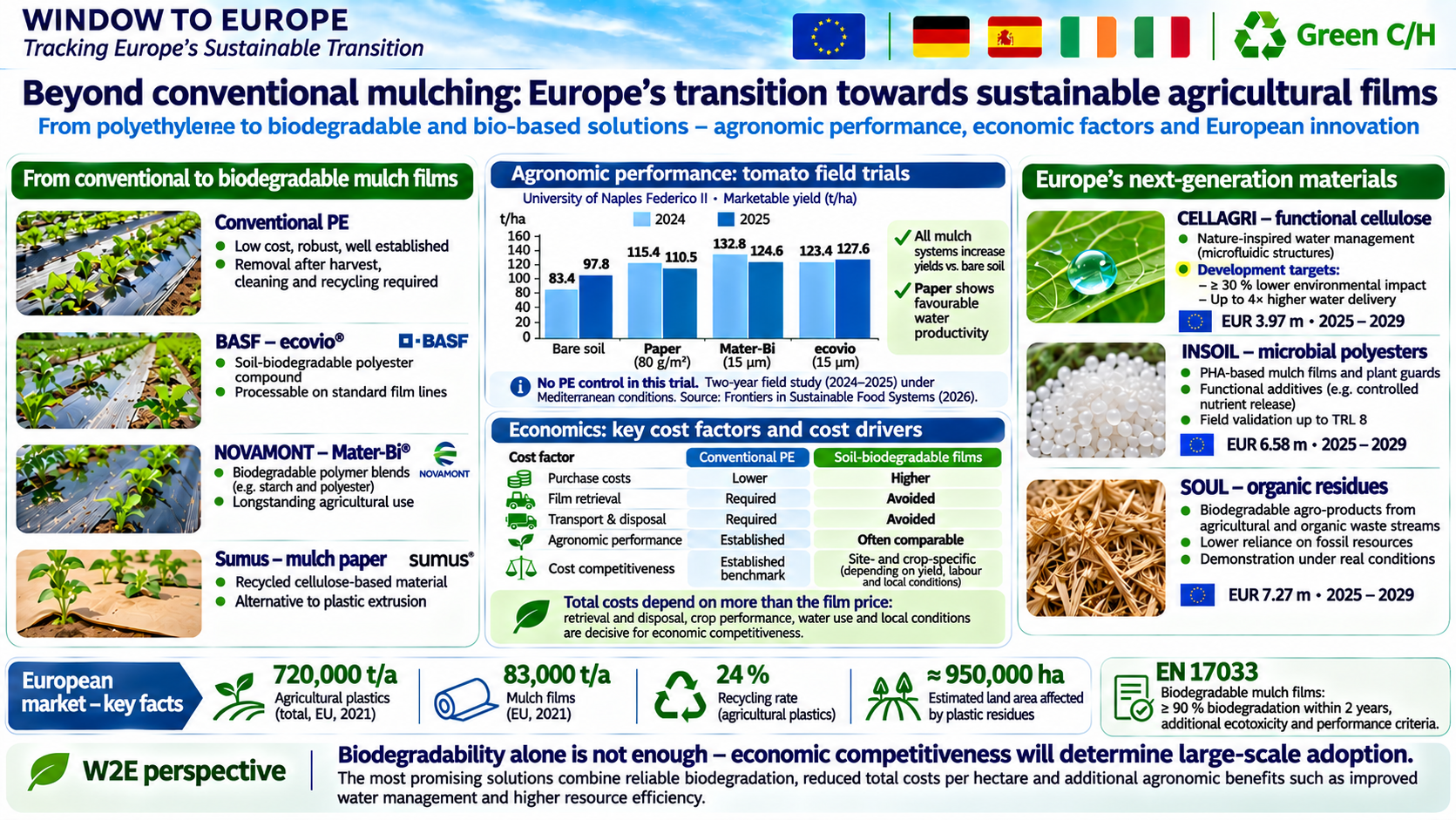
Europe consumes approximately 83,000 tonnes of agricultural mulch films annually, predominantly based on polyethylene. Soil-biodegradable alternatives from BASF and NOVAMONT have demonstrated agronomic performance in field trials, but higher material costs remain a major barrier to widespread adoption. Economic competitiveness depends on total costs per hectare, including film retrieval and disposal. European research projects are now developing multifunctional materials based on cellulose, microbial polyesters and agricultural residues, combining controlled biodegradation with additional agronomic benefits.
Read the full technology analysis
1. Agricultural plastics: a specific end-of-life challenge
Mulch films suppress weeds, reduce water evaporation and modify soil temperature, contributing to agricultural productivity. According to European market estimates published in 2021, agriculture consumes approximately 720,000 tonnes of plastics annually, including 83,000 tonnes of mulch films.
Conventional polyethylene (PE) films are difficult to recover completely after cultivation. Soil contamination and plant residues complicate subsequent recycling, while unrecovered fragments can accumulate in agricultural soils.
Unlike most packaging applications, agricultural mulching therefore represents an important application in which controlled biodegradation may offer advantages over material recycling, particularly where complete film retrieval is technically or economically difficult.
Source: European Commission – Agricultural Plastics, 2021.
2. Commercial alternatives to polyethylene
European manufacturers have established several alternatives to conventional PE films.
BASF (Germany) – ecovio: Soil-biodegradable polyester compounds compatible with conventional film-extrusion equipment. These materials combine biodegradable polyester components, including partially biobased constituents, and are designed for controlled degradation after agricultural use.
NOVAMONT (Italy) – Mater-Bi: Biodegradable polymer blends incorporating starch-based materials and biodegradable polyesters. Mater-Bi formulations have been commercially applied in agriculture for many years.
Sumus (Italy) – recycled paper: Cellulose-based mulching sheets manufactured from recycled paper represent an alternative that does not rely on conventional thermoplastic film extrusion. Wet strength, mechanical stability and functional lifetime remain important design parameters.
Biodegradability should not be confused with renewable carbon content. Commercial biodegradable polyester formulations may contain both fossil-derived and biobased components.
3. Economics: the decisive barrier to market penetration
The higher purchase price of soil-biodegradable mulch films remains a major barrier to widespread adoption. However, the relevant economic indicator is the total cost per hectare and growing season, rather than the purchase price per kilogram of film.
Although conventional polyethylene films generally have lower purchase costs, their use requires post-harvest retrieval, collection, transport and appropriate waste management. Soil-biodegradable films can avoid these operations when used as intended and under suitable environmental conditions.
Economic competitiveness depends on film thickness, labour costs, local waste-management infrastructure, crop-specific performance and actual degradation under field conditions. Additional agronomic benefits, including improved water management and reduced irrigation requirements, could help compensate for higher material costs.
Recent, directly comparable European cost data for individual commercial products remain insufficient to establish a representative market-wide ranking.
Large-scale adoption will therefore depend on demonstrated economic competitiveness at farm level, rather than biodegradability alone.
4. Agronomic performance: evidence from field trials
A 2026 publication from the University of Naples Federico II compared three commercially available biodegradable mulch materials in processing tomato cultivation during the 2024 and 2025 growing seasons.
| Mulch material | 2024 (t/ha) | 2025 (t/ha) |
|---|---|---|
| Bare soil | 83.4 | 97.8 |
| Recycled paper (80 g/m²) | 115.4 | 110.5 |
| Mater-Bi (15 µm) | 132.8 | 124.6 |
| ecovio (15 µm) | 123.4 | 127.6 |
Marketable tomato yields under Mediterranean cultivation conditions.
All three mulch systems improved marketable yields relative to unmulched cultivation. Paper mulch also demonstrated favourable water productivity.
The trial did not include conventional PE films and therefore does not establish an agronomic advantage of biodegradable materials over PE. However, an earlier Italian study published in 2024 directly compared 30 µm LDPE films with 15 µm Mater-Bi and ecovio films in melon cultivation.
These studies illustrate the importance of evaluating material performance under specific agricultural conditions. A comprehensive economic assessment must also consider crop revenues, irrigation costs and the functional lifetime of the mulch material.
Sources: Frontiers in Sustainable Food Systems, 2026; Agronomy, 2024.
5. Controlled biodegradation and soil safety
European standard EN 17033 specifies biodegradation, ecotoxicity and functional requirements for agricultural mulch films. Standardised laboratory testing requires at least 90% biodegradation within two years.
For biodegradable polyester materials, hydrolysis and microbial degradation ultimately convert polymer carbon into carbon dioxide and microbial biomass under aerobic conditions. Cellulose-based materials are degraded through cellulolytic microbial processes.
Importantly, physical fragmentation must be distinguished from actual biological mineralisation. The disappearance of visible film fragments alone does not demonstrate complete biodegradation.
Actual degradation rates in agricultural soils depend on climatic conditions, soil moisture, microbial activity, film thickness and material composition. Premature degradation during cultivation must also be avoided.
Additional European conformity requirements for biodegradable mulch films marketed under the EU Fertilising Products Regulation address environmental safety and biodegradation. Standardised laboratory compliance should be complemented by long-term field studies under different climatic and soil conditions.
6. European research: towards multifunctional mulch materials
Three complementary European research projects illustrate the next generation of agricultural materials. Their common challenge is to combine reliable biodegradation, improved functionality and economically competitive manufacturing.
CELLAGRI – cellulose-based functional films
Coordinated by Fraunhofer FEP in Germany, CELLAGRI brings together nine partners from seven European countries. The project combines cellulose substrates, including bacterial cellulose, with biodegradable coatings, nature-inspired microfluidic structures and plasma surface treatments.
The intended functionality extends beyond weed suppression and evaporation control: surface structures are designed to direct water towards planting holes. The project also investigates continuous roll-to-roll manufacturing.
Development objectives include up to fourfold improved water delivery to planting openings and a reduction in environmental impact of at least 30% relative to conventional plastic mulch films.
With approximately EUR 4 million in European funding, CELLAGRI is particularly interesting from an economic perspective: additional water-management functionality could potentially help compensate for higher material costs. These benefits remain to be demonstrated under representative field conditions.
INSOIL – microbial polyesters
Coordinated by ITENE in Spain, INSOIL involves 16 partners from nine countries and receives approximately EUR 6.58 million in European funding.
The project develops agricultural products based on polyhydroxyalkanoates (PHA), combined with functional additives tailored to agricultural requirements. Target applications include mulch films, plant guards and controlled-release fertilisers.
Microbial PHA production offers an alternative to fossil-derived polymers, but production costs and formulation requirements remain important obstacles to large-scale agricultural applications. Validation under commercial agricultural conditions is planned.
Source: Circular Bio-based Europe Joint Undertaking – INSOIL.
SOUL – valorisation of organic residues
Supported by approximately EUR 7.27 million in European funding, SOUL investigates biodegradable agricultural products based on renewable resources, agricultural residues and organic waste streams.
The use of low-value organic feedstocks could contribute to reduced raw-material costs and lower dependence on fossil resources. However, feedstock variability, purification requirements and processing costs must also be considered.
Source: Circular Bio-based Europe Joint Undertaking – SOUL.
These European projects aim to integrate renewable feedstocks, material functionality and application-specific end-of-life management. Their development objectives should not yet be interpreted as established commercial performance.
7. W2E perspective: biodegradability alone is not enough
Agricultural mulch films demonstrate why sustainable plastics strategies must be tailored to individual applications.
Germany’s MOBILE project addresses recycling-oriented packaging design, while ReBioCycle investigates material recovery from emerging bioplastics. For agricultural mulch films, controlled degradation may represent a more appropriate end-of-life pathway where complete recovery is technically or economically difficult.
However, conventional polyethylene remains a formidable economic benchmark. Its low production costs, established manufacturing infrastructure and reliable functional properties explain its continued dominance.
European innovations are addressing this challenge through three complementary approaches: reducing material and manufacturing costs, eliminating post-harvest retrieval and disposal costs, and adding agronomic functionality that creates additional value for farmers.
Cellulose-based water-management systems and functionalised microbial polyesters could eventually transform mulch films from passive agricultural coverings into multifunctional materials.
Ultimately, widespread adoption will depend on demonstrated economic competitiveness at farm level, alongside reliable biodegradation, long-term soil safety and measurable environmental benefits.
Further reading
- European Commission – Agricultural Plastics, Final Report (2021)
- Marí et al. – Economic evaluation of biodegradable mulch films, Agronomy (2019)
- Agriculture (2025) – Biodegradable mulching materials
- Agronomy (2024) – Comparative field evaluation of biodegradable and polyethylene mulch films
- Frontiers in Sustainable Food Systems (2026) – Processing tomato field trials
- BASF – ecovio biodegradable polymers
- NOVAMONT – Mater-Bi biodegradable materials
- Fraunhofer FEP – CELLAGRI research project
- CBE JU – INSOIL project
- CBE JU – SOUL project