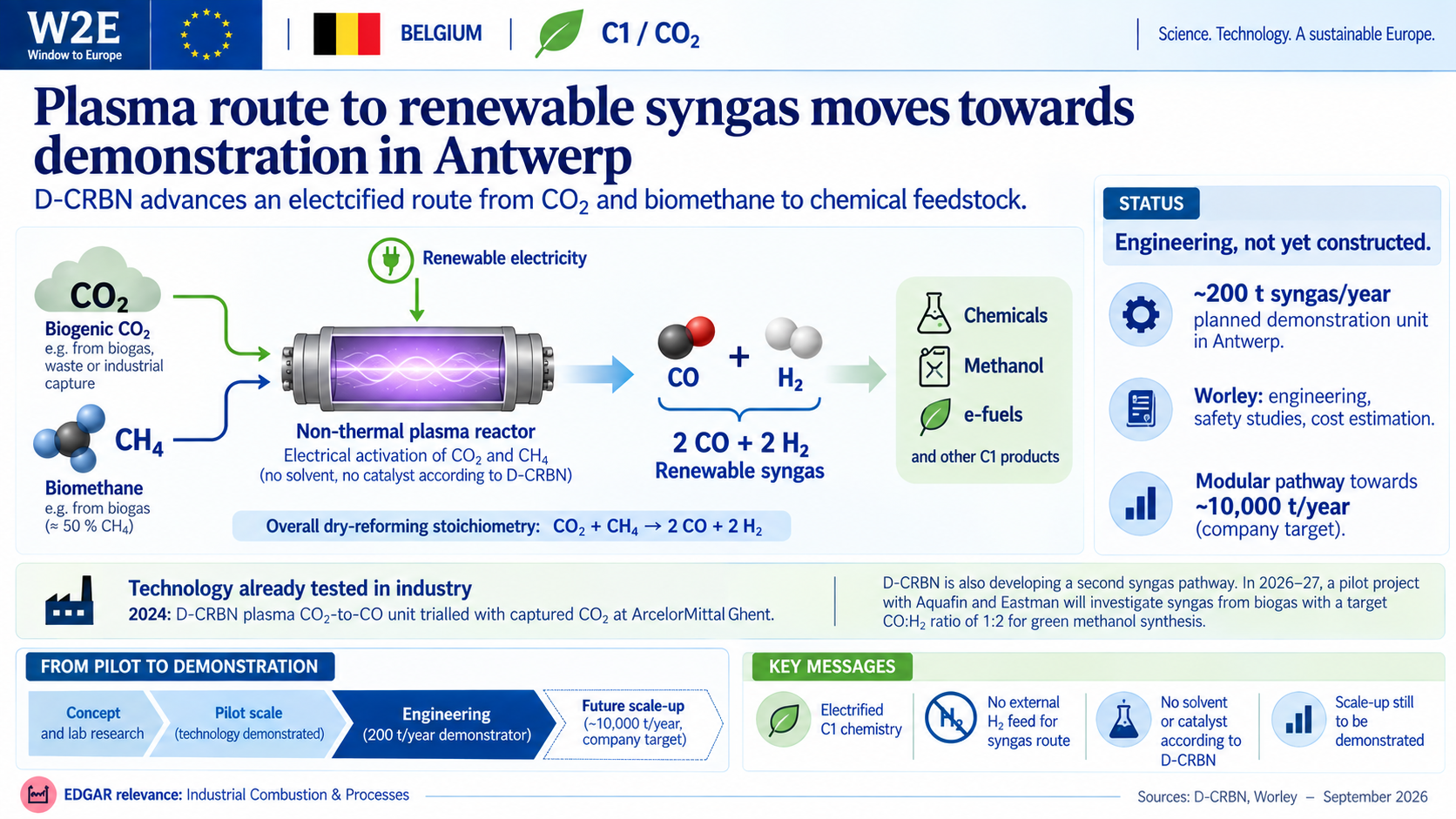
Can renewable electricity turn CO₂ and biomethane directly into chemical feedstock? Antwerp-based D-CRBN is taking its plasma technology towards a 200-t/year syngas demonstration plant – an unusual electrified route from circular carbon to CO and H₂ without an external hydrogen supply.
Belgian technology company D-CRBN is moving its plasma-based route to renewable syngas towards industrial demonstration. In September 2026, Worley was awarded the engineering contract for a demonstration unit to be installed at an industrial site in Antwerp. The plant is designed for continuous operation and a production capacity of approximately 200 tonnes of renewable syngas per year.
From CO₂ and biomethane to syngas
The chemistry can be represented by the overall dry-reforming reaction:
CO₂ + CH₄ → 2 CO + 2 H₂
Instead of conventional thermally driven reforming, D-CRBN uses electrical plasma activation. For the Antwerp demonstrator, the feedstocks are CO₂ and biomethane of biological origin. According to D-CRBN, its proprietary plasma process requires neither solvents nor catalysts.
The resulting mixture of carbon monoxide and hydrogen is a basic C1 feedstock for chemicals and synthetic fuels. An interesting feature of the route is that the hydrogen contained in the syngas originates from methane: no separate external H₂ supply is required for the syngas-production step.
From pilot experience to demonstration
The underlying plasma technology is not entirely new to industrial operation. In 2024, D-CRBN connected a pilot unit to Mitsubishi Heavy Industries‘ CO₂-capture installation at ArcelorMittal Ghent. Captured CO₂ from steelmaking was converted by plasma into CO under industrial conditions. That trial concerned the CO₂-to-CO route rather than the new CO₂/biomethane syngas process, but provided industrial experience with the plasma platform.
The Antwerp project now represents the next scale-up step for renewable syngas. Worley will carry out multidisciplinary engineering, safety studies and cost estimation, while D-CRBN remains responsible for its proprietary plasma reactor. The modular concept is intended eventually to provide a pathway towards plants producing approximately 10,000 t/year, according to the company.
A second development route is also emerging. In a 2026–27 pilot project with Aquafin and Eastman, D-CRBN plans to investigate electrified syngas production from biogas, targeting a CO₂ ratio of 1:2 suitable for green methanol synthesis.
Not yet a demonstration plant
The Antwerp unit has not yet been constructed. The present milestone is the transition into engineering, safety assessment and cost estimation. The 200-t/year capacity and the subsequent 10,000-t/year scale are therefore project targets rather than demonstrated production figures.
Nevertheless, the project is an interesting example of an emerging European C1 strategy: combining circular carbon, renewable electricity and process electrification to produce chemical feedstocks that today are predominantly fossil-based.
Category: C1/CO₂
EDGAR relevance: Industrial Combustion & Processes
Development stage: Engineering for demonstration
Next milestone: Construction and commissioning
D-CRBN – Worley engineering contract for the Antwerp syngas demonstrator
D-CRBN – Industrial CO₂-to-CO trial at ArcelorMittal Ghent
D-CRBN – Aquafin/Eastman electrified syngas project