
In brief
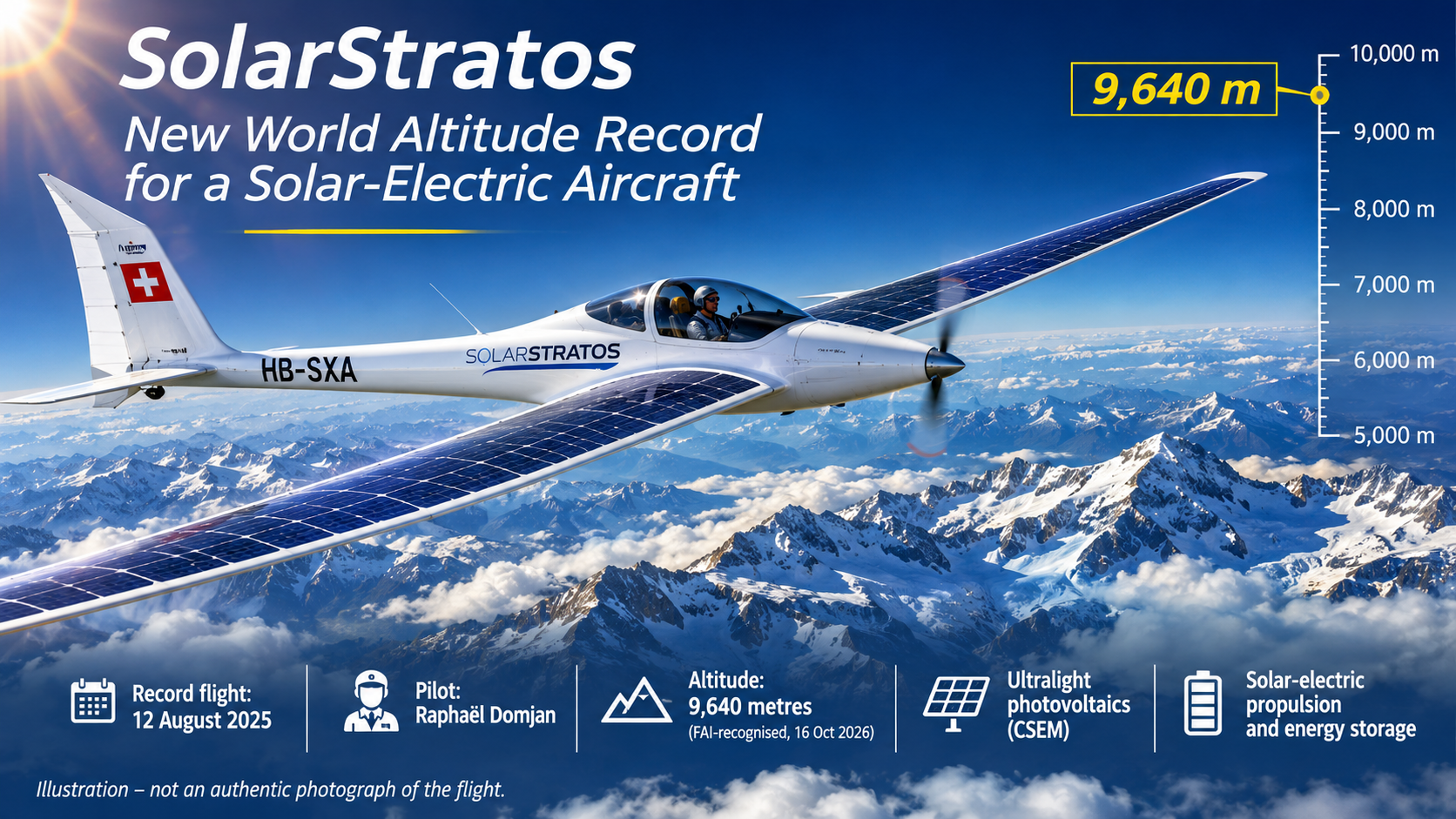
A Swiss solar-electric aircraft has officially entered aviation history. On 16 October 2026, the Fédération Aéronautique Internationale (FAI) confirmed a world altitude record of 9,640 metres, achieved by pilot Raphaël Domjan aboard SolarStratos on 12 August 2025. The record was officially recognised by the FAI in October 2026. The achievement highlights advances in ultralight photovoltaics, energy storage and aircraft engineering – and demonstrates how far solar-powered aviation has progressed.
FAI officially recognised the new altitude record in October 2026.
Lightweight technology makes the difference
SolarStratos is an experimental aircraft designed to explore the possibilities of solar-powered flight at extreme altitudes.
Its long, slender wings carry more than 20 square metres of specially developed photovoltaic modules. A major technological contribution came from the Swiss research and technology organisation CSEM.
CSEM engineers developed ultralight photovoltaic modules integrated directly into the wings and tail surfaces. Their work included protective encapsulation materials designed to withstand low temperatures, vibration and mechanical deformation.
According to the CSEM Scientific and Technical Report 2025, the modules achieved efficiencies above 21% and an areal mass as low as 700 g/m². They also underwent extensive mechanical and thermal testing.
Battery technology is equally important. At high altitudes, every kilogram matters, and the energy storage system must operate reliably under demanding conditions.
From Solar Impulse to SolarStratos
Switzerland has a remarkable tradition in solar aviation.
Solar Impulse demonstrated the possibility of long-distance solar-electric flight, culminating in its pioneering round-the-world journey in 2015–2016.
SolarStratos pursues a different objective: reaching the stratosphere with a crewed solar-electric aircraft, without fossil fuel propulsion.
The project therefore represents not simply another record attempt, but a continuing experiment in lightweight materials, photovoltaics, aerodynamics and energy management.
The SolarStratos team continued its flight-test programme in 2026, exploring further improvements in aircraft performance and operational capabilities.
A glimpse of aviation’s future
SolarStratos does not suggest that large passenger aircraft can soon be powered directly by solar panels. The energy requirements of commercial aviation are far greater.
Nevertheless, the project demonstrates technologies that may find applications beyond experimental aircraft, including lightweight solar modules, advanced energy storage and solar-powered high-altitude platforms.
Its most important message may be that progress in sustainable aviation is not limited to new fuels. Materials science, photovoltaics, electrical engineering and intelligent energy management also have important roles to play.
And sometimes, the best way to demonstrate technological progress is simply to fly higher than anyone has flown before – powered by the sun.