
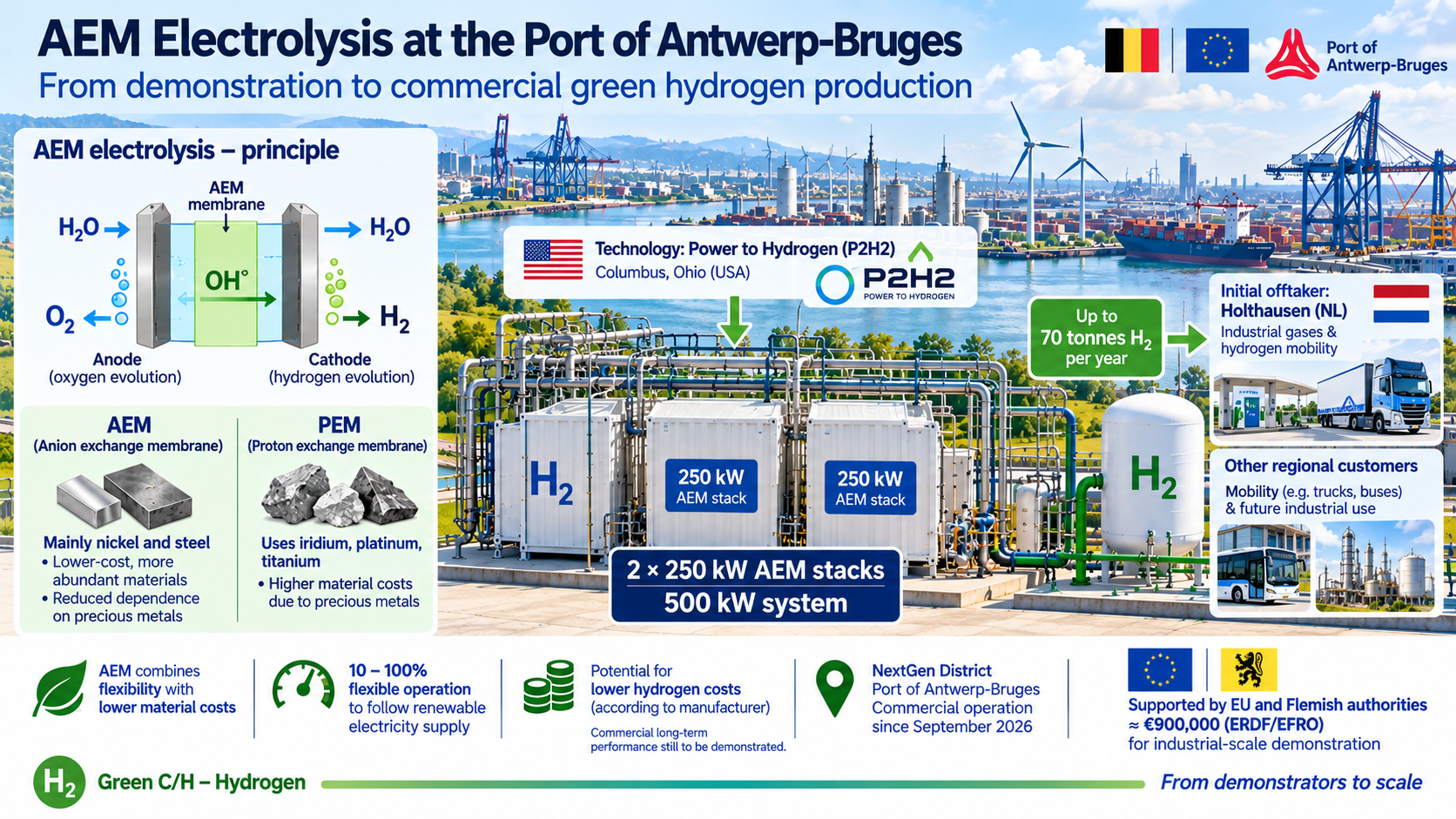
US electrolyzer technology enters commercial operation in a European industrial environment.
US-based Power to Hydrogen (P2H2), headquartered in Columbus, Ohio, has started commercial green hydrogen production at the NextGen District of the Port of Antwerp-Bruges. The 500 kW installation consists of two 250 kW anion exchange membrane (AEM) stacks – reportedly the first commercial deployment of AEM stacks of this size.
The project demonstrates how Europe can provide an industrial test and scale-up environment also for technologies developed outside Europe. The Antwerp installation has received nearly €900,000 in support from the EU and Flemish authorities through the European Regional Development Fund (ERDF/EFRO).
The plant is designed to produce up to 70 tonnes of green hydrogen per year. An initial offtaker is Holthausen in the Netherlands, a supplier of industrial gases and hydrogen mobility solutions. Other regional customers and future industrial applications are expected to follow.
AEM electrolysis is attracting interest because it may combine some of the operational flexibility associated with PEM electrolysis with reduced dependence on expensive and scarce materials. While PEM systems typically require materials including iridium, platinum and titanium, AEM technology can rely more strongly on nickel, steel and other comparatively abundant materials. P2H2’s Antwerp system is designed for flexible operation between 10 and 100% load, allowing hydrogen production to respond to fluctuating renewable electricity supply and electricity prices.
The commercial start follows more than 1,250 hours of testing of P2H2’s commercial-scale AEM technology with Repsol under variable loads and pressures. This provides useful validation, but does not yet demonstrate long-term performance over several years. Claims concerning substantially lower capital costs and hydrogen production costs should therefore still be regarded as manufacturer projections rather than established commercial benchmarks.
The Antwerp installation is small compared with the multi-megawatt and gigawatt electrolyzer projects envisaged for Europe’s future hydrogen economy. Its significance lies elsewhere: an emerging US electrolyzer technology is moving into commercial operation under real conditions at a major European industrial port, supported by European and regional funding and connected to a cross-border hydrogen market.
From demonstrators to scale: Antwerp will show whether large-stack AEM electrolysis can translate its potential advantages – flexible operation, lower-cost materials and reduced dependence on precious metals – into durable and competitive performance in everyday industrial operation.