
LANXESS – Powers Large-Scale Plant with Hydrogen for the First Time
LANXESS – German original press release
An established chemical Verbund turns hydrogen from a neighbouring process into a low-carbon industrial fuel.
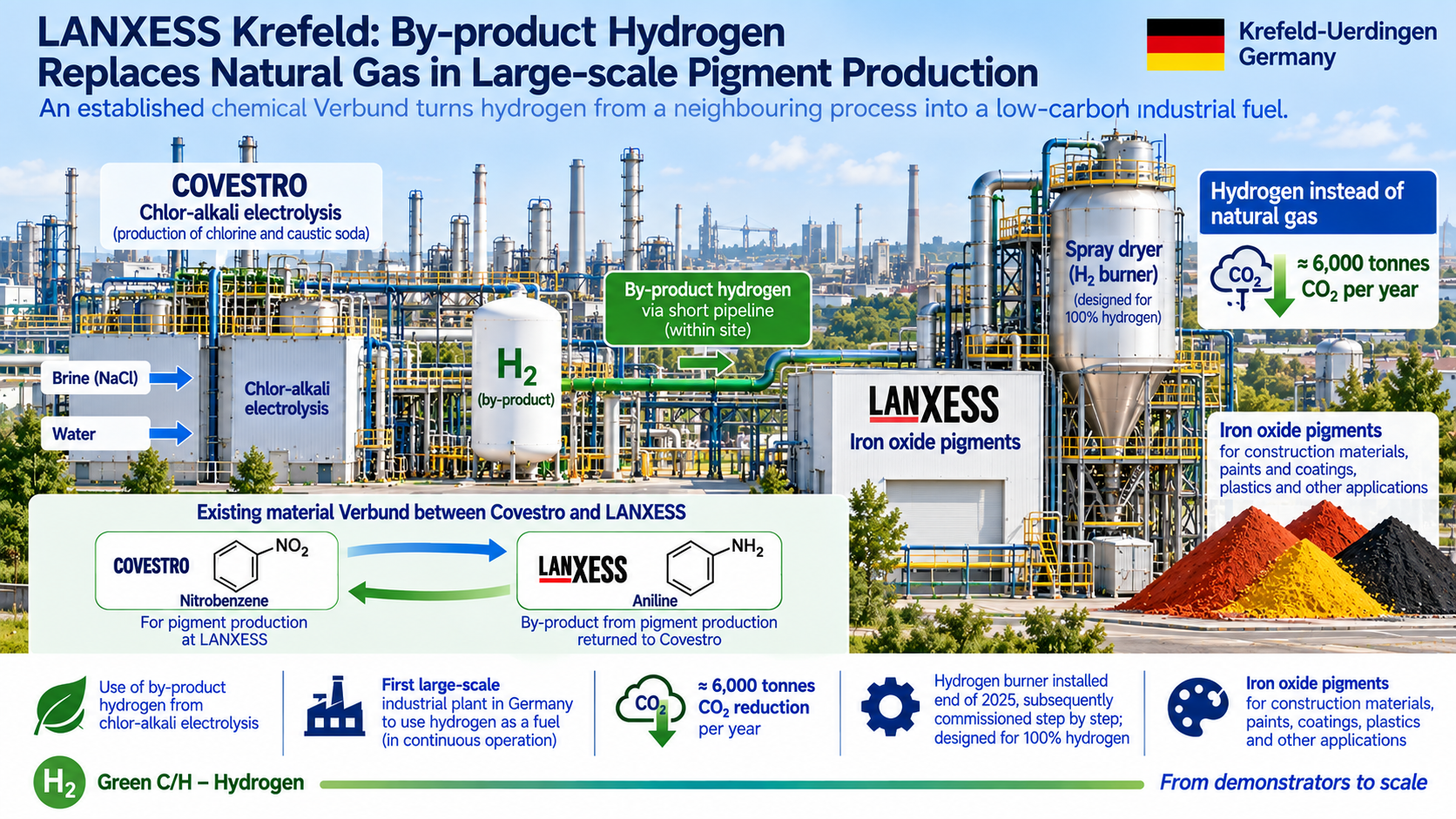
At its Krefeld-Uerdingen site in Germany, LANXESS has started using hydrogen instead of natural gas to dry iron oxide pigments. According to the company, the spray dryer is one of the first large-scale industrial plants in Germany to use hydrogen as a fuel in continuous operation. The switch is expected to reduce CO₂ emissions by around 6,000 tonnes per year.
The particularly interesting aspect is the integration within an existing chemical production network. The hydrogen is not produced in a dedicated new electrolyzer. It arises as a by-product of chlorine electrolysis at the neighbouring Covestro plant and is supplied directly to LANXESS through a short pipeline.
LANXESS installed the hydrogen burner at the end of 2025 and subsequently brought it into operation step by step. The system is designed to operate entirely on hydrogen. Integration required a dedicated hydrogen line, adapted burner and measurement technology as well as additional safety and control systems. Lanxess
The hydrogen link extends an already established material Verbund between the two companies. Covestro supplies nitrobenzene to LANXESS for pigment production. Aniline generated in the LANXESS process is returned to Covestro as a raw material for plastics production. Short transport routes, shared infrastructure and established safety concepts are therefore already part of the site.
Krefeld-Uerdingen is LANXESS’s largest production site for iron oxide pigments, which have been manufactured there for around 100 years. They are used in construction materials, paints and coatings, plastics and other applications.
From demonstrators to scale: The project illustrates a pragmatic route towards industrial decarbonisation: rather than building an entirely new hydrogen infrastructure, an existing by-product stream is integrated into another large-scale production process, replacing natural gas where high-temperature process energy is required.