
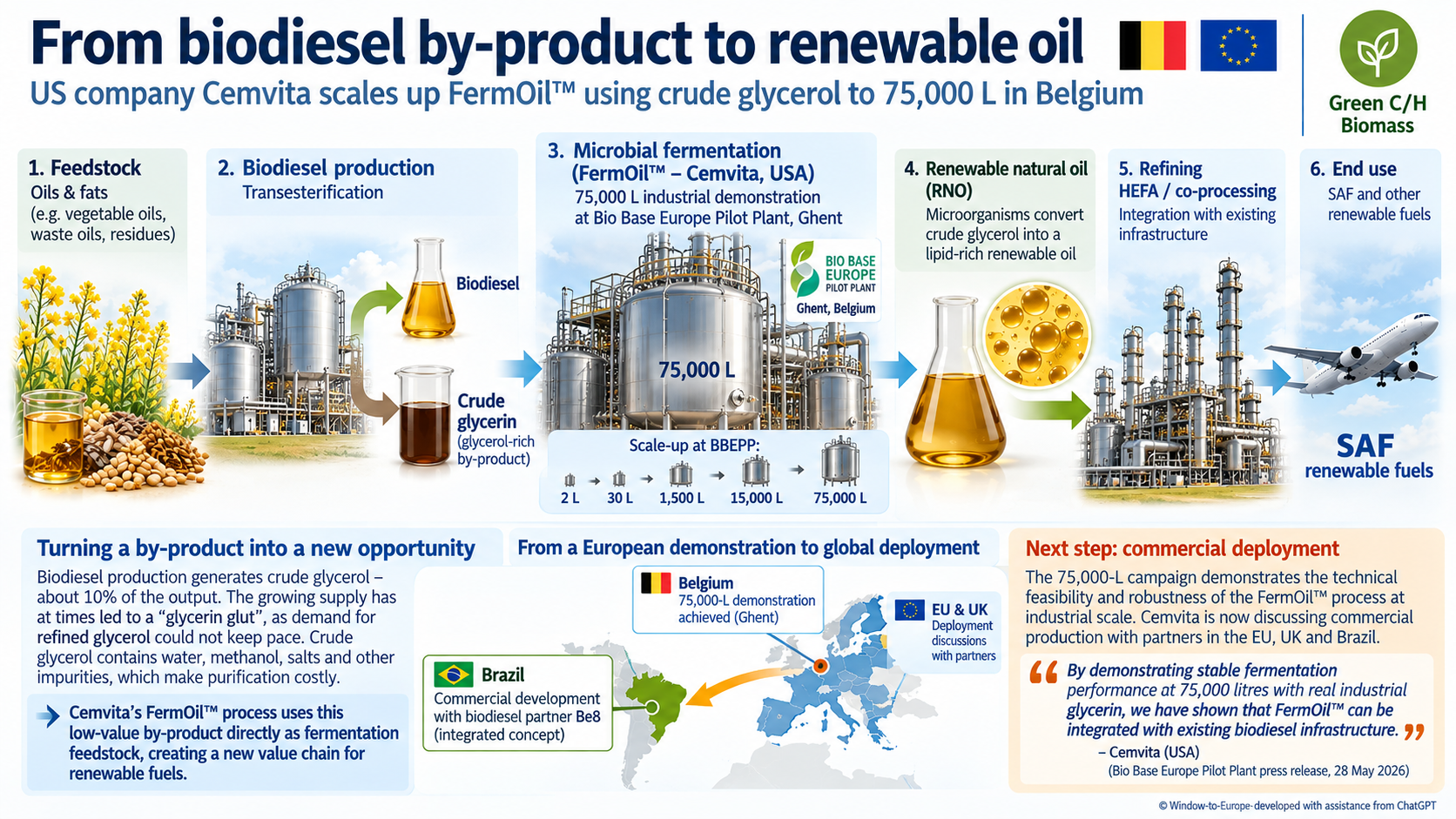
Biodiesel production generates large quantities of crude glycerin. An industrial-scale fermentation campaign in Ghent demonstrates how this low-value co-product could become the starting point for a second renewable-carbon value chain.
At the Bio Base Europe Pilot Plant (BBEPP) in Ghent, US biotechnology company Cemvita has successfully demonstrated its FermOil™ process at 75,000-L fermentation scale. The process was progressively scaled through 2-L, 30-L, 1,500-L and 15,000-L stages before reaching the 75,000-L demonstration. According to Cemvita, target technical metrics were achieved and process performance remained consistent during a 2,500-fold increase from 30 to 75,000 L. Bio Base Europe Pilot Plant
Turning a biodiesel co-product into a feedstock
Biodiesel is produced by transesterification of oils and fats, generating crude glycerin as a major co-product. The rapid expansion of biodiesel production created large additional quantities of glycerin, while crude material containing water, methanol, salts and other impurities is less valuable than purified glycerol.
FermOil™ takes a different approach. Instead of extensively purifying this stream for conventional glycerol markets, Cemvita uses industrial crude glycerin directly as a fermentation feedstock. The Ghent campaign used crude glycerin supplied by an unnamed industrial partner, demonstrating that the process can handle a real stream from existing biodiesel production. Cemvita
Microbial fermentation converts the glycerol-rich feedstock into a lipid-rich Renewable Natural Oil (RNO). This oil is designed to be compatible with existing HEFA and refinery co-processing infrastructure, potentially providing feedstock for Sustainable Aviation Fuel (SAF) and other renewable fuels. Cemvita
The resulting value chain is therefore:
Oils & fats → biodiesel + crude glycerin → fermentation → renewable natural oil → HEFA/co-processing → SAF
Rather than treating crude glycerin simply as a low-value co-product, the concept creates a second renewable-carbon value chain from the same original biomass feedstock.
From Ghent to global deployment
The concept already extends beyond the Belgian demonstration. In January 2025, Cemvita and Brazilian biodiesel producer Be8 signed an agreement to investigate an integrated value chain in which crude glycerin from Be8’s biodiesel operations would be converted by Cemvita’s technology into sustainable bio-oil. A joint working group is evaluating technical and economic feasibility, a collaborative business model and investment requirements for a glycerin-to-bio-oil plant in Brazil. The resulting oil is also being considered as a feedstock for the Omega Green SAF project in Paraguay. Cemvita
Following the successful 75,000-L demonstration, Cemvita reported that it is advancing commercial deployment discussions with strategic partners in Brazil, the EU and the UK. Commercial FermOil™ production, however, has not yet been demonstrated. Cemvita
Why it matters for Europe
The project illustrates two aspects of Europe’s sustainable transition. First, it demonstrates how an existing industrial by-product can become a renewable carbon resource rather than requiring a new primary feedstock. Second, BBEPP provides the European scale-up infrastructure needed to move an industrial biotechnology process from laboratory development towards commercial production.
The result in Ghent is therefore more than a fermentation record: industrial demonstration scale has been achieved; commercial deployment is the next step.
Source: Bio Base Europe Pilot Plant / Cemvita, 28 May 2026. Bio Base Europe Pilot Plant
Original BBEPP report – 75,000-L FermOil™ demonstration
Cemvita – FermOil™ scale-up and deployment plans
Be8 – partnership with Cemvita