
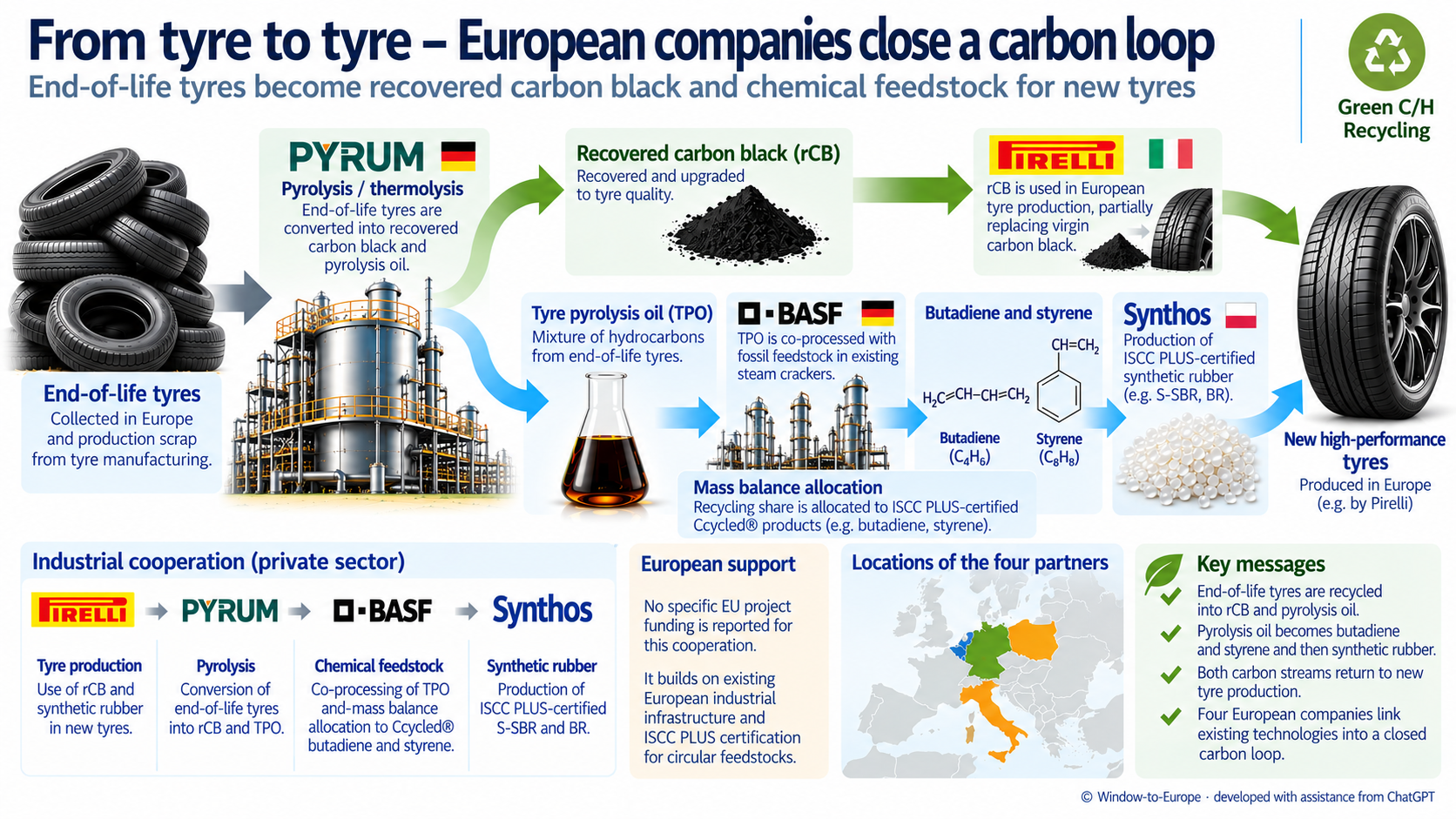
End-of-life tyres become carbon black and pyrolysis oil; the latter returns through butadiene, styrene and synthetic rubber into new tyres. Four European industrial partners demonstrate how recycling can close a complex chemical carbon loop.
End-of-life tyres contain valuable carbon in two major forms: carbon black and hydrocarbons bound in the rubber polymers. A European collaboration coordinated by Pirelli now aims to return both carbon streams into new tyres rather than losing their material value.
The industrial chain brings together Pirelli, Pyrum, BASF and Synthos. End-of-life tyres collected in Germany, together with production scrap from Pirelli’s Breuberg plant, are processed by Pyrum using pyrolysis – thermal decomposition in the absence of oxygen. This generates two secondary raw materials: recovered carbon black (rCB) and tyre pyrolysis oil (TPO). BASF
Two routes back into the tyre
The first route is comparatively direct. Pyrum upgrades the recovered carbon black, which is returned to Pirelli’s European tyre production and partially replaces virgin carbon black.
The second route is chemically more complex – and particularly interesting from a Green C/H perspective. Tyre pyrolysis oil is supplied to BASF and co-fed with conventional fossil feedstock into existing chemical production.Using a mass-balance approach, the recycled feedstock share is attributed to ISCC PLUS-certified Ccycled® products such as butadiene and styrene. BASF
These basic chemicals then enter the next stage of the loop. Synthos uses the circular feedstock route to manufacture ISCC PLUS-certified synthetic rubber, which Pirelli can again use for high-performance tyres. Synthos is Europe’s largest producer of synthetic rubber and a leading producer of solution styrene-butadiene rubber (SSBR). BASF
The complete carbon pathway therefore becomes:
End-of-life tyre → pyrolysis → TPO → chemical feedstock → butadiene/styrene → synthetic rubber → new tyre
while a second, shorter loop returns recovered carbon black directly to tyre production.
What does “mass balance” mean?
An important distinction is that the chemical pathway does not physically segregate recycled and fossil molecules throughout BASF’s production system. TPO is processed together with fossil feedstock, and the corresponding recycled share is allocated to certified products according to the mass-balance principle.
Thus, it cannot be claimed that an individual carbon atom from an old tyre can subsequently be traced into a particular new tyre. The approach instead allows existing large-scale chemical plants to introduce recycled feedstocks without constructing completely separate production lines.
Why this matters for Green C/H
Chemical recycling of tyres is not in itself new. What makes this project noteworthy is the attempt to connect the individual technologies into a intergrated European industrial value chain: waste collection, pyrolysis, recovered carbon black, chemical feedstock, basic chemicals, synthetic rubber and finally new tyres.
The partners describe it as their most comprehensive European application of this tyre-to-tyre approach to date. It demonstrates an important principle of circular carbon management: recycling becomes considerably more valuable when recovered carbon is not merely transformed into another product, but returned to the same demanding industrial application from which it originated. BASF
W2E assessment: The individual industrial processes already exist; the advance lies in linking them into a certified tyre-to-tyre value chain. Particularly significant for Green C/H is the chemical route from pyrolysis oil through basic chemicals and synthetic rubber back into new tyres.
Source: Pirelli / Pyrum / BASF / Synthos, 22 July 2026. BASF