
In brief
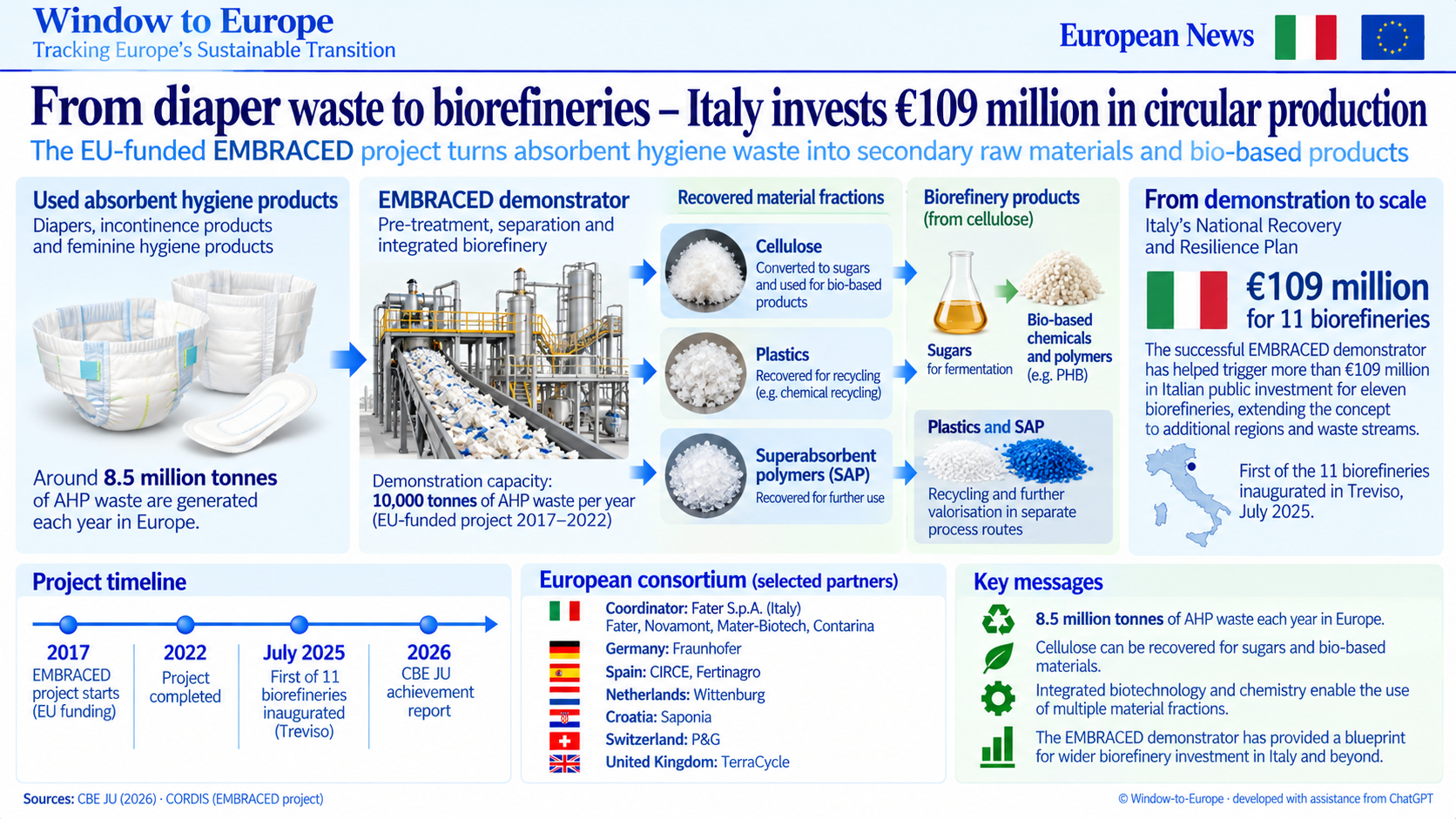
Europe generates around 8.5 million tonnes of absorbent hygiene product waste each year. The EU-funded EMBRACED project demonstrated how used diapers and similar products can become feedstock for integrated biorefineries. Its demonstration concept has now contributed to more than €109 million in Italian public investment – an example of European research moving from demonstration towards wider industrial implementation.
A difficult waste stream becomes a resource
Disposable diapers, incontinence products and feminine hygiene products combine cellulose fibres, plastics and superabsorbent polymers in a complex material structure. After use, these absorbent hygiene products (AHPs) are difficult to recycle and are therefore largely incinerated or landfilled.
The EU-funded EMBRACED project (2017–2022) set out to change this. Coordinated by the Italian company Fater, the consortium developed an integrated biorefinery concept in which separately collected AHP waste is sterilised and separated into reusable material fractions.
At the heart of the concept is the recovery of cellulose, plastics and superabsorbent material. The recovered cellulose can be further converted into fermentable sugars and subsequently into bio-based chemicals and materials. In this way, a difficult municipal waste stream becomes a potential source of secondary raw materials rather than simply an end-of-life problem.
From demonstration to investment
EMBRACED demonstrated the approach at a capacity of around 10,000 tonnes of AHP waste per year. The project received approximately €10.5 million in EU funding and combined waste treatment with subsequent biological and chemical conversion routes.
The more important development has come after the project itself. According to CBE JU, the successful demonstration contributed to an Italian programme providing more than €109 million for eleven biorefineries. The first facility supported under this wider initiative was inaugurated in Treviso in July 2025.
These plants should not be understood simply as eleven copies of the EMBRACED diaper-recycling demonstrator. Rather, the programme extends the biorefinery approach to additional regions and waste streams, targeting products including biofuels, bioplastics and biomaterials.
A broader European development
Other European projects are exploring complementary routes for the individual material fractions. In Belgium, for example, Woosh, BlueAlp and Borouge International have demonstrated a pathway in which plastics recovered from used diapers are converted by pyrolysis into circular hydrocarbon feedstock for new polymers.
Together, these developments illustrate a broader change in waste management: complex consumer waste is increasingly being considered as a feedstock for new industrial value chains.
For EMBRACED, the most significant result may therefore be neither an individual product nor a single recycling process. It is the demonstration that an integrated biorefinery can provide a model sufficiently convincing to stimulate investment well beyond the original EU research project.
From demonstrator to scale:
AHP waste → separation → secondary raw materials → biorefinery products → wider industrial investment
Sources
CBE JU – EMBRACED: Successful demonstrator triggers €109 million investment wave in Italy