
In brief
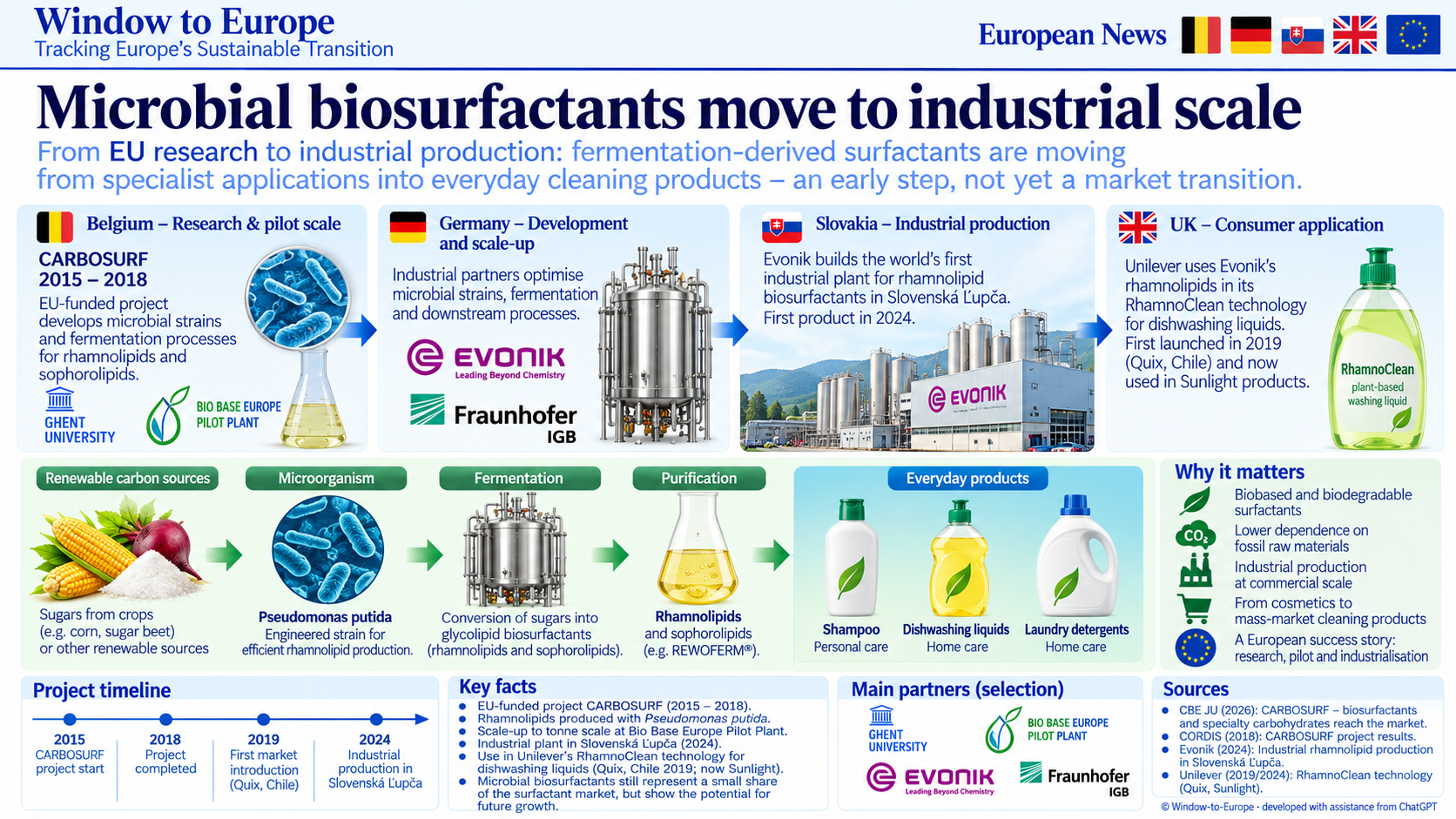
Microbial surfactants have been researched in Europe for decades, but production costs limited their wider use. The EU-funded CARBOSURF project helped overcome bottlenecks in fermentation and downstream processing of rhamnolipids. Evonik now produces them industrially in Slovakia, and they have reached consumer products including dishwashing liquids – an early step towards complementing conventional surfactants with fermentation-derived alternatives Circular Bio-based Europe
Surfactants are essential ingredients in shampoos, detergents and dishwashing liquids. Most are still produced from fossil raw materials or vegetable oils. Microorganisms offer another route: bacteria and yeasts can convert renewable carbon sources into surface-active glycolipids such as rhamnolipids and sophorolipids.
The principle is not new. Microbial biosurfactants have been investigated for decades. The main challenge has been to achieve sufficiently high fermentation yields and to recover and purify the products economically. CARBOSURF was specifically designed to tackle these technological bottlenecks. CORDIS
From European research to industrial scale
The EU-funded CARBOSURF project (2015–2018) was coordinated by Ghent University and brought together academic and industrial partners from several European countries. It developed microbial strains as well as fermentation and downstream processes for glycolipid biosurfactants and specialty carbohydrates. The EU contributed €2.73 million to a project with total costs of about €5.96 million. Circular Bio-based Europe
Processes were scaled up at the Bio Base Europe Pilot Plant in Ghent. For rhamnolipids, the process was debottlenecked at the tonne scale in a 1,500-litre system, while potential problems expected at commercial scale were investigated. German partners included Evonik and Fraunhofer. CORDIS
Evonik subsequently invested a triple-digit million-euro sum in an industrial rhamnolipid plant at Slovenská Ľupča, Slovakia. First product was manufactured in January 2024 and the plant was officially inaugurated in May 2024. Evonik describes it as the world’s first facility producing rhamnolipid biosurfactants on an industrial scale. Evonik
The new CBE JU assessment published on 6 October 2026 explicitly describes the CARBOSURF pilot work as a springboard for this subsequent industrial investment. The Slovak plant uses corn-derived sugar as renewable carbon feedstock. Circular Bio-based Europe
Beyond high-value applications
Biosurfactants are attractive ingredients for cosmetics and personal care, where relatively high product prices make novel ingredients easier to introduce. The more demanding test is their use in high-volume, price-sensitive household products.
This transition has begun. Evonik supplies fermentation-derived rhamnolipids for cleaning and personal-care applications. Unilever, working with Evonik, developed its RhamnoClean technology and first introduced rhamnolipids commercially in its Quix hand-dishwashing liquid in Chile in 2019. The technology has subsequently been incorporated into Sunlight dishwashing products. Unilever
The production chain can therefore be summarized as:
renewable carbon → microorganism → fermentation → rhamnolipids → personal and home-care products
An early step, not yet a market transition
Microbial biosurfactants still represent only a small part of the overall surfactant market. Conventional petrochemical and oleochemical surfactants continue to dominate. Significantly, even CARBOSURF’s original ambitions referred to contributing towards replacing only 5–10% of fossil-based surfactants rather than wholesale substitution. Circular Bio-based Europe
Their importance therefore lies less in present market volume than in demonstrating that fermentation-derived surfactants can now be manufactured at industrial scale and used beyond high-value speciality applications.
CARBOSURF provides a good example of the European innovation chain: publicly supported research led to pilot-scale validation, followed by substantial private investment and commercial production. CBE JU now estimates that CARBOSURF has helped leverage more than €150 million in subsequent investment, including developments at Evonik and the Belgian biotechnology company Inbiose. Circular Bio-based Europe
The technology has thus crossed an important threshold. Whether microbial biosurfactants can eventually capture significant volumes of the detergent and cleaning-products market will depend above all on production costs, fermentation efficiency and further scale-up.
Sources
CBE JU – CARBOSURF’s biosurfactants and specialty carbohydrates reach the market, 6 October 2026; CORDIS – CARBOSURF project and results; Evonik – Industrial rhamnolipid plant in Slovakia; and Unilever – RhamnoClean and Sunlight.