
In brief
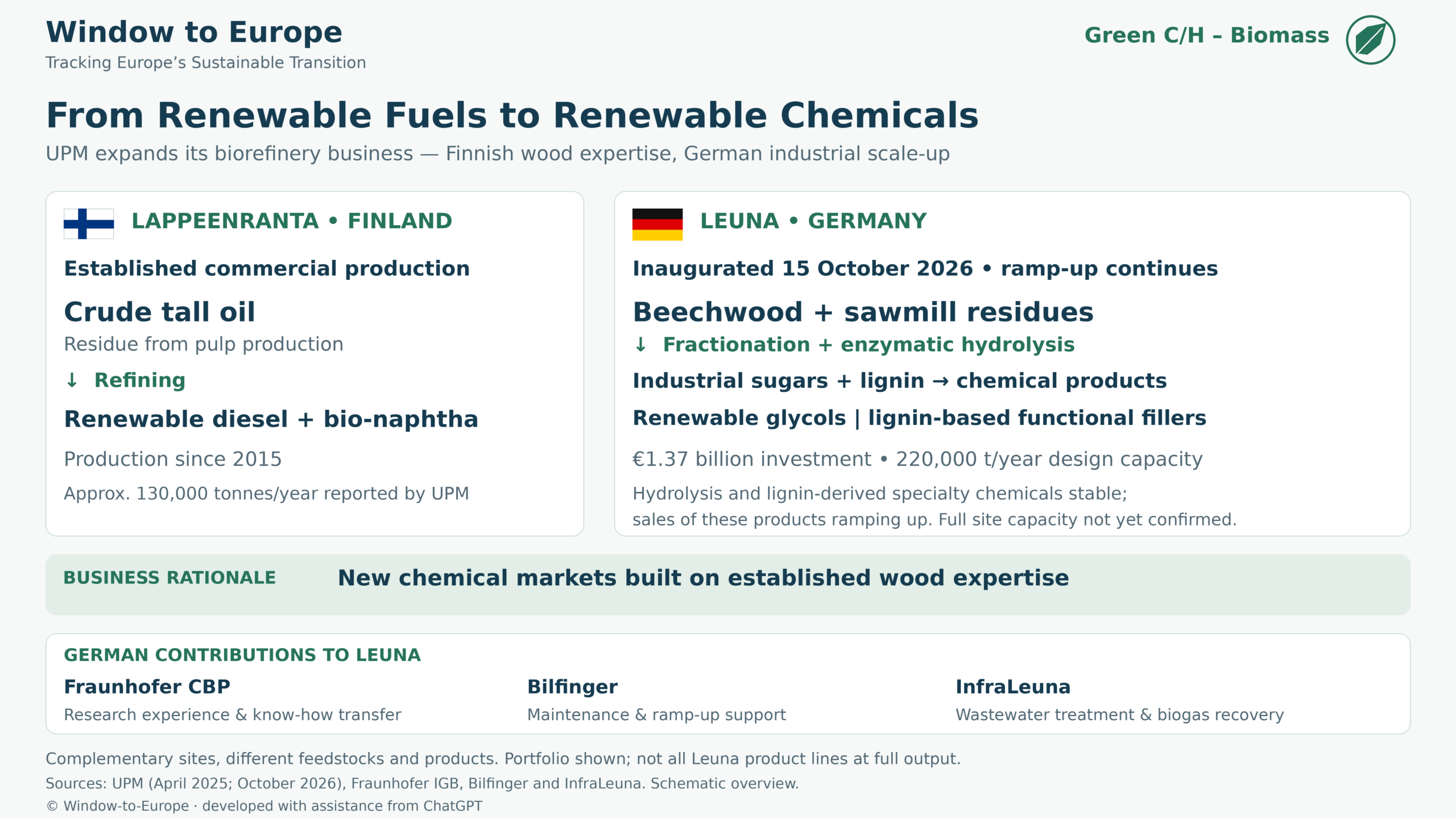
Finnish company UPM inaugurated its biorefinery in Leuna, Germany, on 15 October 2026. Enzymatic hydrolysis and the production of lignin-derived specialty chemicals have reached stable operation, and sales of these products are being ramped up. The investment illustrates how renewable-carbon chemistry can advance through company investment, research experience and established industrial infrastructure.
Why a Forest-Industry Company Invests €1.37 Billion in Chemicals
For UPM, a Finnish group with deep roots in forestry, pulp and paper, Leuna represents an expansion into new markets. The company is applying its experience in wood sourcing and biomass processing to chemical raw materials that have traditionally been made from oil and gas.
The business opportunity extends beyond selling renewable carbon. Manufacturers need materials with suitable performance for packaging, textiles, rubber and other applications. Wood-derived glycols and lignin-based functional fillers offer UPM access to these markets and opportunities to build new customer relationships.
UPM describes the biorefinery, together with its renewable fuels business, as a platform for profitable growth. The €1.37 billion investment is therefore a strategic move to diversify the company’s portfolio and develop a new industrial business from its existing renewable-resource base. Its commercial success will depend on reliable production, competitive costs and customer uptake as the plant ramps up.
UPM already has more than a decade of commercial biorefinery experience in Lappeenranta, Finland, where crude tall oil, a residue of pulp production, is converted into renewable diesel and bio-naphtha. Leuna extends this renewable-carbon business into wood-derived chemicals for materials markets.
Sources: UPM — Biorefinery inauguration and strategic rationale, 15 October 2026; UPM — Ten years of renewable fuel production in Lappeenranta.
Industrial Production Moves Forward
The Leuna biorefinery has an annual design capacity of 220,000 tonnes. Its feedstock consists of beechwood from thinnings and sawmill residues, sourced within approximately 200 kilometres. According to UPM, these materials are unsuitable for higher-value uses such as timber or furniture.
The opening marks further progress in the plant’s ramp-up. UPM specifically confirms stable operation of enzymatic hydrolysis and lignin-derived specialty chemical production. This does not yet establish that every product line is operating at full capacity.
Source: UPM — Biorefinery inauguration, 15 October 2026.
Linking Biotechnology and Chemistry
Enzymatic hydrolysis breaks down the carbohydrate fraction of wood into industrial sugars. These provide renewable feedstocks for subsequent chemical conversion. The Leuna product portfolio includes renewable glycols and lignin-based functional fillers, opening applications in materials such as packaging, textiles and rubber.
This combination of biotechnology and chemical processing allows different components of wood to enter established industrial value chains as alternatives to fossil-derived raw materials.
Source: UPM — The future of chemicals starts with a new source of carbon.
German Research Experience Supports Industrial Scale-Up
The Fraunhofer Center for Chemical-Biotechnological Processes CBP in Leuna provides a documented connection between research, pilot-scale development and industrial implementation.
In a Fraunhofer account, Dr Moritz Leschinsky describes how he established and managed a pilot plant for organosolv wood fractionation and a lignocellulose research group during nine years at CBP. After joining UPM in 2019, he became responsible for constructing the plant for lignin-based rubber fillers, applying experience gained in pilot operations and plant engineering.
Fraunhofer also reports that the regional BioEconomy Cluster, working closely with CBP, helped attract UPM to Leuna. The cluster emerged from the German Federal Ministry of Education and Research’s 2012 Leading-Edge Cluster Competition.
These links demonstrate knowledge transfer and the value of a research-supported industrial ecosystem. They do not imply that Fraunhofer developed UPM’s entire production process.
Sources: Fraunhofer — Moritz Leschinsky: pioneering work continued at UPM; Fraunhofer CBP — Research, scale-up and regional industrial development.
Industrial Partners Support the New Production Platform
German partners support the operation of the new biorefinery. Bilfinger has a six-year framework agreement covering comprehensive maintenance services and supports commissioning and ramp-up.
InfraLeuna developed a dedicated anaerobic pretreatment plant for the biorefinery’s organically concentrated wastewater. Designed for 4,000 m³ per day, it removes at least 80% of the chemical oxygen demand before further treatment in the site’s central biological wastewater facility. InfraLeuna reports approximately 6 MW of biogas output and describes a staged ramp-up towards full performance.
The combination connects chemical production with wastewater treatment and energy recovery within an existing industrial site.
Sources: Bilfinger — Maintenance partnership with UPM; InfraLeuna — Anaerobic wastewater treatment and biogas recovery.
Leuna offers a concrete example of Europe’s transition towards renewable chemical feedstocks: a Finnish industrial investor, German research and engineering experience, regional biomass and integrated site services. Product-specific climate benefits will depend on the feedstocks, energy supply, conversion processes and materials replaced; the inauguration announcement does not provide a quantified plant-wide CO₂ reduction.