
In brief
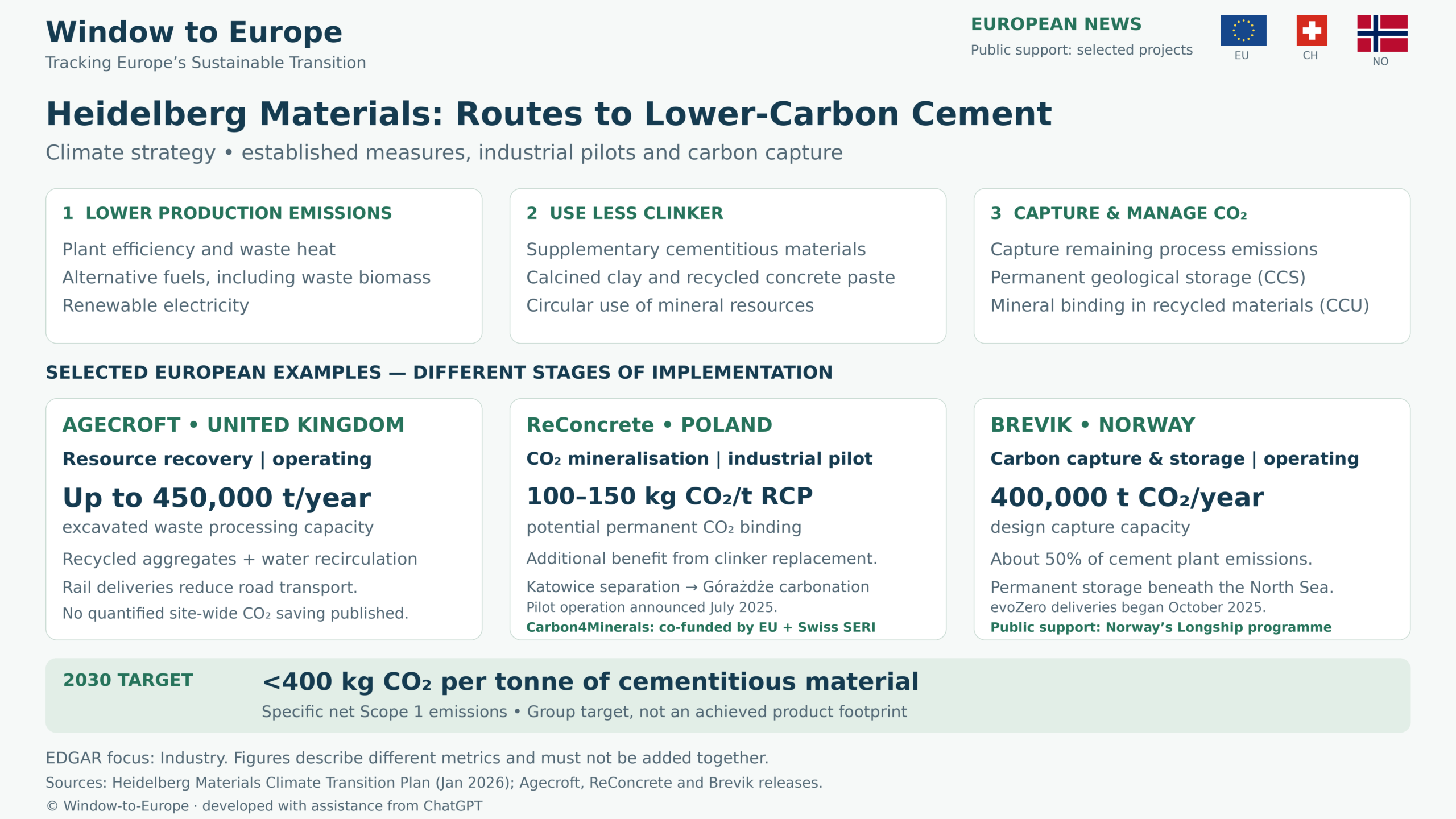
Heidelberg Materials combines resource recovery, lower-clinker cements, energy improvements, CO₂ mineralisation and carbon capture to reduce emissions from construction materials. European examples range from expanded recycling operations in Britain to an operating carbonation pilot in Poland and carbon-captured cement supplied from Norway. Public funding supports the development and deployment of key new technologies.
Reducing Emissions in Cement Production
Heidelberg Materials’ Climate Transition Plan identifies several complementary measures: modernising plants and improving efficiency; increasing alternative fuels, particularly waste-based biomass; using renewable electricity and waste heat; and reducing the proportion of clinker in cement.
Clinker alternatives include established materials such as slag and fly ash, alongside calcined clay and recycled concrete paste. Carbon capture, utilisation and storage address remaining emissions, including those released when limestone is converted into clinker.
The company targets specific net Scope 1 emissions below 400 kg CO₂ per tonne of cementitious material by 2030. This is a Group-wide intensity target, not an achieved product footprint.
Source: Heidelberg Materials — Climate Transition Plan, January 2026.
Recovering Materials: Agecroft, United Kingdom
The recently expanded Agecroft recycling operation near Manchester illustrates the resource-efficiency side of this strategy. A new wash plant can process up to 450,000 tonnes of excavated waste annually, producing recycled aggregates for construction. A water recovery system recirculates almost all the process water.
A new rail siding receives primary aggregates from the company’s Horton quarry. Heidelberg Materials says this reduces road traffic and associated CO₂ emissions. The announcement provides no quantified carbon saving for the overall Agecroft operation.
The company describes the expansion as an investment but does not disclose whether it received public funding.
Source: Heidelberg Materials UK — Agecroft expansion.
Binding CO₂ and Replacing Clinker: ReConcrete, Poland
Heidelberg Materials announced the start of its industrial carbonation pilot in Górażdże in July 2025.
Concrete demolition waste is separated at Katowice into aggregates and a cement-paste-rich fine fraction. In Górażdże, this recycled concrete paste (RCP) is exposed to CO₂-containing kiln exhaust gases. Accelerated carbonation permanently binds CO₂, while the treated material can partially replace clinker in new composite cements.
The company estimates a total reduction potential of approximately 900–1,000 kg CO₂ per tonne of RCP used: 100–150 kg permanently bound through carbonation and 750–850 kg of avoided emissions through clinker substitution. These are process-potential figures, rather than verified annual savings from the pilot.
The carbonation pilot forms part of Carbon4Minerals, a research and development project co-funded by the European Union and the Swiss State Secretariat for Education, Research and Innovation (SERI).
Source: Heidelberg Materials — ReConcrete carbonation facility in Poland.
Capturing Remaining Emissions: Brevik, Norway
Heidelberg Materials inaugurated its Brevik CCS facility in June 2025 and began delivering evoZero cement to European customers in October that year.
The facility is designed to capture approximately 400,000 tonnes of CO₂ annually—about half the cement plant’s emissions—for permanent storage beneath the North Sea. This figure describes design capacity, not achieved annual capture.
Brevik is part of Norway’s Longship programme, supported by substantial public funding for the development of a complete CO₂ capture, transport and storage chain. The Norwegian government reported approximately NOK 22 billion in construction and operating grants for Longship as a whole; this is not the funding amount for Brevik alone.
Sources: Heidelberg Materials — evoZero deliveries begin across Europe; Norwegian Ministry of Energy — Longship enters operation.
Connecting Circularity and Industrial Decarbonisation
These examples show how resource recovery, clinker substitution, mineral binding and geological storage can contribute to a combined industrial climate strategy. Established production measures and newer technologies are being advanced through company investment, research partnerships and public support.
Their contributions must be assessed separately: recycling capacity, CO₂-binding potential, capture capacity and Group emissions targets describe different measures and cannot simply be added together.