
Summary
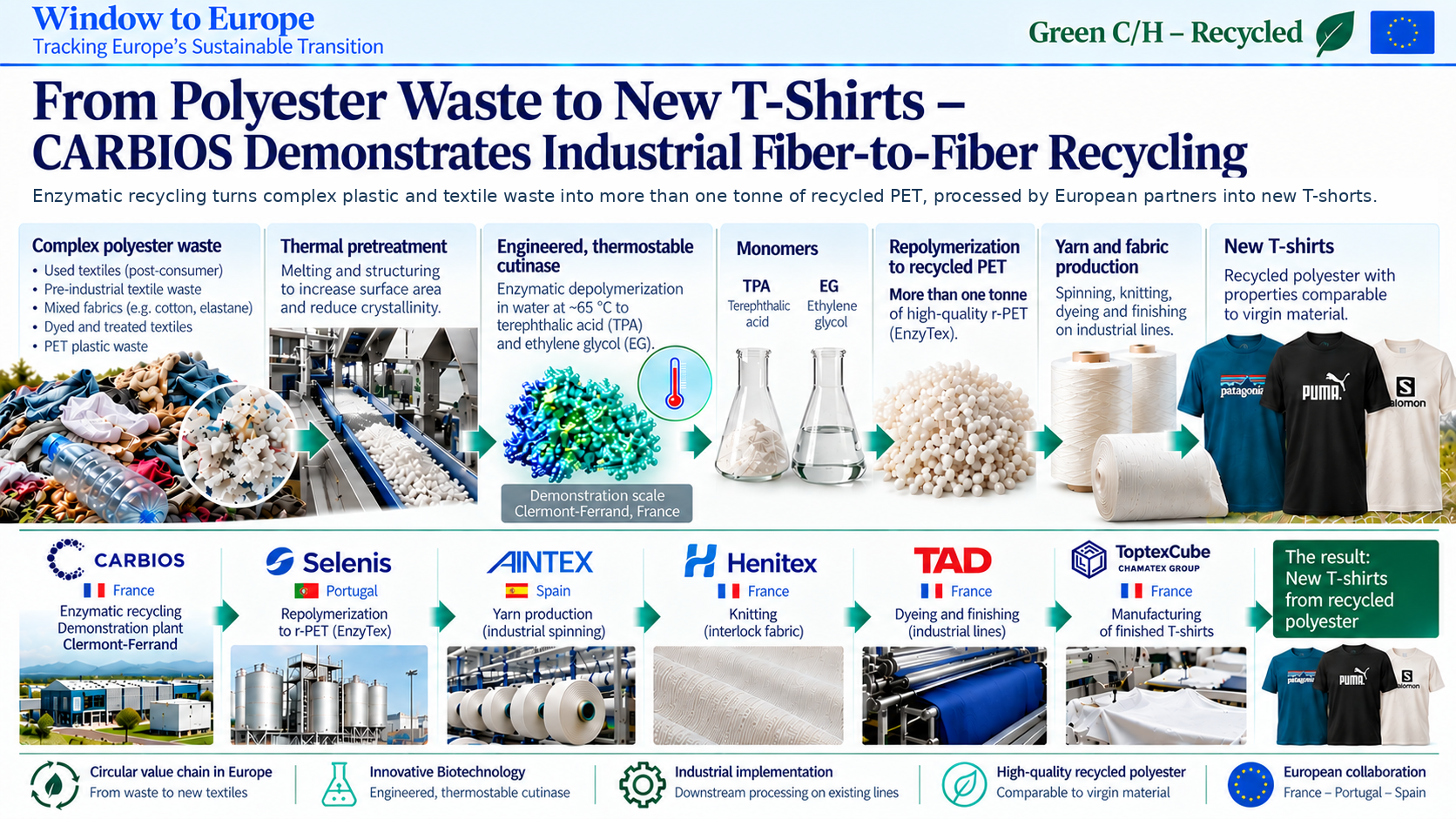
French biotechnology company CARBIOS and its European industrial partners have demonstrated the conversion of complex polyester-containing waste into new, high-quality T-shirts. Enzymatic recycling produced purified monomers that were repolymerized into more than one tonne of recycled PET. Industrial facilities in Portugal, Spain and France subsequently transformed the polymer into yarn, fabric and finished garments.
The achievement combines a remarkable enzyme-engineering innovation with conventional polymer chemistry and established textile manufacturing technologies. While the enzymatic recycling step is still operated at demonstration scale, the successful downstream processing represents an important milestone towards industrial fiber-to-fiber recycling.
Closing the Polyester Loop
Polyethylene terephthalate (PET) is used extensively in packaging and synthetic textiles. Polyester fabrics, however, present particular recycling challenges. They may contain cotton, elastane, dyes, coatings and other additives, making conventional mechanical recycling difficult.
CARBIOS has developed an enzymatic process that breaks down PET into its original chemical building blocks: terephthalic acid (TPA) and ethylene glycol (EG). Following purification, these monomers can be used to produce new PET with properties comparable to those of virgin polymer.
Unlike mechanical recycling, which generally preserves the polymer chains, enzymatic depolymerization returns PET to its constituent monomers. This opens the possibility of producing high-quality polyester repeatedly, provided that the monomers are efficiently recovered and purified.
The latest demonstration shows how this approach can be integrated into an existing European textile manufacturing chain.
Source: CARBIOS, 29 September 2026 – Industrial production of recycled polyester T-shirts
The Scientific Breakthrough: An Engineered, Thermostable Cutinase
At the heart of CARBIOS‘ technology is an engineered variant of leaf-branch compost cutinase (LCC), an enzyme originally identified in compost microorganisms.
Natural cutinases hydrolyze ester bonds, but conventional enzymes are generally insufficiently active or stable for the rapid depolymerization of PET under industrially relevant conditions.
Through protein engineering, researchers substantially improved both the activity and thermal stability of LCC. The optimized enzyme can efficiently attack PET at elevated temperatures, where the mobility of polymer chains increases and ester bonds become more accessible.
This temperature dependence is particularly important. PET has a glass transition temperature of approximately 70–80°C, while its melting temperature is much higher, around 250–260°C.
CARBIOS therefore combines thermal pretreatment with enzymatic hydrolysis. The PET feedstock is prepared to reduce crystallinity and improve accessibility before undergoing enzymatic depolymerization in an aqueous reaction system at approximately 65°C.
The enzyme does not operate in molten PET at 250°C. Rather, the innovation lies in combining a highly active, thermostable biocatalyst with a pretreatment process that makes the polymer susceptible to hydrolysis.
The underlying research was published in Nature in 2020 by Tournier and colleagues. The engineered enzyme achieved at least 90% PET depolymerization within ten hours under the experimental conditions reported in that study.
The subsequent challenge has been to translate this scientific breakthrough into a reproducible, scalable recycling process capable of handling real post-consumer waste.
Scientific reference: Tournier et al. (2020), An engineered PET depolymerase to break down and recycle plastic bottles, Nature 580, 216–219
From Complex Waste to New T-Shirts: A European Industrial Chain
In September 2026, CARBIOS announced the successful production of recycled polyester T-shirts in cooperation with the Fiber-to-Fiber Consortium, whose members include Patagonia, PUMA and Salomon.
The process began with complex plastic waste and polyester-containing textile waste, including pre-industrial and post-consumer materials. These feedstocks can contain fiber blends, dyes, finishing agents and other substances that complicate conventional recycling.
CARBIOS processed the PET fraction enzymatically at its demonstration facility in Clermont-Ferrand, France, obtaining monomers suitable for producing new polyester.
The subsequent manufacturing steps were carried out by specialized European industrial partners:
- Selenis, Portugal: Repolymerization of the recovered monomers into more than one tonne of high-quality recycled PET, marketed as EnzyTex.
- ANTEX, Spain: Conversion of the recycled polymer into polyester yarn using industrial spinning equipment.
- Henitex, France: Knitting of the yarn into interlock fabric.
- TAD, France: Industrial dyeing and finishing.
- ToptexCube, Chamatex Group, France: Manufacturing of the finished T-shirts.
According to CARBIOS, the recycled polyester demonstrated mechanical strength, dyeability and color fastness comparable to conventional virgin polyester.
An important feature of this demonstration is that the downstream manufacturing steps were carried out under standard industrial operating conditions. The recycling technology therefore supplied a material that could be processed by established textile production equipment.
Source: CARBIOS and the Fiber-to-Fiber Consortium, 29 September 2026
Demonstrating Reproducibility
The T-shirt project builds on earlier achievements at CARBIOS‘ industrial demonstration plant in Clermont-Ferrand.
In July 2026, the company reported that the facility had successfully completed its 100th production batch. Tests involving complex post-consumer polyester textile waste achieved more than 95% PET conversion within 24 hours.
These results provide evidence that enzymatic depolymerization can be reproduced under conditions representative of industrial operations, including the treatment of heterogeneous textile feedstocks.
The demonstration plant is an important intermediate stage between laboratory development and commercial production. However, the reported conversion rates should not be interpreted as proof that the process has already achieved continuous commercial operation at full industrial capacity.
Source: CARBIOS, 21 July 2026 – 100 batches at the industrial demonstration plant
What Remains to Be Demonstrated?
The successful manufacture of recycled T-shirts represents a substantial technological achievement, but important steps remain before enzymatic polyester recycling can become a widely deployed industrial process.
CARBIOS still needs to demonstrate sustained commercial-scale operation, reliable access to suitable waste feedstocks and economically competitive processing costs.
The September announcement does not provide a complete material balance identifying the respective contributions of textile waste and other PET waste to the recycled polymer. Nor does it quantify the recovery or utilization of non-PET components such as cotton and elastane.
These questions will become increasingly important as the technology progresses from demonstration to commercial production.
CARBIOS is pursuing industrial-scale deployment through its planned facility at Longlaville in France and an international partnership in China. The progress of these projects will provide further evidence of the technology’s industrial and economic viability.
Outlook
The CARBIOS project illustrates how industrial biotechnology can complement established chemical and manufacturing technologies.
The enzyme performs the selective breakdown of PET, conventional chemical processing recovers and repolymerizes the monomers, and existing textile factories transform the resulting polymer into finished products.
The latest European demonstration is therefore more than another example of recycled clothing. It shows that an advanced enzymatic recycling technology can supply high-quality raw materials to an established multinational industrial production chain.
The remaining challenge is to establish the same reliability and performance in continuous commercial-scale recycling operations.
For Europe’s transition towards a circular chemical industry, CARBIOS offers a promising example of biotechnology and conventional polymer engineering working together to keep valuable carbon-containing materials in productive use.