
Summary
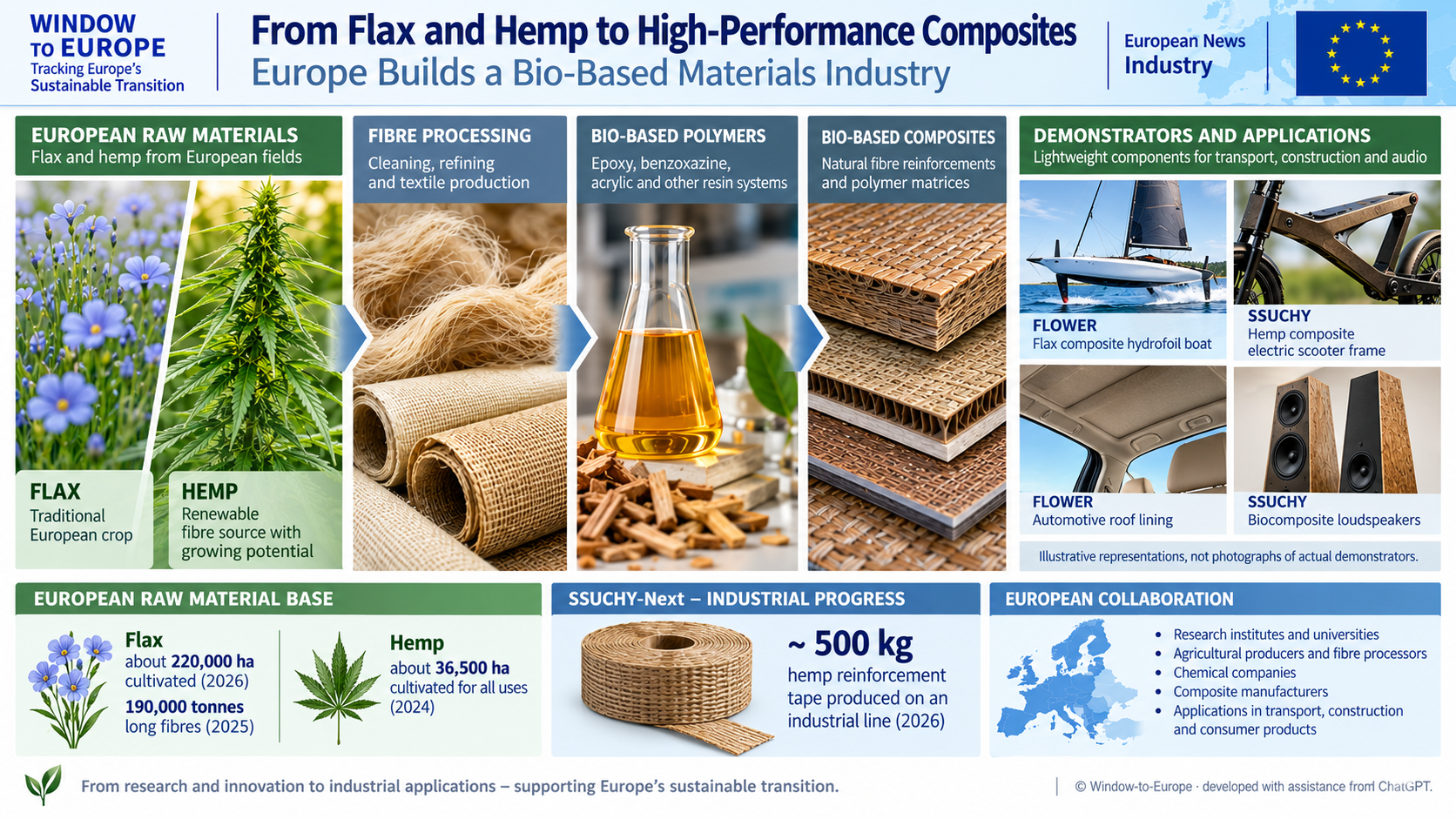
European research and industry are opening new markets for flax and hemp as renewable raw materials for high-performance composites. The EU-supported projects FLOWER, SSUCHY and SSUCHY-Next connect agricultural producers, fibre processors, polymer chemists and manufacturers across Europe. Demonstrators in transport, construction and audio technology, together with recent progress in industrial hemp-fibre processing, illustrate the transition from research to commercial applications.
Europe’s agricultural raw material base
Europe already possesses a substantial agricultural and industrial infrastructure for flax production. France, Belgium and the Netherlands are among the leading producers of high-quality flax fibres, supplying much of the global linen industry.
European flax cultivation covered approximately 220,000 hectares in 2026, while production of long flax fibres reached around 190,000 tonnes in 2025, according to industry statistics.
Industrial hemp cultivation is smaller but offers considerable opportunities for diversification. Approximately 36,500 hectares were cultivated in Europe in 2024 for applications ranging from construction materials and textiles to food and technical fibres.
Both crops offer renewable fibre resources. Their environmental advantages depend on cultivation practices, processing, product lifetime and the materials they replace.
The emerging opportunity is therefore not simply to increase agricultural production, but to create higher-value industrial applications for European natural fibres, particularly in composite materials traditionally reinforced with glass or carbon fibres.
Source: Alliance for European Flax-Linen & Hemp – Economic Observatory
FLOWER: Flax composites from research to demonstrators
The cross-border INTERREG project FLOWER (2018–2023) was coordinated by the University of South Brittany (Université Bretagne Sud), Lorient, France.
Its eight partners from France and the United Kingdom represented the entire flax-composite value chain.
The four academic partners were:
- University of South Brittany, France – project coordination and composite engineering.
- INRAE Nantes, France – plant materials and biopolymers.
- University of Cambridge, United Kingdom – natural materials and structural applications.
- University of Portsmouth, United Kingdom – polymer and composite engineering.
Four industrial partners contributed manufacturing expertise and practical applications:
- Teillage Vandecandelaère (Depestele Group), France – flax production and fibre processing.
- Eco-Technilin, France – natural-fibre reinforcement materials.
- Howa-Tramico, France – automotive components.
- Kaïros, France – marine applications and bio-based products.
FLOWER developed three principal demonstrators: a flax-composite hydrofoil boat, automotive roof-lining components and Kairlin®, a flax/PLA material for advertising displays.
The hydrofoil boat underwent sea trials, while Kairlin was validated for industrial manufacturing. These results demonstrated that flax fibres could be incorporated into technically demanding products beyond traditional textiles.
Original sources: FLOWER – Official project website | University of Cambridge – FLOWER consortium
SSUCHY: Hemp fibres and bio-based polymer chemistry
The EU-funded SSUCHY project, launched in 2017, was coordinated by the University of Franche-Comté/FEMTO-ST in Besançon, France, under the scientific leadership of Vincent Placet.
Its consortium brought together 17 partners from seven European countries: France, Belgium, Germany, Italy, the Netherlands, Sweden and the United Kingdom.
The research organisations included the University of Franche-Comté, CNRS/Chimie Paris, Stockholm University, KU Leuven, the University of Bristol, the University of Derby, the University of Bourgogne, ENIT Tarbes, ENSAIT and Università Cattolica del Sacro Cuore.
The industrial and application-oriented partners included:
- Nouryon, Netherlands – polymer and chemical expertise.
- Linificio e Canapificio Nazionale, Italy – hemp fibre processing, spinning and weaving.
- NPSP, Netherlands – design and manufacture of composite components.
- Trèves, France – automotive applications.
- Wilson Benesch, United Kingdom – high-performance loudspeaker systems.
- EADCO, Germany – industrial composite applications.
Bioeconomy For Change in France supported communication and exploitation of the project results.
SSUCHY developed improved hemp-fibre reinforcements and bio-based epoxy resin systems using renewable aromatic building blocks, including isoeugenol and lignin-derived compounds. These developments provide a route towards composites with substantially increased renewable content.
Four demonstrators illustrated the technical potential: automotive components, an electric scooter frame, an aircraft cockpit dashboard and loudspeaker enclosures.
Life-cycle assessments indicated environmental advantages compared with selected conventional reference products, although the results cannot be generalized to all natural-fibre composites.
One particularly interesting commercial application emerged from Wilson Benesch, which has incorporated biocomposite technology developed through SSUCHY into its loudspeaker products.
Original sources: SSUCHY – Consortium and partners | SSUCHY – Technical responsibilities | European Commission CORDIS – Final reporting
SSUCHY-Next: Towards industrial manufacturing
The successor project SSUCHY-Next (2024–2028) is coordinated by KU Leuven, Belgium, with Professor Aart van Vuure leading the consortium.
It brings together academic institutions, research centres, fibre processors, chemical companies and composite manufacturers from Belgium, France, the Netherlands, Denmark, Italy and the United Kingdom.
Important participants include:
- Eco-Technilin and Terre de Lin, France – natural-fibre processing and industrial reinforcement production.
- Linificio e Canapificio Nazionale, Italy – hemp yarns and fabrics.
- Arkema, France, and Bitrez, United Kingdom – polymer and resin technologies.
- Materia Nova, Belgium – development of bio-based and reprocessable resins.
- NPSP, Netherlands – composite manufacturing and building applications.
- Olsen Wings, Denmark – wind energy components.
- Woodoo, France – wood-based composite materials.
- KU Leuven, TU Delft, DTU, University of Tarbes and research groups in Besançon – materials science, mechanical testing and process development.
CETIM, the French mechanical industries technical centre, contributes industrial engineering expertise, while Bioeconomy For Change supports dissemination and exploitation.
Several partners have participated in earlier projects, ensuring continuity between material development and industrial application.
Measurable industrial progress in 2026
Recent project reports provide concrete evidence of scale-up.
Approximately 4 tonnes of hemp fibre slivers have been produced, and Eco-Technilin has processed around 500 kg of unidirectional HempTape® reinforcement on an industrial manufacturing line.
Linificio e Canapificio Nazionale is developing industrial hemp fabrics, with approximately one tonne targeted by the end of 2026.
These quantities represent progress in industrial fibre preparation, although they do not yet demonstrate continuous commercial production of finished composite products.
The project is also developing recyclable and bio-based resin systems and larger structural demonstrators.
A particularly ambitious objective is a 12.6-metre wind turbine blade, being developed with DTU and industrial partners. This remains a planned demonstrator rather than an established commercial product.
Original sources: CBE JU – SSUCHY-Next consortium | SSUCHY-Next – Work package leaders and responsibilities, September 2026 | JEC Composites – Industrial hemp fibre scale-up, October 2026
European cooperation creates new industrial opportunities
FLOWER and SSUCHY were separate, partly overlapping European research initiatives, while SSUCHY-Next explicitly builds on the results of SSUCHY.
Together, they illustrate how European collaboration can connect agriculture, chemical research, materials engineering and industrial manufacturing.
France contributes a well-established natural-fibre industry and extensive polymer research. Belgium provides composite expertise and project coordination. Italian and Dutch companies contribute fibre processing and manufacturing technologies, while British, Danish and German partners support applications and industrial development.
The transition from laboratory materials to demonstrators and industrial reinforcement production is creating new opportunities for European agriculture and the chemical industry.
Why it matters
Natural-fibre composites can reduce dependence on fossil-derived polymers and energy-intensive reinforcement materials, while creating additional markets for European agricultural products.
Their sustainability benefits must nevertheless be demonstrated for each application through appropriate life-cycle assessments.
FLOWER and SSUCHY have already delivered practical demonstrators and selected commercial applications. SSUCHY-Next is now addressing industrial manufacturing, material reproducibility, durability and recyclability.
Europe’s flax and hemp industries are thus gaining opportunities beyond traditional textiles, as research and manufacturing partnerships develop a new generation of bio-based structural materials.