
In brief
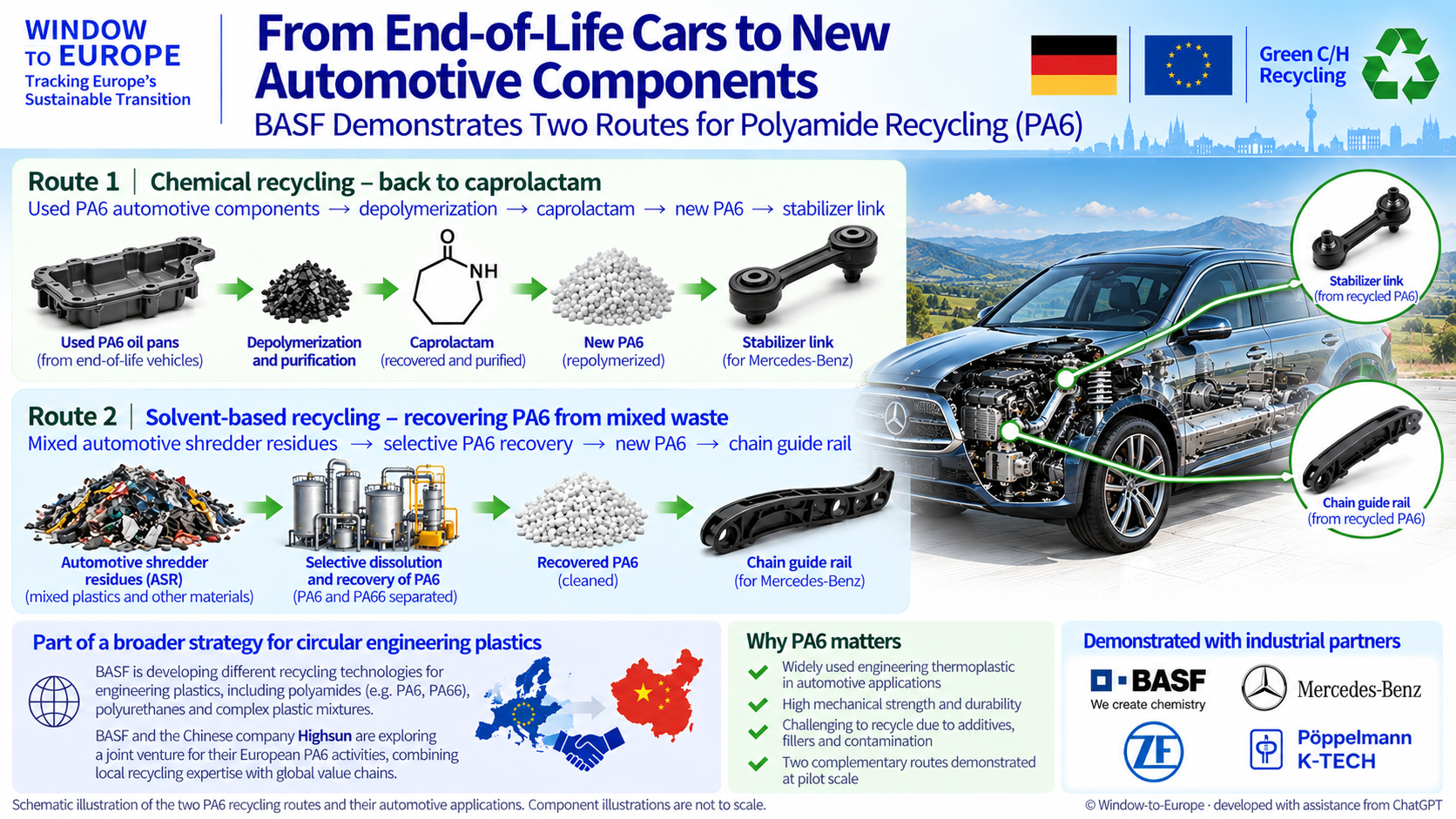
BASF is pursuing a broader strategy to develop circular material flows for engineering plastics, combining different recycling technologies with industrial partnerships. Its activities include polyamides, polyurethane materials and complex plastic waste streams.
The German chemical company is also exploring closer cooperation with China’s Highsun Holding Group in the European polyamide 6 (PA6) business, reflecting the increasingly international character of the polyamide value chain.
A particularly tangible result of BASF’s recycling research was announced on 16 October 2026: Together with Mercedes-Benz, ZF and Pöppelmann K-TECH, BASF has demonstrated two complementary technologies for recovering high-quality PA6 from end-of-life vehicles.
One route chemically depolymerizes used PA6 components into caprolactam, while the other uses solvents to recover PA6 from mixed automotive shredder residues.
Both processes have reached pilot scale, and the recovered materials have been used to manufacture technically demanding automotive components.
The achievement illustrates how Europe’s chemical and automotive industries are moving towards circular engineering plastics, while also highlighting the challenges of industrial scale-up.
A Broader Strategy for Circular Engineering Plastics
Engineering plastics play a crucial role in modern industry. Compared with commodity plastics, they offer combinations of mechanical strength, temperature resistance, chemical stability and dimensional precision.
Polyamides are among the most important materials in this category. PA6 and PA66 are widely used in automotive components, electrical equipment, machinery and other demanding applications.
Their recycling is considerably more challenging than that of relatively clean packaging plastics. Industrial components frequently contain glass fibres, additives, pigments and other materials, while end-of-life products may be contaminated by oils and operating fluids.
BASF is therefore investigating different recycling technologies rather than relying on a single process.
These include chemical depolymerization, solvent-based polymer recovery and other approaches for complex engineering plastics.
The objective is to recover valuable materials while preserving or restoring the performance required for industrial applications.
An important question is whether such processes can ultimately operate economically at industrial scale and deliver measurable environmental benefits.
International Cooperation: BASF and China’s Highsun
On 19 October 2026, BASF and China’s Highsun Holding Group announced that they were exploring a potential joint venture involving their European PA6 activities.
Highsun is an important international producer of caprolactam and polyamide materials. Its activities extend across the polyamide value chain, from chemical intermediates to polymer production.
The proposed cooperation could combine BASF’s European industrial operations and materials expertise with Highsun’s international polyamide activities.
The announcement is significant because caprolactam is also the central chemical intermediate in one of BASF’s new PA6 recycling processes.
However, the discussions concern the broader PA6 business. They do not constitute an announced joint recycling project, nor has a new recycling facility been confirmed.
The potential partnership nevertheless illustrates how Europe’s future materials industry may combine regional production and technological expertise with increasingly international value chains.
Against this background, BASF’s latest recycling demonstrations provide a concrete example of technological progress.
Two Routes for Recycling Polyamide 6
On 16 October 2026, BASF reported successful pilot-scale demonstrations of two different processes for recovering PA6 from automotive waste.
Both projects involved partners from the German automotive industry and resulted in new components intended for demanding applications.
The technologies address different types of waste and employ fundamentally different chemical principles.
Route 1: Chemical Recycling – Back to Caprolactam
The first process starts with used PA6 transmission oil pans recovered from end-of-life vehicles.
These components are challenging recycling feedstocks because they contain additives and may be contaminated by lubricants and other operating materials.
BASF chemically depolymerized the PA6 into caprolactam, the cyclic monomer used to manufacture PA6.
After purification, the recovered caprolactam was repolymerized to produce new PA6.
The recycled polymer was subsequently compounded with glass fibres to obtain a material suitable for demanding automotive applications.
Working with ZF, BASF used this material to manufacture a stabilizer link for Mercedes-Benz.
According to ZF, the polymer fraction of the component consisted entirely of recycled PA6. This does not mean that the complete glass-fibre-reinforced component consisted of 100% recycled material.
The stabilizer link was produced using existing ZF manufacturing equipment and tested under conditions approaching series production.
The component met the specified mechanical requirements, demonstrating that chemically recycled PA6 can be suitable for demanding structural applications.
This is an important advance beyond merely recovering a polymer in the laboratory.
Source: BASF, 16 October 2026
Route 2: Solvent-Based Recycling – Recovering PA6 from Mixed Waste
The second process addresses a different challenge: the recovery of engineering plastics from mixed automotive shredder residues.
These residues are generated during the processing of end-of-life vehicles and contain complex mixtures of polymers and other materials.
BASF investigated a solvent-based separation process in which PA6 and PA66 were separated from mixed residues and cleaned.
PA6 was then selectively recovered using solvents.
Unlike chemical depolymerization, solvent-based recycling aims to recover the polymer without breaking it down into its constituent monomers.
Together with Pöppelmann K-TECH, BASF used the recovered PA6 to manufacture a chain guide rail for Mercedes-Benz.
Such components must withstand mechanical wear, elevated temperatures and contact with operating fluids.
The successful pilot demonstration indicates that mixed automotive waste streams could become sources of high-quality engineering polymers.
Although PA66 was included in the separation investigations, BASF has not reported an equivalent PA66 component demonstrator from this project.
Source: BASF, 16 October 2026
Two Complementary Technologies
The two approaches address different recycling challenges.
| Chemical depolymerization | Solvent-based recycling | |
|---|---|---|
| Feedstock | Used PA6 automotive components | Mixed automotive shredder residues |
| Main principle | Breakdown into caprolactam | Selective dissolution and polymer recovery |
| Recovered material | Caprolactam, subsequently repolymerized | PA6 polymer |
| Demonstrated component | Stabilizer link | Chain guide rail |
| Industrial partner | ZF | Pöppelmann K-TECH |
| Automotive application | Mercedes-Benz | Mercedes-Benz |
| Development stage | Pilot-scale demonstration | Pilot-scale demonstration |
The two technologies are complementary rather than competing alternatives.
Depolymerization can be particularly attractive when contaminated PA6 needs to be returned to its chemical building block and subsequently rebuilt into a polymer.
Solvent-based recovery offers another possibility for obtaining useful polymers from heterogeneous waste mixtures.
Both routes could contribute to reducing dependence on virgin fossil-based feedstocks, provided that their environmental and economic performance can be demonstrated at larger scale.
Beyond PA6: What About Other Polyamides?
PA6 is a particularly interesting starting point because its polymer chains can be chemically converted back into caprolactam.
Other polyamides require different approaches.
PA66, for example, is produced from hexamethylenediamine and adipic acid rather than caprolactam. Recovering its original chemical building blocks therefore involves a different chemical challenge.
The solvent-based BASF project already included PA66 in its separation investigations, demonstrating that the company is considering more than one polyamide type.
However, the published results focus on PA6 recovery and the manufacture of new PA6 automotive components.
BASF has not announced corresponding industrial-scale recycling projects for other polyamide types in connection with these demonstrations.
Extending recycling technologies to additional engineering polymers remains an important area for future development.
Industrial Cooperation Along the Value Chain
The PA6 projects involved several companies representing different stages of the automotive materials value chain.
BASF contributed polymer chemistry, recycling technology and materials development.
ZF manufactured and validated the stabilizer link using chemically recycled PA6.
Pöppelmann K-TECH processed solvent-recovered PA6 into a chain guide rail.
Mercedes-Benz provided the automotive application context for both components.
This cooperation is important because successful recycling requires more than recovering a chemically identifiable material.
The recycled polymer must also meet the processing and performance requirements of industrial customers.
The ability to manufacture actual automotive components using established equipment therefore represents an important step towards future commercial applications.
The projects received recognition through the MATERIALICA Award 2026 and the Fakuma Innovation Award 2026.
Environmental Potential and Industrial Scale-Up
Initial life-cycle assessments associated with the pilot projects indicate potential reductions in product carbon footprints compared with conventional virgin PA6.
However, the publicly available information does not establish the environmental performance of future commercial recycling installations.
Several factors will determine whether the technologies can be scaled successfully:
- Energy requirements for depolymerization, purification and repolymerization
- Recovery and reuse of solvents
- Material yields and tolerance of contaminated feedstocks
- Consistent polymer quality
- Processing costs and economic competitiveness
The two processes remain at pilot scale.
Their successful application to real automotive components is an important technical milestone, but further industrial development will be necessary before commercial-scale performance can be assessed.
European Significance
Europe’s automotive and chemical industries face the challenge of reducing their dependence on virgin fossil-based raw materials while maintaining the performance of sophisticated engineering plastics.
BASF’s broader recycling strategy, its potential international cooperation with Highsun and the successful PA6 demonstrators illustrate different dimensions of this transition.
The international partnership discussions concern the future organization of the polyamide value chain, while the recycling projects demonstrate technological solutions developed with German industrial partners.
The decisive achievement is that two distinct recycling processes have progressed to the manufacture and validation of demanding automotive components.
The next step will be to establish whether these technologies can be operated economically and with demonstrable environmental benefits at industrial scale.
For Europe’s transition towards a more circular chemical industry, the results provide an encouraging example of research being translated into practical industrial applications.