
In brief
Nearly 2,000 years after the eruption of Mount Vesuvius, European synchrotron technology and artificial intelligence are bringing forgotten voices of antiquity back to life.
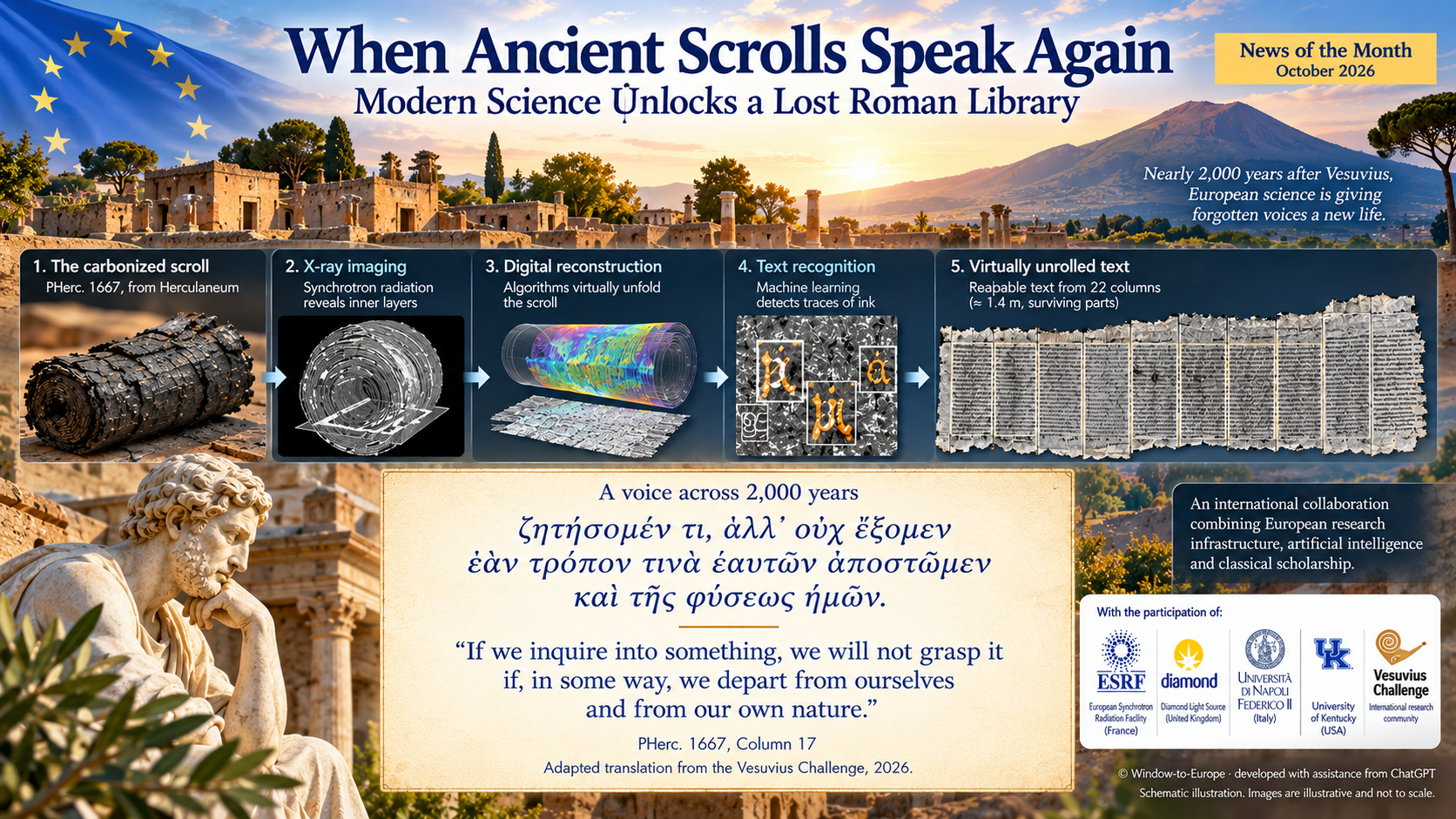
In June 2026, an international research team achieved a remarkable breakthrough: for the first time, the surviving portion of a carbonized Herculaneum scroll was virtually unrolled and read from beginning to end, without physically opening it.
The recovered writing surface extends over approximately 1.4 metres and contains parts of 22 columns of ancient Greek philosophy.
European research facilities, artificial intelligence and classical scholarship have opened a new window into a library that had remained silent for almost two millennia.
A Library Silenced by Vesuvius
When Mount Vesuvius erupted in AD 79, it buried the Roman town of Herculaneum. Among the treasures preserved beneath the volcanic deposits was a remarkable collection of papyrus scrolls in the Villa of the Papyri.
The scrolls survived, but at a terrible price. The heat had transformed them into fragile, blackened objects. Attempts to open them frequently destroyed the very words scholars hoped to recover.
For generations, much of the library remained silent.
Then, on 25 June 2026, researchers announced that the surviving core of one scroll, PHerc. 1667, had been virtually unrolled and read from beginning to end.
Although parts of the original manuscript had been lost through earlier attempts to open it, the achievement revealed a substantial philosophical text that had remained inaccessible for centuries.
When Physics Meets Philosophy
The breakthrough required an extraordinary combination of disciplines.
At the European Synchrotron Radiation Facility (ESRF) in Grenoble, France, high-resolution X-ray tomography revealed the tightly wound layers of carbonized papyrus.
Computer algorithms reconstructed their three-dimensional structure and virtually flattened the delicate sheets. Artificial intelligence helped identify traces of ink almost indistinguishable from the surrounding material.
Finally, specialists in ancient Greek interpreted the recovered writing.
The international Vesuvius Challenge brought together researchers from Europe and the United States, combining physics, computer science, mathematics and classical scholarship.
A Voice from the Ancient World
The recovered manuscript appears to be a work of Stoic philosophy, probably dating from the second century BC.
Its unknown author reflects on human nature, reason and the pursuit of wisdom.
One passage offers a thought that seems remarkably relevant even today.
A voice across 2,000 years
Ancient Greek – PHerc. 1667
… ζητήσομέν τι, ἀλλ’ οὐχ ἕξομεν ἐὰν τρόπον τινὰ ἑαυτῶν ἀποστῶμεν καὶ τῆς φύσεως ἡμῶν …
English – Adapted translation
“If we inquire into something, we will not grasp it if, in some way, we depart from ourselves and from our own nature.”
Adapted from the English translation published by the Vesuvius Challenge, June 2026.
The words seem especially moving in their new context. Nearly two thousand years after they disappeared from human view, scientists have recovered an ancient reflection on the very nature of understanding.
Modern science has not only restored a forgotten text. It has made possible a conversation across twenty centuries.
Hundreds of Voices Still Waiting
The achievement is only a beginning.
Hundreds of Herculaneum scrolls remain unopened. Some may contain works of philosophy, literature or history that have been lost since antiquity.
The techniques developed by the Vesuvius Challenge could eventually make many of them accessible without physical damage.
What makes this discovery so special is not simply the technological achievement. It is the encounter between two worlds: the intellectual curiosity of ancient Europe and the scientific ingenuity of our own time.
Almost 2,000 years after Vesuvius silenced a library, science is giving its authors a voice again.
Sources
- Vesuvius Challenge – An Entire Herculaneum Scroll Has Been Read for the First Time, 25 June 2026
- Angelotti et al. – Complete Virtual Unwrapping and Reading of a Rolled Herculaneum Papyrus, 2026
- ESRF – The Day the Herculaneum Scrolls Began Speaking Again, 25 June 2026
- Diamond Light Source – New Secrets Revealed from the Herculaneum Scrolls, 25 June 2026