
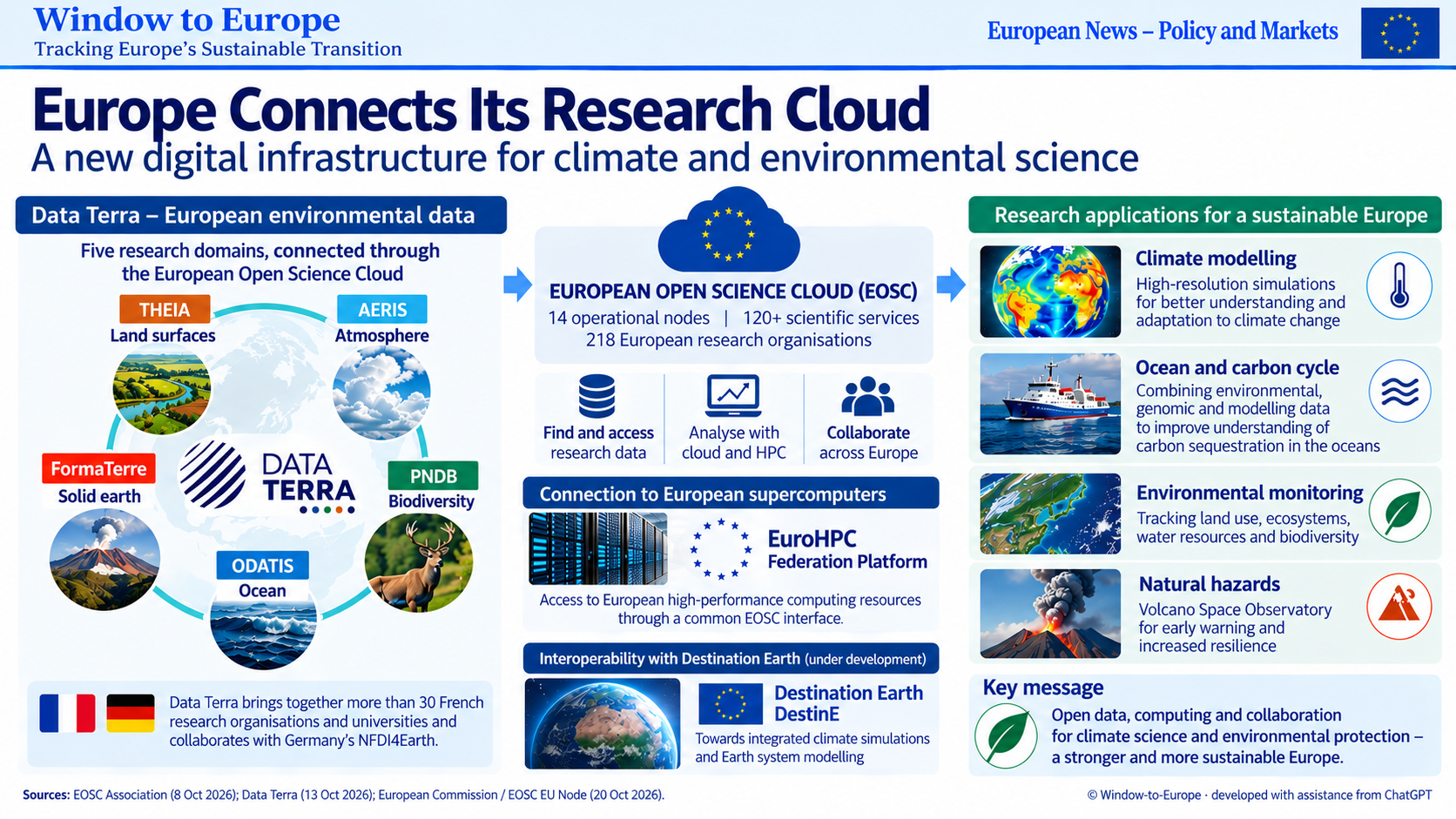
From prototype to operation: Europe’s Open Science Cloud connects environmental data, computing resources and scientific communities across national borders.
In brief
In October 2026, the European Open Science Cloud (EOSC) Federation entered its operational phase with 14 nodes and more than 120 scientific services. Among them is Data Terra, a French environmental research infrastructure working closely with Germany’s NFDI4Earth consortium. By connecting environmental observations, research datasets and computing resources across Europe, the Federation creates new opportunities for climate modelling, ocean research, biodiversity monitoring and other sustainability-related sciences.
From a European vision to an operational research infrastructure
On 8 October 2026, 13 new nodes joined the already operational EOSC EU Node, establishing a distributed infrastructure involving 218 European research organisations.
Rather than creating a single centralised cloud, EOSC connects existing national, thematic and computing infrastructures. Researchers can discover, access and reuse scientific data and services across institutional and national boundaries.
The Federation entered operation with more than 120 scientific services, marking a transition from demonstration to practical scientific use.
Source: EOSC Association – Federation moves into production, 8 October 2026
Climate and environmental research: the Data Terra example
A particularly relevant development for Europe’s sustainable transition is the EOSC Node Data Terra, which entered production in October 2026.
Data Terra brings together more than 30 French research organisations and universities and collaborates with Germany’s NFDI4Earth consortium, coordinated by TU Dresden.
It integrates five major environmental research domains: atmosphere (AERIS), oceans (ODATIS), land surfaces (THEIA), solid Earth (FormaTerre) and biodiversity (PNDB).
Through shared catalogues, authentication systems and analysis environments, these resources can support interdisciplinary research into the Earth’s climate and ecosystems.
Source: Data Terra – EOSC Node enters production, 13 October 2026
From environmental data to scientific applications
The infrastructure supports the development of cross-disciplinary scientific workflows.
Galaxy for Earth System Sciences enables reproducible analyses combining environmental datasets and computing resources. Another example, the Volcano Space Observatory, integrates satellite, atmospheric and geophysical observations to investigate volcanic activity and associated hazards.
The wider EOSC Federation is also developing applications that combine genomic, environmental and modelling data to improve understanding of carbon sequestration in the oceans.
These applications are at different stages of maturity. The infrastructure is operational, but not all cross-node workflows have reached routine scientific use.
Sources: Data Terra – Earth System and Environmental Sciences · EOSC Association – Federation moves into production
Connecting European supercomputers and climate simulations
At the EOSC Symposium in Florence, the European Commission presented the Florence Release of the EOSC EU Node on 20 October 2026.
An important technical achievement is its operational connection to the EuroHPC Federation Platform. Researchers can now discover and access their allocated European high-performance computing resources through a common interface.
Further interoperability is being developed with Destination Earth, Europe’s programme for high-resolution digital simulations of the Earth system and climate change.
This connection could eventually make advanced climate modelling resources more readily accessible to researchers across Europe. However, the integration with Destination Earth is still being developed.
Source: EOSC EU Node – Florence Release, 20 October 2026
Why this matters for Europe’s sustainable future
Understanding climate change and developing effective responses increasingly require the integration of enormous quantities of environmental data, advanced computing and expertise from different scientific disciplines.
EOSC provides an important foundation for this cooperation. It can facilitate access to environmental information, support reproducible scientific analyses and strengthen collaboration across national borders.
The cooperation between French Data Terra and German NFDI4Earth illustrates how European research organisations can combine their capabilities while retaining their established infrastructures.
The transition from prototype to production in October 2026 is therefore more than an IT milestone. It represents a tangible step towards a shared European research environment supporting climate science, environmental protection and evidence-based approaches to sustainability.