
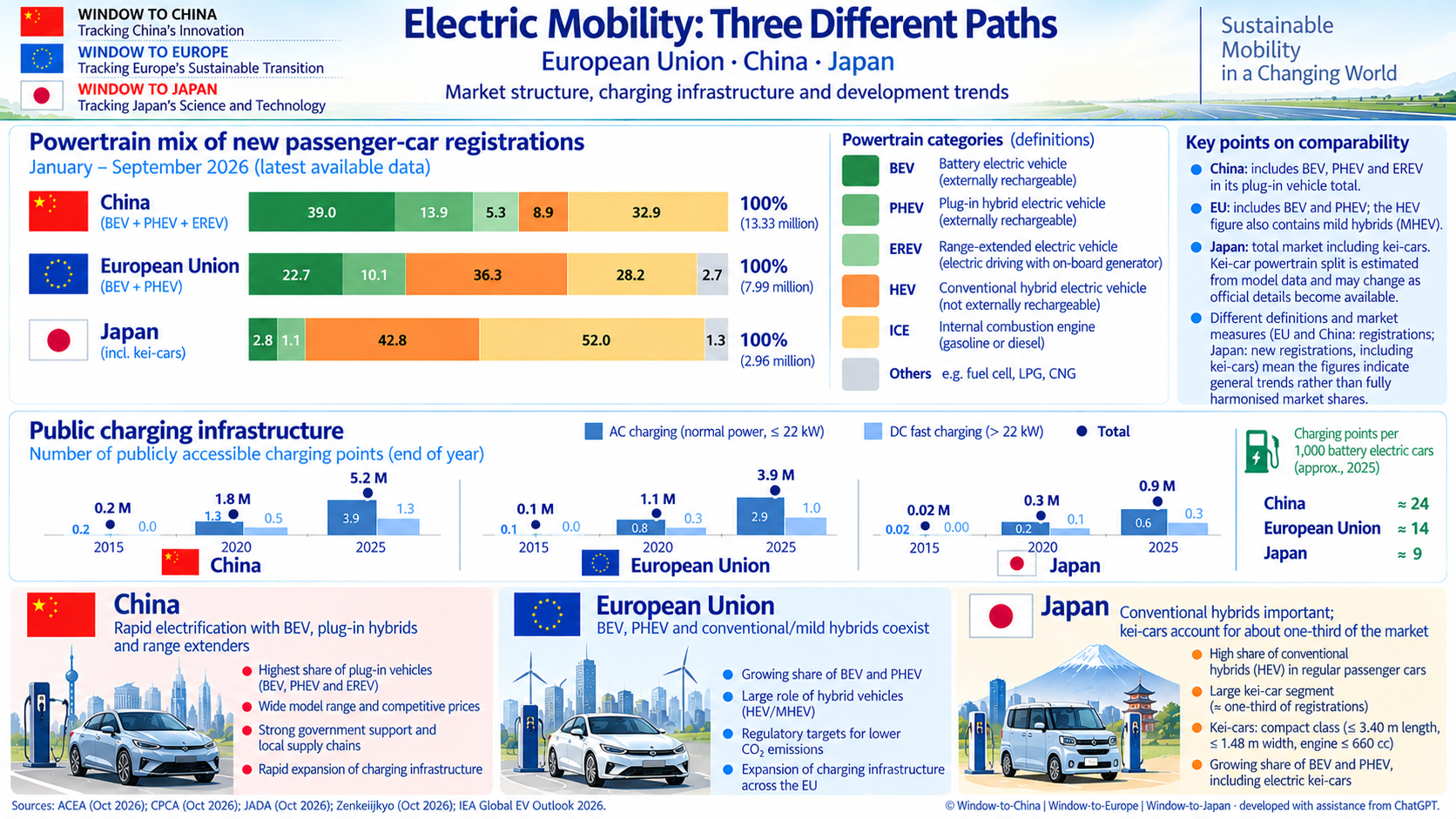
How three major automotive markets are transforming passenger-car technology — from battery-electric vehicles and plug-in hybrids to Japan’s distinctive kei-cars.
In brief
China, the European Union and Japan are pursuing different paths towards the electrification of passenger cars. China has rapidly expanded battery-electric vehicles (BEVs) and plug-in hybrids, including range-extended electric vehicles (EREVs). Europe combines growing BEV sales with plug-in hybrids and conventional hybrid technology. Japan continues to rely strongly on non-plug-in hybrids, while its distinctive market for compact kei-cars adds another dimension to the transition.
Registration data for January–September 2026 highlight these differences. The share of externally rechargeable passenger cars — BEVs and plug-in hybrids, including EREVs — reached approximately 58% in China and 33% in the European Union. Japan’s corresponding share remains much smaller, although an exact comparison requires the inclusion of its kei-car market.
The differences extend beyond vehicle technology. Charging infrastructure, industrial supply chains, public policy and consumer preferences are shaping three distinct approaches to electric mobility.
China: Rapid expansion of battery-electric and plug-in vehicles
China has developed the world’s largest market for electrically rechargeable passenger cars. Battery-electric vehicles are increasingly complemented by plug-in hybrids and range-extended electric vehicles.
EREVs use an electric drivetrain, with a combustion engine serving primarily as an onboard generator. They offer electric driving while reducing dependence on external charging during longer journeys.
Chinese manufacturers have expanded their model ranges across different price segments. Large-scale domestic battery production, competition among manufacturers and extensive charging infrastructure have supported this development.
According to passenger-car retail statistics from the China Passenger Car Association (CPCA), BEVs, PHEVs and EREVs together accounted for approximately 58% of the Chinese passenger-car market during January–September 2026.
The rapid transition also reflects China’s industrial strategy. Electric mobility has become an important field for domestic technology development, manufacturing and international competitiveness.
Source: China Automobile Dealers Association / CPCA – Passenger-car market statistics.
European Union: Several technologies coexist
The European Union is following a more diversified transition. Battery-electric vehicles are gaining market share, supported by CO₂ emission regulations, charging infrastructure investments and an expanding range of available models.
Plug-in hybrids remain an important option, particularly for drivers seeking both electric operation and the flexibility of a combustion engine.
At the same time, conventional hybrids and mild hybrids account for a substantial proportion of new registrations. Unlike BEVs and PHEVs, these vehicles cannot be recharged directly from the electricity grid.
During January–September 2026, BEVs represented approximately 22.7% and PHEVs 10.1% of new EU passenger-car registrations. Hybrid-electric vehicles, including mild hybrids, accounted for approximately 36.3%.
This broad technology mix reflects differences among European countries in purchasing power, charging infrastructure, vehicle use and national incentives.
For Europe’s automotive industry, the transition involves not only changing vehicle technologies but also adapting manufacturing capacity, battery supply chains and employment structures.
Source: European Automobile Manufacturers‘ Association (ACEA) – Vehicle registration statistics.
Japan: Conventional hybrids and the importance of kei-cars
Japan’s electrification strategy differs substantially from those of China and Europe.
Japanese manufacturers pioneered the large-scale commercialization of hybrid-electric vehicles, combining combustion engines with electric motors and batteries. This technology remains highly successful in the domestic market.
Among regular passenger cars registered in Japan during January–September 2026, conventional hybrids accounted for approximately 61% of registrations, while BEVs and PHEVs represented much smaller shares.
However, Japan’s vehicle market has an important characteristic that must be considered in international comparisons: kei-cars.
Kei-cars (kei jidōsha, 軽自動車) are a legally defined class of compact Japanese vehicles. Their dimensions are limited to 3.40 m in length, 1.48 m in width and 2.00 m in height, while combustion engines may have a displacement of no more than 660 cm³.
These vehicles benefit from specific tax and regulatory arrangements and are particularly popular for everyday mobility. Despite their small exterior dimensions, many offer surprisingly spacious interiors.
Kei-cars account for approximately one-third of Japanese passenger-car registrations. They include gasoline-powered, hybrid-assisted and battery-electric models, such as the Nissan Sakura.
Because detailed powertrain statistics for kei-cars are not fully harmonized with those for regular passenger cars, the overall Japanese powertrain mix cannot simply be inferred from regular-car registrations.
Japan’s approach therefore combines the continued importance of conventional hybrid technology with a substantial compact-vehicle market and a more gradual introduction of externally rechargeable vehicles.
Sources: Japan Automobile Dealers Association (JADA); Japan Light Motor Vehicle and Motorcycle Association (Zenkeijikyo).
Charging infrastructure: A second dimension of electrification
Vehicle sales alone do not fully describe the transition towards electric mobility. The availability of charging infrastructure is another essential factor.
China has invested heavily in publicly accessible charging facilities, including fast-charging networks. This infrastructure supports the rapidly expanding population of BEVs and plug-in hybrids.
The European Union has also significantly expanded its public charging network. However, charging-point availability varies considerably among member states, reflecting differences in market development and infrastructure investment.
Japan’s public charging network has developed more gradually, consistent with the country’s comparatively low share of externally rechargeable vehicles. The continuing importance of conventional hybrids also reduces immediate demand for public charging.
For historical comparisons, the years 2015, 2020 and 2025 provide useful reference points. They illustrate the expansion of charging infrastructure over the decade in which electric vehicles moved from a relatively small market segment towards broader commercial adoption.
A methodological distinction is important: publicly accessible charging points are not equivalent to charging stations, which may contain several individual connectors. Charging power, availability and the distinction between public and private charging must also be considered.
Source: International Energy Agency – Global EV Outlook 2026.
Three approaches to a common transformation
The three regions illustrate how the transition towards lower-emission mobility can follow different technological and industrial pathways.
China has prioritized the rapid expansion of externally rechargeable vehicles and their associated manufacturing and charging infrastructure.
The European Union is combining electrification with a broad range of vehicle technologies, while adapting its automotive industry to increasingly stringent environmental requirements.
Japan continues to build on its extensive experience with hybrid technology and its distinctive compact-car market, while gradually expanding battery-electric mobility.
These differences should not be interpreted as a simple ranking. Battery-electric vehicles, plug-in hybrids and conventional hybrids differ in their dependence on charging infrastructure, electricity supply, fuel consumption and vehicle use.
Their environmental performance also depends on electricity generation, manufacturing emissions and the complete vehicle life cycle.
The comparison demonstrates that electric mobility is not developing along a single global pathway. China, Europe and Japan are transforming their automotive industries at different speeds and with different technological priorities.
Notes on statistical comparability
The 2026 market figures refer to January–September and are based on the respective regional industry statistics. The EU data concern new registrations, while Chinese figures are based on passenger-car retail sales.
China reports range-extended electric vehicles separately within its externally rechargeable vehicle market. European hybrid-electric statistics include mild hybrids. Japan’s regular passenger-car statistics do not cover kei-cars, which represent approximately one-third of the country’s passenger-car market.
Consequently, the figures illustrate broad structural differences rather than a fully harmonized international ranking of every powertrain category.
Sources: ACEA; CPCA/CADA; JADA; Zenkeijikyo; International Energy Agency, Global EV Outlook 2026.