
European News | Transport | 23 October 2026
Battery-electric cars reach 22.7% of EU registrations. Charging infrastructure expands, lifecycle emissions fall, and European manufacturers adapt to growing international competition.
In brief
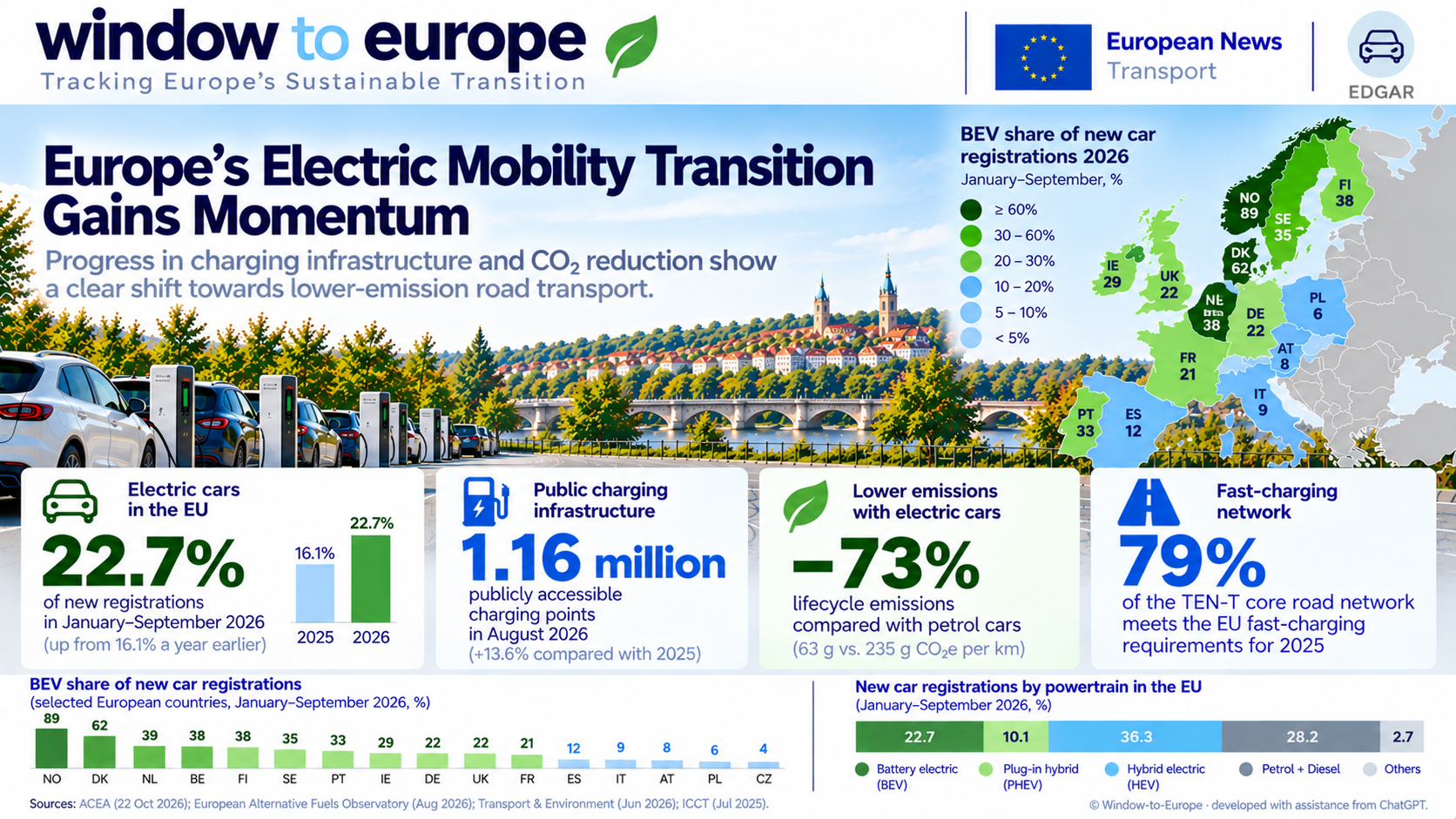
Europe’s transition to electric mobility is accelerating. In the first nine months of 2026, almost 1.93 million battery-electric passenger cars were newly registered in the European Union, representing 22.7% of the market, compared with 16.1% a year earlier. Public charging infrastructure has expanded to approximately 1.16 million charging points, while lifecycle assessments indicate that electric cars can reduce greenhouse gas emissions by more than 70% compared with conventional petrol vehicles.
European manufacturers remain important participants in this transformation. However, increasing competition from Chinese producers and changing international supply chains make the transition both an environmental and an industrial challenge.
Source: ACEA – New car registrations, 22 October 2026
Electric cars move further into the mainstream
According to the European Automobile Manufacturers‘ Association (ACEA), 1,931,465 battery-electric cars were registered in the EU between January and September 2026, an increase of 48.5% compared with the previous year.
Growth was particularly strong in France (+79.1%) and Germany (+58.1%). Battery-electric vehicles have now overtaken petrol cars in EU new registrations, although conventional hybrids remain the largest powertrain category.
The market shares for January–September 2026 were:
- Battery-electric vehicles (BEV): 22.7%
- Plug-in hybrids (PHEV): 10.1%
- Conventional and mild hybrids: 36.3%
- Petrol and diesel combined: 28.2%
The figures describe new registrations rather than the existing vehicle fleet. Since conventional combustion-engine cars remain dominant in the overall fleet, the transition will take many years.
Source: ACEA – September 2026 registration statistics
Europe’s charging infrastructure is expanding
The European Alternative Fuels Observatory (EAFO) reported 1,159,838 publicly accessible charging points in the EU in August 2026, representing an increase of 13.6% compared with August 2025.
Charging capacity is also increasing. By June 2026, the EU’s public charging network had reached 41.6 GW, approximately 29% more than a year earlier.
Along the Trans-European Transport Network (TEN-T), 79% of the core road network met the EU’s relevant fast-charging requirements for 2025 by June 2026. Western Europe had achieved more than 99% coverage, while gaps remained particularly in parts of Southern, Central and Eastern Europe.
The distribution of infrastructure remains uneven. Nevertheless, the figures show that charging networks are developing beyond pilot installations into a substantial European transport infrastructure.
Sources: EAFO – September 2026 data update · ACEA – Charging infrastructure report, September 2026 · Transport & Environment – European charging infrastructure
What does this mean for CO₂ emissions?
The climate benefits of electric mobility extend beyond the elimination of exhaust emissions.
A lifecycle assessment published by the International Council on Clean Transportation (ICCT) in July 2025 compared the greenhouse gas emissions of passenger cars sold in the EU, including vehicle and battery manufacturing, energy production, operation, maintenance and recycling.
The study estimated average lifecycle emissions of 63 g CO₂-equivalent per kilometre for battery-electric cars, compared with 235 g for petrol vehicles. The electric-car estimate assumes the projected average EU electricity mix over the vehicles‘ lifetime.
This corresponds to a reduction of approximately 73%.
At an assumed annual driving distance of 12,000 km, the difference represents approximately 2.1 tonnes of CO₂-equivalent per vehicle on an annualised lifecycle basis.
Applied hypothetically to the 1.93 million BEVs newly registered during January–September 2026, the corresponding reduction potential would amount to approximately four million tonnes of CO₂-equivalent per full year of vehicle use.
This is an illustrative calculation, not a measurement of emissions already avoided in 2026. Actual reductions depend on driving distances, vehicle replacement patterns, electricity generation and the development of the existing vehicle fleet.
Source: ICCT – Life-cycle greenhouse gas emissions from passenger cars in the EU, July 2025
European manufacturers: strong industrial base, growing competition
The electric mobility transition is also transforming Europe’s automotive industry.
According to the International Energy Agency (IEA), production of electric passenger cars in the EU increased by approximately 30% in 2025 to nearly 3.2 million vehicles, including battery-electric and plug-in hybrid cars. The EU remained the world’s second-largest electric-car production region.
European manufacturers continued to account for the majority of this production. The remaining share, less than 20%, was largely attributable to manufacturers headquartered outside Europe, including Chinese-owned Volvo Cars and American manufacturers such as Tesla and Ford.
The EU also remained a net exporter of electric cars, with exports exceeding one million vehicles in 2025.
On the European market, established manufacturers remain prominent. In January 2026, Volkswagen Group accounted for approximately 26% of electric-car registrations, followed by Stellantis with around 10% and BMW Group with approximately 9%. These are early-2026 figures for the broader European market, not full-year EU market shares.
The European transition is therefore supported by an established industrial base, although manufacturers differ substantially in their pace of electrification.
Sources: IEA – Global EV Outlook 2026: Manufacturing and trade · EAFO – European EV market starts 2026
Imports from China: European brands are part of the picture
The relationship between vehicle production and manufacturer nationality is becoming increasingly complex.
According to an analysis published by Transport & Environment in July 2026, Chinese-made vehicles accounted for 17% of battery-electric car sales in the EU during the first quarter of 2026, down from a peak of 22% in 2024.
These imports were not exclusively vehicles from Chinese manufacturers.
European manufacturer groups accounted for approximately 23% of battery-electric imports from China in the first quarter of 2026, compared with 38% in 2024. Tesla’s share of these imports also declined, from 26% to 19%.
The shift is consistent with increasing localisation of electric-car production in Europe, although changes in market shares and model availability may also contribute.
At the same time, Chinese manufacturers have expanded their share of Chinese-made electric vehicles sold in Europe. The IEA reports that the proportion of Chinese brands among electric-car imports from China increased from approximately 50% in 2023 to more than 70% in 2025, using its broader electric-car definition.
These developments illustrate two parallel trends: European and international manufacturers are increasingly producing electric vehicles within Europe, while Chinese manufacturers are strengthening their position in the European market.
The distinction is important. A vehicle sold under a European brand is not necessarily manufactured in Europe, and a vehicle manufactured in Europe is not necessarily produced by a European-owned company.
Sources: Transport & Environment – The presence of Chinese automakers in the EU car market, July 2026 · IEA – Manufacturing and trade · ACEA – EU-China vehicle trade, May 2026
Europe’s transition in an international context
China has progressed considerably further in electrifying its domestic new-car market and has become the world’s largest electric-vehicle manufacturing centre.
Europe occupies an intermediate position: electric-car registrations are growing rapidly, charging infrastructure is expanding, and established automotive manufacturers are adapting their production.
Japan, by contrast, continues to rely much more heavily on conventional hybrid technology, with a comparatively small battery-electric share of its domestic passenger-car market.
These differences reflect distinct industrial structures, consumer markets and technological strategies. They also illustrate why the electrification of road transport is becoming an important factor in international automotive competition.
Source: IEA – Global EV Outlook 2026
A measurable step towards sustainable transport
Europe’s electric mobility transition is progressing beyond research programmes and policy announcements.
Millions of electric cars are entering the market, charging infrastructure is expanding, and the industrial production base is adapting. Lifecycle assessments indicate substantial potential for reducing greenhouse gas emissions.
Nevertheless, the transition remains incomplete. Regional infrastructure gaps, charging costs, access to affordable electric vehicles and international competition remain important challenges.
The latest figures demonstrate that Europe’s transport transformation is underway — with measurable environmental benefits and significant implications for its automotive industry.