
An EU-funded consortium is developing integrated recycling technologies for neodymium-iron-boron permanent magnets, aiming to strengthen Europe’s circular economy and reduce dependence on imported critical raw materials.
In brief
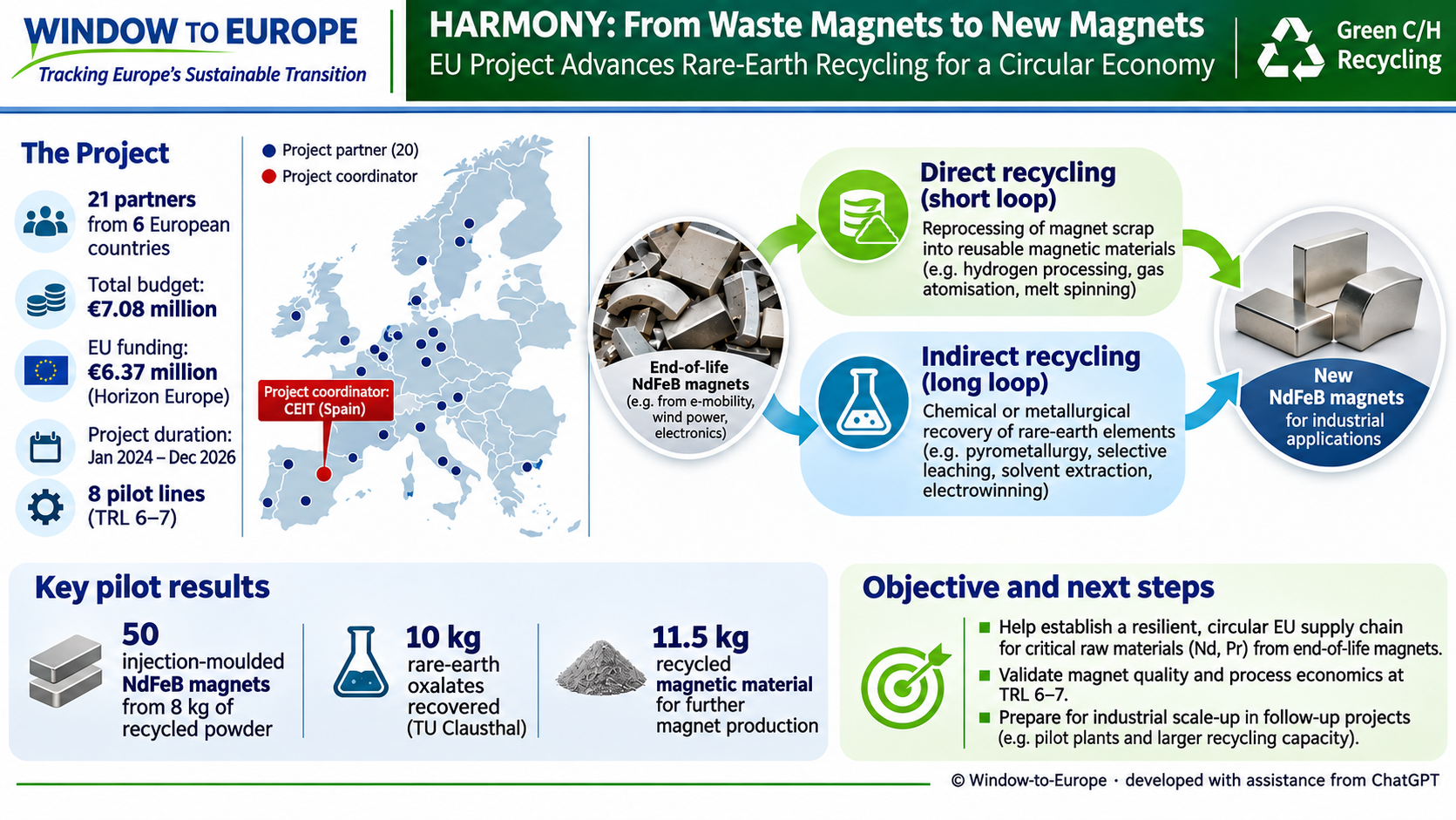
The European HARMONY project has demonstrated several pilot-scale technologies for recovering rare-earth elements and manufacturing new magnets from recycled materials. Eight pilot lines cover different stages of the recycling chain, from processing discarded magnets to producing materials for industrial applications. HARMONY – Project results
Closing the loop for permanent magnets
Neodymium-iron-boron (NdFeB) magnets are essential components of electric vehicles, wind turbines, industrial motors and numerous electronic devices. Their production relies on critical raw materials, including neodymium and praseodymium, whose supply chains are heavily concentrated in China.
The EU-funded HARMONY project (2024–2026), coordinated by the Spanish technology centre CEIT, brings together research institutions, recycling specialists and industrial manufacturers to develop an integrated European recycling value chain.
Rather than relying on a single recycling technology, HARMONY investigates complementary processes adapted to different waste streams and magnet qualities.
Source: European Commission – CORDIS, HARMONY Project 101138767
Two routes to recover valuable materials
The project combines two principal approaches:
Direct recycling (short loop): Used magnets are processed into reusable magnetic materials without completely separating their constituent elements. Technologies include hydrogen processing of magnet scrap (HPMS), gas atomisation and melt spinning. This approach can preserve more of the material’s original value while reducing processing requirements.
Indirect recycling (long loop): Magnets are chemically or metallurgically processed to recover individual rare-earth elements. Technologies include pyrometallurgy, selective leaching, solvent extraction and electrowinning. These routes are particularly relevant for heterogeneous or contaminated waste streams.
Eight pilot lines cover different stages of these processes, with the objective of demonstrating technologies at readiness levels TRL 6–7.
Source: HARMONY – Final Event at MMA26, recycling technologies and pilot lines
First magnets produced from recycled materials
HARMONY has already reported several concrete achievements:
- 50 injection-moulded NdFeB magnets were produced by Kolektor Mobility in Slovenia from 8 kg of recycled powder supplied by the University of Birmingham. Following quality checks and magnetic field mapping, the magnets were delivered to COPRECI in Spain for integration into a demonstrator.
- 10 kg of rare-earth oxalates were recovered through continuous hydrometallurgical processing at TU Clausthal in Germany.
- 11.5 kg of recycled magnetic material were prepared by the University of Birmingham for further magnet manufacturing.
- The first overmoulded rotors were manufactured for hydraulic-pump prototypes.
These achievements demonstrate progress towards recycling magnets into functional industrial components, although large-scale commercial production has not yet been established.
Sources: HARMONY – Injection-moulded magnets reach key milestone | HARMONY – Results across eight pilot lines
European cooperation and industrial prospects
HARMONY brings together 21 partners from six European countries, including universities, research institutes, recycling companies and magnet manufacturers.
The project has a total budget of approximately €7.08 million, including €6.37 million from the EU’s Horizon Europe programme.
Source: European Commission – CORDIS, project funding and participants
HARMONY held its final project event at the Magnetic Materials and Applications 2026 conference in Grenoble, France, on 27–29 October 2026. The programme provided opportunities to present recycling technologies, magnet samples and industrial applications.
Source: HARMONY – Final Event at MMA26
By integrating material recovery with magnet production and industrial validation, HARMONY contributes to Europe’s efforts to establish a more resilient supply chain for critical raw materials.
The next challenge will be to demonstrate consistent magnet performance, economically viable recycling processes and sufficient collection of end-of-life products to support commercial-scale operations.