
How China combines photovoltaics, concentrated solar power and thermal storage – and how Europe and other regions are developing complementary technologies for reliable renewable electricity.
In brief
China is rapidly expanding large hybrid solar power plants combining photovoltaics (PV), concentrated solar power (CSP) and molten-salt thermal storage. A new 1 GW installation in Fukang, Xinjiang, connected to the grid on 30 October 2026, illustrates this development.
The technological significance lies in combining different forms of solar energy conversion. Photovoltaics generate electricity directly, while concentrated solar power produces high-temperature heat that can be stored and converted into electricity when needed.
A further development allows surplus photovoltaic electricity to be converted into heat and stored in molten salt, connecting the two technologies more closely.
Europe has contributed pioneering CSP technologies, particularly through research and engineering in Spain and Germany. Morocco, a major European energy partner, is increasingly developing photovoltaic plants with battery storage. China also deploys battery storage on a large scale.
International projects in Dubai, Chile and South Africa demonstrate additional approaches to solar thermal generation and long-duration energy storage.
1. China: From solar power plants to integrated energy systems
Xinjiang: Large-scale integration of photovoltaics and solar thermal power
On 30 October 2026, the Luneng Fukang solar thermal power project in Xinjiang was connected to the electricity grid.
According to Xinhua, it is the sixth molten-salt solar tower power plant commissioned in the region.
The project combines:
- 900 MW of photovoltaics, converting sunlight directly into electricity.
- 100 MW of concentrated solar power, using heliostats to concentrate sunlight onto a receiver at the top of a solar tower.
- Molten-salt thermal storage, allowing collected heat to be used for electricity generation after sunset.
The CSP component is expected to generate approximately 120 GWh of electricity annually, with projected CO₂ emission reductions of around 140,000 tonnes per year.
Source: Xinhua, 1 November 2026.
Similar combinations of large photovoltaic fields and CSP installations have been developed at other locations in Xinjiang, including Hami and Bortala.
Several projects use configurations combining approximately 900 MW of photovoltaics with 100 MW of CSP and around eight hours of thermal storage.
The six commissioned solar towers reported for Xinjiang should not, however, be interpreted as six identical PV-CSP hybrid plants.
The repeated use of comparable technical configurations illustrates increasing standardisation in heliostat systems, receivers, molten-salt circuits, steam turbines and plant control.
Source: SolarPACES – CSP projects in China.
Qinghai: Photovoltaic electricity can also charge thermal storage
An important additional development has been demonstrated in Qinghai province.
On 1 October 2026, PowerChina connected a 1 GW hybrid solar project in Gonghe County to the grid.
The installation combines:
- 900 MW of photovoltaic capacity
- 100 MW of CSP
- Eight hours of molten-salt thermal storage
- A 20 MW electric heating system
The electric heater can convert surplus photovoltaic electricity into heat, which is subsequently stored in molten salt.
This creates a direct technological connection between photovoltaic electricity generation and the thermal storage system.
In conventional CSP plants, the heat stored in molten salt originates from concentrated sunlight. With electric heating, surplus electricity from photovoltaics or other renewable sources can also contribute to the stored thermal energy.
The stored heat can later be converted into electricity through the CSP plant’s steam turbine.
This power-to-heat approach may reduce renewable electricity curtailment and increase the flexibility of large solar power parks.
Sources: SolarPACES, 5 October 2026; pv magazine, 9 October 2026.
China is also expanding photovoltaic battery storage
Concentrated solar power is only one element of China’s renewable energy storage strategy.
Large battery energy storage systems (BESS), particularly lithium iron phosphate batteries, are increasingly being integrated into photovoltaic and wind power projects.
An example is the 500 MW CECEP photovoltaic project in Xinjiang, which incorporates a 75 MW / 150 MWh battery storage system.
The project reached full-capacity grid connection in January 2026.
Battery storage provides functions that differ from those of CSP:
- Rapid response to changing grid conditions
- Short- and medium-duration electricity storage
- Frequency regulation and grid stabilisation
- Integration of variable photovoltaic and wind generation
China is therefore developing both thermal and electrochemical energy storage, with different technologies serving complementary functions.
Source: CECEP Solar, 22 January 2026.
2. Europe: Pioneering solar thermal technologies
Europe has played a major role in the development of modern concentrated solar power.
Spain operates approximately 2.3 GW of CSP capacity, representing one of the world’s largest established fleets.
European research institutions and engineering companies have contributed to advances in parabolic-trough collectors, heliostats, receivers, high-temperature materials, thermal storage and power plant integration.
The German Aerospace Center (DLR) has been particularly active in solar thermal research and testing.
European engineering expertise has also contributed to projects outside Europe.
One example is the Stellio heliostat technology developed by the German engineering company sbp sonne and industrialised in cooperation with Chinese partners.
Such collaborations demonstrate the international transfer of solar thermal engineering expertise.
Source: European Commission, Joint Research Centre – Solar Thermal Energy in the EU, 2025.
Spain: Combining CSP and photovoltaics
The Spanish engineering company Sener developed Solgest-1, a proposed hybrid solar power plant near Seville.
The design combined:
- 110 MW of CSP generating capacity
- 40 MWp of photovoltaics
- More than six hours of thermal storage
The photovoltaic installation was intended to supply electricity directly to the grid and partly cover the CSP plant’s auxiliary electricity demand.
The CSP system would provide additional electricity generation during periods of reduced sunlight.
Although the project did not proceed to construction, its engineering concept illustrates the potential for integrating solar thermal and photovoltaic technologies.
The Spanish authorities rejected its final authorisation in May 2025 after the required grid access and connection permits had expired.
Sources: Sener – Solgest-1; Spanish Official State Gazette, 16 June 2025.
Morocco: European cooperation and alternative storage technologies
Morocco has developed one of the world’s most important CSP complexes at Ouarzazate.
The Noor programme has received substantial international financial support, including contributions from European development institutions.
The Noor III solar tower plant has a capacity of 150 MW and incorporates more than seven hours of molten-salt thermal storage.
The project demonstrates large-scale thermal storage technology, while its operating experience also illustrates the importance of reliable high-temperature components and storage systems.
Source: Moroccan Ministry of Energy – Noor Ouarzazate III.
More recent Moroccan projects increasingly use photovoltaic generation combined with battery energy storage.
The Noor Midelt II and III projects, awarded to ACWA Power in 2025, each combine approximately 400 MW of photovoltaics with 602 MWh of battery storage.
Germany’s KfW Development Bank also supports the wider Noor Midelt solar programme, including photovoltaic generation and battery storage.
These installations demonstrate an alternative technological approach:
- Photovoltaics generate electricity directly.
- Batteries store electricity electrochemically.
- Power electronics control electricity delivery to the grid.
Sources: pv magazine – Noor Midelt II and III, 6 August 2025; KfW Development Bank – Noor Midelt.
Morocco and Spain: Existing electricity interconnections
Morocco and Spain are connected through two high-voltage electricity interconnections, each with a nominal capacity of 700 MW.
These connections enable electricity exchanges between the Moroccan and European power systems.
The existing infrastructure allows electricity transmission in both directions, although this does not establish that electricity from particular Moroccan solar plants is already being exported to Spain.
A third interconnection is under development.
The existing links provide an important technological foundation for future cross-border renewable electricity integration.
Source: Med-TSO – Rules Applied to Interconnections Between EU and Extra-EU Countries, 2025.
3. View from the USA and Other Regions
Several countries outside China and Europe have developed large CSP installations, including hybrid systems combining concentrated solar power and photovoltaics.
United Arab Emirates: Noor Energy 1
Dubai’s Noor Energy 1 project combines 700 MW of CSP with 250 MW of photovoltaics.
The CSP component includes 600 MW of parabolic-trough technology and a 100 MW solar tower.
Thermal storage provides up to approximately 15 hours of energy storage.
The project reached full commercial operation in 2024 and represents one of the world’s largest operational examples of CSP-PV integration.
It also demonstrates extensive international cooperation involving companies and investors from the United Arab Emirates, Saudi Arabia, China and Europe.
Source: Dubai Electricity and Water Authority, September 2026.
Chile: Cerro Dominador
The Cerro Dominador project in Chile’s Atacama Desert combines a 110 MW solar tower plant with a 100 MW photovoltaic installation.
Its molten-salt thermal storage system was designed for approximately 17.5 hours of full-load electricity generation.
The project demonstrates the potential for extended solar thermal storage in regions with exceptionally high direct solar irradiation.
Its operating experience also highlights the importance of reliability and maintenance in large CSP systems.
Source: ACCIONA – Cerro Dominador CSP Plant.
South Africa: Redstone
The Redstone solar thermal power project in South Africa’s Northern Cape has a generating capacity of 100 MW.
It incorporates molten-salt storage designed for approximately 12 hours of full-load electricity generation.
Unlike the Chinese PV-CSP hybrid installations, Redstone is primarily a stand-alone CSP power plant.
It demonstrates the use of long-duration thermal storage to extend renewable electricity generation beyond daylight hours.
Source: Redstone CSP – South African Institute of Steel Construction.
United States: Early CSP development
The United States was among the pioneers of commercial concentrated solar power.
The 280 MW Solana Generating Station in Arizona, commissioned in 2013, incorporates approximately six hours of thermal energy storage.
American research also continues to address advanced solar receivers, high-temperature storage media and next-generation power cycles.
These technologies may contribute not only to electricity generation but also to industrial applications requiring high-temperature process heat.
Source: SolarPACES/NLR – International CSP Project Database.
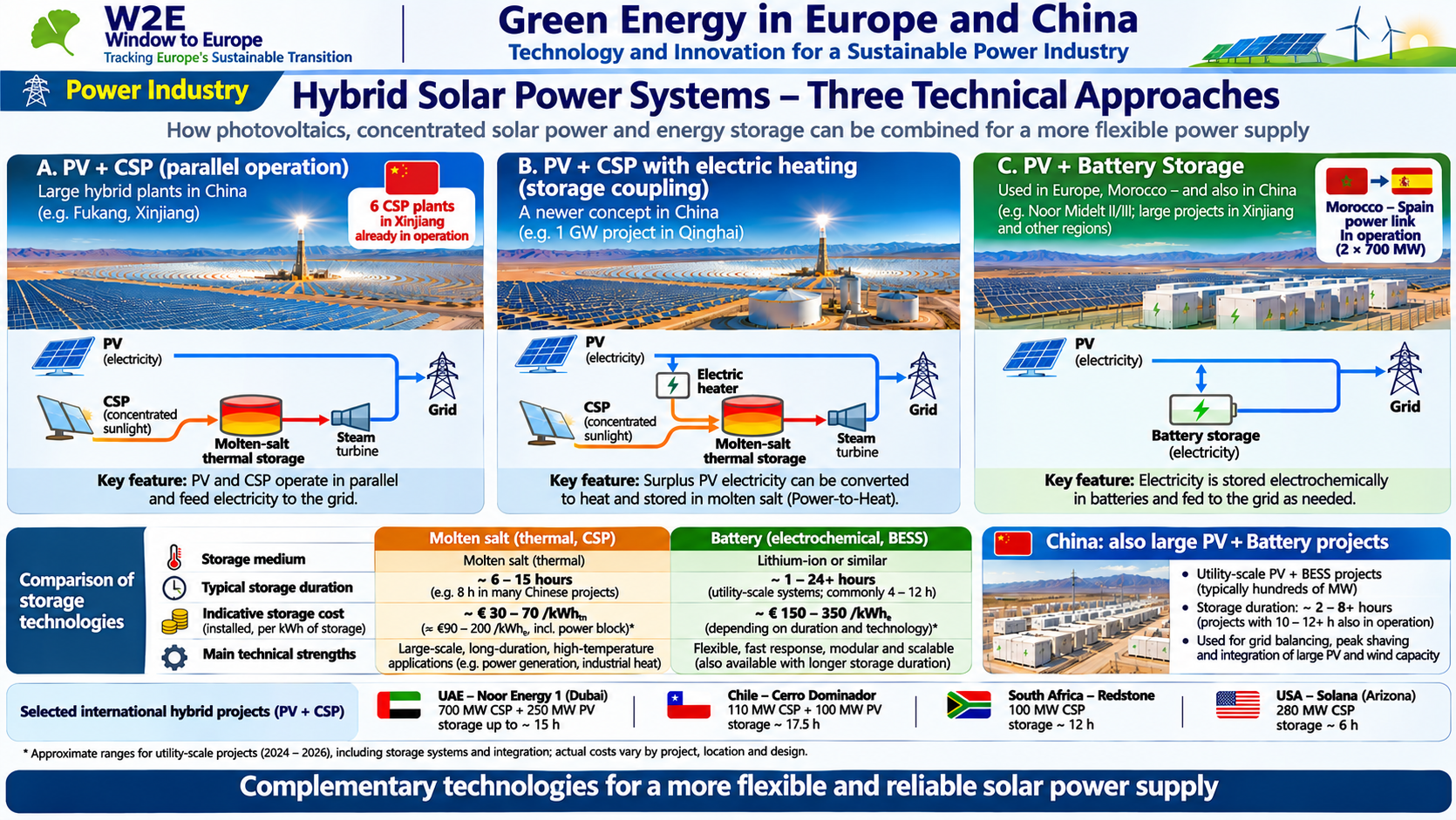
4. Three technical approaches to integrated solar power
The international examples illustrate three principal configurations.
A. Photovoltaics and CSP operating in parallel
Photovoltaic modules generate electricity directly, while the CSP installation collects solar heat and stores it in molten salt.
Both systems supply electricity to the grid, but the photovoltaic electricity does not necessarily charge the thermal storage system.
This configuration is used in several large Chinese hybrid solar parks.
B. Photovoltaics and CSP with electrically coupled thermal storage
In this configuration, surplus photovoltaic electricity can be converted into heat using electric heaters.
The heat is stored in molten salt and subsequently converted back into electricity through a steam turbine.
This approach is demonstrated by the new Gonghe hybrid project in Qinghai.
It provides an additional pathway for integrating variable renewable electricity into thermal storage systems.
C. Photovoltaics with battery energy storage
Photovoltaic electricity is stored electrochemically and subsequently delivered to the grid through power electronics.
Battery systems provide rapid response and can be configured for different storage durations.
This approach is increasingly used in China, Europe, Morocco and other regions.
Comparing the storage technologies
| Characteristic | Molten-salt thermal storage | Battery energy storage |
|---|---|---|
| Storage medium | High-temperature molten salt | Lithium-ion or other electrochemical systems |
| Stored energy | Heat | Electricity |
| Typical discharge duration | Approximately 6–15 hours in many CSP projects | Commonly 2–8 hours in grid-scale projects; longer-duration systems are possible |
| Electricity conversion | Thermal energy drives a turbine | Electricity supplied through power electronics |
| Technical strengths | Long-duration storage, high-temperature applications, integration with thermal power cycles | Rapid response, modular construction, high electrical round-trip efficiency |
| Main technical challenges | Heat losses, high-temperature materials, thermal cycling, turbine operation | Degradation, thermal management, materials supply and recycling |
Storage duration is a design parameter rather than a fixed technological limit.
Molten-salt systems can exceed 15 hours, as demonstrated by Cerro Dominador’s design, while battery systems can also be engineered for durations beyond eight or twelve hours.
The two technologies therefore overlap in their potential applications but differ in their energy conversion processes and operating characteristics.
5. Outlook: Towards integrated renewable electricity systems
China’s expansion of large PV-CSP hybrid plants demonstrates a transition from individual renewable energy technologies towards integrated electricity generation and storage systems.
The combination of photovoltaics, concentrated solar power and molten-salt storage allows solar electricity and solar heat to contribute complementary functions.
Electrically heated molten-salt storage provides an additional technological connection between photovoltaic generation and thermal storage.
At the same time, China is expanding electrochemical battery storage, while Europe and Morocco are developing complementary approaches to renewable electricity integration.
International experience from Dubai, Chile, South Africa and the United States demonstrates the technological potential of long-duration thermal storage.
Future developments will depend on improvements in heliostat manufacturing, receiver technology, high-temperature materials, thermal storage systems, battery technology and integrated plant control.
Economic considerations will ultimately influence the deployment of these technologies. CSP systems require substantial initial investment, while photovoltaics and batteries have benefited from rapid manufacturing expansion and declining costs. Industrial standardisation, operating experience and large-scale deployment may improve the competitiveness of CSP-based hybrid systems. China’s investment and industrial framework can support such scaling, particularly during the early stages of technology deployment. The long-term balance between thermal and electrochemical storage will depend on technological progress, reliability, storage duration and the value of electricity delivered when needed.
The technological objective is clear: transforming variable solar energy into a flexible and reliable component of future electricity systems.