
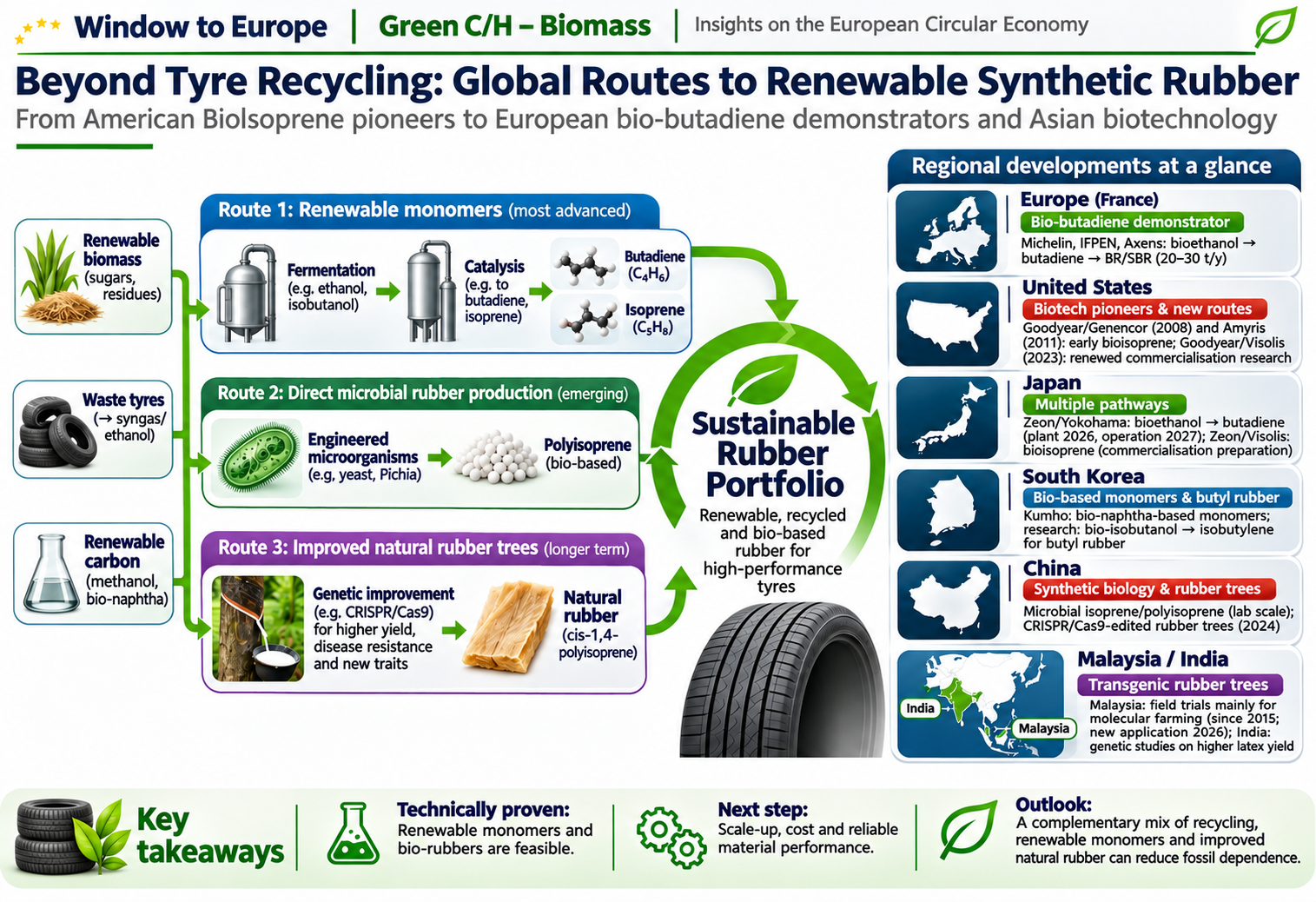
In brief
Can biotechnology replace petroleum-derived building blocks in synthetic rubber? Nearly two decades of research demonstrate technical feasibility, but large-scale economics remain challenging.
The United States pioneered microbial isoprene production: Goodyear and Genencor launched BioIsoprene™ development in 2008, and prototype tyres followed. Amyris subsequently worked with Michelin. Yet these early achievements did not establish a documented commercial bioisoprene industry. Goodyear returned to the field in 2023 through a collaboration with Visolis. [1] [2]
Europe has progressed further with bioethanol-derived butadiene: Michelin, IFPEN and Axens demonstrated production in France and subsequently converted the monomer into BR and SBR rubber. Japan is developing related catalytic routes and, with US partner Visolis, bio-based isoprene. South Korea combines bio-based monomer supply chains with research into biotechnology-derived butyl rubber. China is investigating direct microbial polyisoprene synthesis and gene-edited rubber trees. [3] [4] [5] [6] [7]
Perspective: Recycling used rubber, replacing fossil monomers and improving natural rubber production are complementary strategies. Their industrial impact depends on feedstock sustainability, process costs, consistent polymer quality and scale-up.
Further reading
1. Why isoprene and butadiene matter
Modern tyres combine natural rubber with several synthetic elastomers. Isoprene (C5H8) is the monomer of synthetic polyisoprene; 1,3-butadiene (C4H6) is used for polybutadiene (BR) and styrene-butadiene rubber (SBR). Isobutylene (C4H8) is another important monomer, used with small amounts of isoprene to make butyl rubber for tyre inner liners.
Renewable production can follow different routes: direct microbial synthesis of a monomer; fermentation of ethanol or isobutanol followed by catalysis; direct microbial synthesis of polyisoprene; or conventional petrochemical processing using certified bio-based feedstocks. These approaches must not be treated as technologically equivalent.
2. United States: Early BioIsoprene pioneers
In 2008, Goodyear and Genencor (then part of Danisco) launched a programme to manufacture isoprene through fermentation. Following DuPont’s acquisition of Danisco, the partners demonstrated prototype tyres using BioIsoprene™ in 2012. Amyris, a US metabolic-engineering pioneer, separately partnered with Michelin in 2011, with Braskem later participating in the bioisoprene initiative. Neither early programme is documented here as having reached sustained commercial-scale monomer production. [1] [12]
Goodyear did not leave the field: in October 2023 it announced a collaboration with California-based Visolis to produce isoprene by upcycling biobased materials, supported by an SBIR grant. The history illustrates the gap between successful fermentation, prototype tyres and competitive industrial production. [2]
3. Europe: Michelin’s BioButterfly demonstration
Michelin, IFP Energies nouvelles (IFPEN) and Axens inaugurated the BioButterfly industrial demonstrator at Bassens, France, in January 2024. It was designed to produce approximately 20–30 tonnes of bio-butadiene per year from bioethanol, including ethanol derived from first- and second-generation feedstocks. [3]
In December 2025, the partners reported successful polymerisation of the resulting butadiene into BR and SBR, meeting relevant polymer-grade specifications. This extends the demonstration beyond monomer production, but the plant remains far below commercial commodity-chemical capacity. Cost, energy demand, catalyst durability and sustainable ethanol supply remain decisive. [4]
4. Japan: Parallel catalytic and biotechnological routes
Zeon and Yokohama Rubber are developing a route from renewable ethanol to butadiene under a NEDO-supported programme. Zeon completed a bench-scale facility at Tokuyama in July 2026; regular operation is planned for January 2027. Prototype polybutadiene and tyre trials are intended to support further scale-up, with commercialisation targeted for 2034. A completed bench facility is not equivalent to commercial production. [5]
In a separate Japan–US partnership, Zeon and Visolis demonstrated bio-based styrene-isoprene-styrene (SIS) and signed a binding term sheet in February 2026 to prepare a potential commercial bioisoprene/SAF facility. A final investment decision or operating commercial plant was not established by that announcement. [6]
5. South Korea: Bio-based supply chains and butyl rubber
Kumho Petrochemical, SK geo centric and Tongsuh Petrochemical announced cooperation to develop a supply chain for bio-based monomers, including butadiene derived from bio-naphtha. This substitutes renewable feedstocks in largely conventional chemical routes; it is not direct fermentation of butadiene. The announcement is a supply-chain initiative, not proof of full-scale supply volumes. [8]
In a separate 2025 study, Korean researchers fermented glucose with engineered E. coli to isobutanol, converted it catalytically into isobutylene and copolymerised the product with isoprene to obtain butyl rubber. The paper demonstrated a viable laboratory process, not industrial manufacture. The isoprene used in the reported copolymerisation was reagent-grade, so the study did not demonstrate an entirely renewable butyl rubber. [7]
6. China: Direct microbial polyisoprene and rubber-tree editing
Chinese researchers reported direct production of cis-1,4-polyisoprene from methanol using engineered Pichia pastoris in 2026. In a 5 L fed-batch experiment, the reported titre reached 87.29 mg/L, with polymer molecular weight around 10,000 Da. This is an intriguing C1-to-polymer route, but the titre and molecular weight are not yet competitive with commercial tyre-rubber production. Methanol is only a low-fossil-carbon feedstock if its origin and production energy support that claim. [9]
China’s Chinese Academy of Tropical Agricultural Sciences (CATAS) has also reported regeneration of CRISPR/Cas9-edited Hevea brasiliensis plants. The initial work demonstrated gene-editing capability, not higher latex yields in mature plantation trees. [10]
7. Malaysia and India: The natural-rubber perspective
Malaysia has undertaken confined research with genetically modified rubber trees, particularly to express recombinant pharmaceutical proteins in latex. This is an example of molecular farming, not a demonstrated improvement in rubber yield. India has investigated genetic and molecular approaches to rubber biosynthesis and latex productivity. Neither case establishes widespread commercial cultivation of high-yield transgenic rubber trees. [11]
Such work is relevant because natural rubber remains essential for demanding tyre applications. However, any claim of improved plantation productivity must distinguish laboratory or nursery results from durable yield gains in mature trees.
8. International comparison: How far have the technologies progressed?
| Region | Approach | Documented stage / limitation |
|---|---|---|
| United States | Fermentative isoprene; Visolis routes | Prototype tyres; renewed development, no documented commercial bioisoprene output |
| Europe (France) | Bioethanol → butadiene → BR/SBR | 20–30 t/y demonstrator; polymerisation demonstrated |
| Japan | Bioethanol → butadiene; Zeon–Visolis isoprene | Bench facility completed; planned operation and commercialisation preparation |
| South Korea | Bio-naphtha-based monomers; isobutanol → isobutylene | Supply-chain initiative; laboratory butyl-rubber synthesis |
| China | Microbial polyisoprene; gene-edited Hevea | 5 L fermentation research; edited plants, no demonstrated plantation yield gain |
| Malaysia / India | Transgenic Hevea and genetic research | Confined research / experimental studies; no established commercial yield improvement |
These stages are not directly comparable: they refer to monomers, finished polymers, supply-chain arrangements and living trees.
9. Economics and sustainability: The decisive tests
Feedstock: Sustainable sugars, residues, ethanol, methanol and bio-naphtha differ in price, availability, land-use effects and greenhouse-gas intensity. Process: Fermentation titre and productivity, recovery of volatile products, catalyst performance and energy requirements affect competitiveness. Product: Tyre manufacturers require reliable monomer purity and polymer performance. Scale: Laboratory yields, demonstration plants and industrial commodity supply are fundamentally different milestones.
Renewable or mass-balance-certified carbon should not be equated automatically with low greenhouse-gas emissions. Comparable life-cycle assessments and transparent chain-of-custody information are essential.
Conclusion
The US pioneered fermentative bioisoprene, Europe has advanced bio-butadiene into demonstration and polymer production, Japan is developing several industrial routes, South Korea combines feedstock substitution with new biochemical pathways, and China is exploring direct microbial rubber synthesis and rubber-tree editing. No single route has yet broadly displaced conventional petrochemical rubber.
A credible transition will combine recycling of existing rubber, renewable production of synthetic-rubber building blocks and more sustainable natural-rubber cultivation.
Sources and further information
- Goodyear / DuPont Industrial Biosciences: BioIsoprene prototype tyres (2012).
- Goodyear / Visolis: Isoprene from upcycled biobased materials (26 October 2023).
- Michelin / IFPEN / Axens: BioButterfly demonstrator (18 January 2024).
- Axens / Michelin / IFPEN: Bio-butadiene converted to BR and SBR (11 December 2025).
- Zeon: Tokuyama bench-scale bio-butadiene facility, press release (31 July 2026); Yokohama Rubber / Zeon programme (2025).
- Zeon / Visolis: Binding term sheet ahead of investment decision (16 February 2026); Zeon: SIS polymer demonstration.
- Kim et al., ACS Sustainable Chemistry & Engineering (2025): Sustainable Butyl Rubber Production from Microbial Isobutanol-Derived Isobutylene.
- Kumho Petrochemical / SK geo centric / Tongsuh: Bio-monomer supply-chain MoU (2024, industry report).
- Zhao et al., ACS Sustainable Chemistry & Engineering (2026): De Novo Biosynthesis of cis-1,4-Polyisoprene from Methanol.
- Industrial Crops & Products (2024): CRISPR/Cas9 gene editing in Hevea brasiliensis.
- Malaysia: Public consultation on confined GM rubber-tree research (2026). This is an application/consultation, not proof of authorisation.
- Michelin: Background on the development of renewable rubber raw materials.