In brief
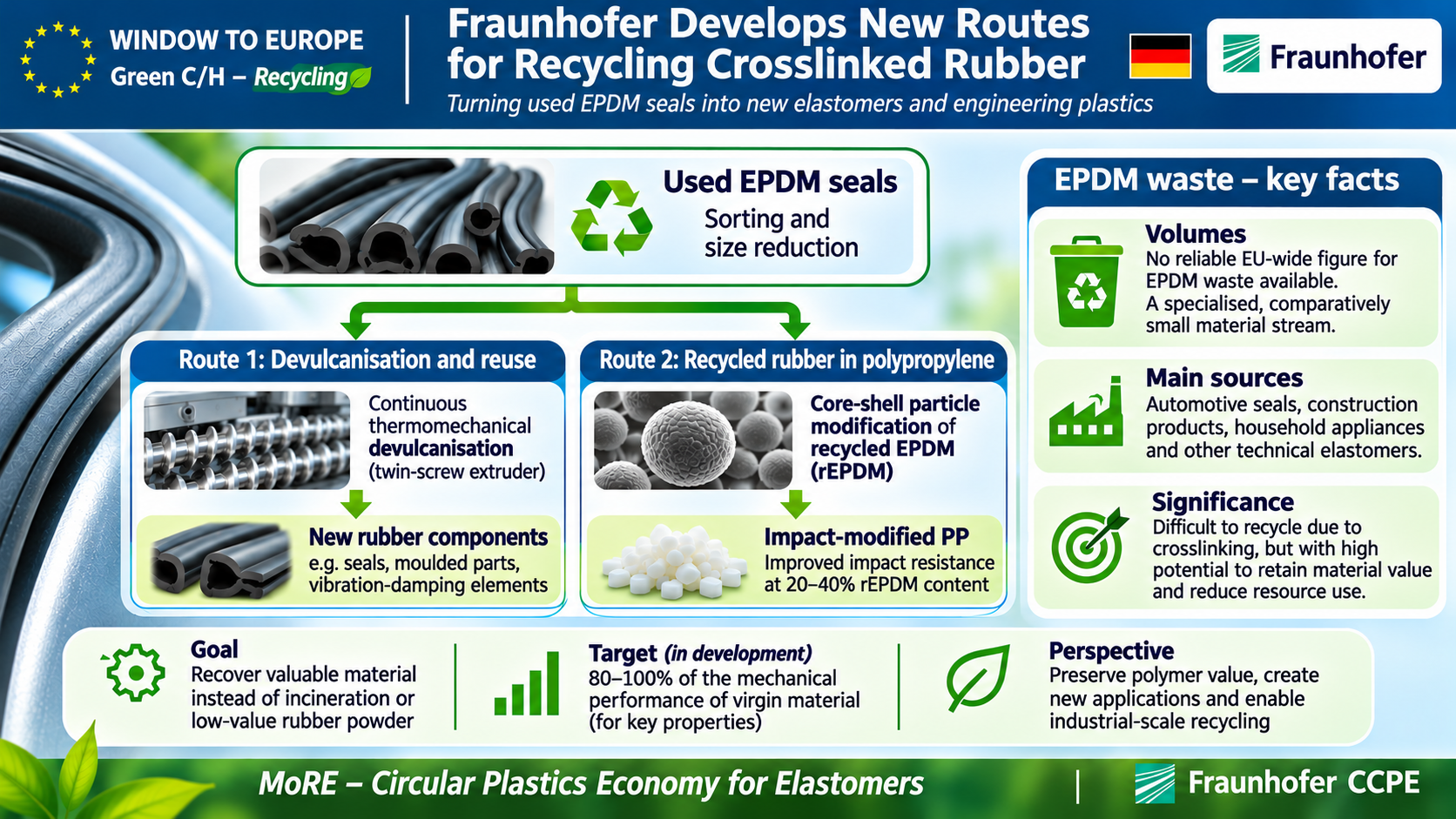
Fraunhofer researchers are developing two routes to recycle used EPDM rubber seals into higher-value materials. In the MoRE project, the Fraunhofer Cluster of Excellence Circular Plastics Economy (CCPE) is investigating how to recover crosslinked ethylene-propylene-diene rubber (EPDM) from automotive and household-appliance seals.
Fraunhofer ICT is developing continuous thermomechanical devulcanisation in a twin-screw extruder. The recovered rubber could be revulcanised for new seals and technical components. The project targets 80–100% of virgin-material performance for selected mechanical properties; this is a goal, not a verified industrial result.
In a second route, Fraunhofer UMSICHT modifies recycled EPDM into core-shell particles that improve polypropylene’s impact resistance at reported recycled-material contents of 20–40%.
Perspective: MoRE will not solve Europe’s plastic-waste problem by volume, but it could help retain the value of difficult-to-recycle elastomers. Industrial performance, economics and environmental benefits remain to be demonstrated.
Further reading
Why EPDM is difficult to recycle
EPDM is used in weather-resistant seals and technical rubber components. Vulcanisation forms a crosslinked network that cannot simply be melted and reshaped like a thermoplastic. Used seals are therefore often incinerated or ground into rubber powder, losing much of their original material value.
Route 1: Devulcanisation and revulcanisation
Fraunhofer ICT is developing a continuous twin-screw extrusion process that partially breaks EPDM’s crosslinked network. Microwave and ultrasound-assisted processing are also under investigation, while intensive degassing is intended to reduce odours. Fraunhofer LBF is evaluating whether the resulting recycled EPDM (rEPDM) can be revulcanised into new seals, moulded parts and vibration-damping components.
The stated goal is to recover 80–100% of virgin-material performance for important mechanical properties. This should not be interpreted as a proven result across all applications.
Route 2: Impact modification of polypropylene
Fraunhofer UMSICHT is developing core-shell particles based on modified rEPDM for use as impact modifiers in polypropylene (PP). Fraunhofer reports improved impact resistance at recycled-material contents of 20–40%. This creates another possible outlet for recovered rubber, although it is not a closed EPDM-to-EPDM loop.
Industrial prospects and limits
As MoRE approaches its final phase, the focus is on industrial transfer. Consistent material properties, processing throughput, cost and availability of separately collected EPDM waste will determine commercial feasibility. Compared with pyrolysis, devulcanisation aims to preserve more of the polymer structure, but comparative life-cycle data are needed before an environmental advantage can be claimed.
Conclusion: MoRE illustrates how recycling can preserve high-value polymer functionality instead of recovering only lower-value products or chemical feedstocks.
Source
Fraunhofer CCPE, “Zirkuläre Kunststoffwirtschaft für Elastomere – Vom alten Dichtungswerkstoff zum neuen Industrieprodukt”, press release, 4 November 2026.