
Renewable electricity is only as useful as the grid that can carry it. A new 1 GW link between Portugal and Spain shows why cross-border infrastructure is becoming a key part of Europe’s sustainable transition.
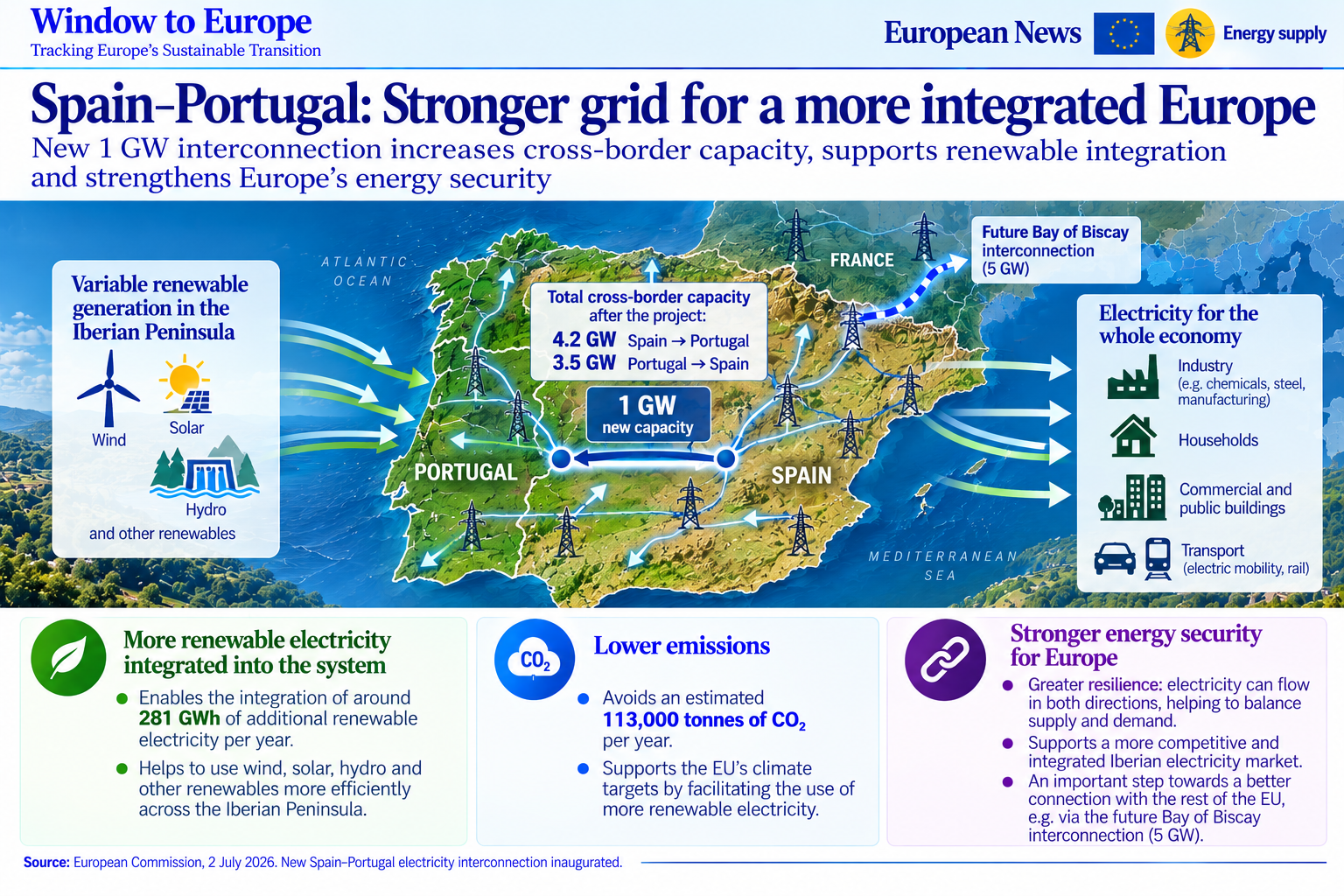
A new electricity interconnection between northern Portugal and Galicia entered operation on 2 July 2026. The project adds 1 GW of cross-border capacity, bringing total exchange capacity to 4.2 GW from Spain to Portugal and 3.5 GW in the opposite direction. Electricity can therefore flow according to generation and demand rather than in one predetermined direction.
This flexibility becomes increasingly important as Europe adds variable renewable generation. According to the European Commission, the reinforced Iberian grid can integrate around 281 GWh of additional renewable electricity annually, avoiding an estimated 113,000 tonnes of CO₂ per year. The electricity enters the general grid and can serve industry, buildings, households and increasingly electrified transport.
The project also illustrates a wider European challenge. Portugal and Spain have substantial renewable-energy resources, but the Iberian Peninsula is still comparatively weakly connected with the rest of Europe. The Bay of Biscay interconnection between Spain and France, now under development, is intended to double Spain–France exchange capacity to 5 GW and further integrate the peninsula into the European electricity market.
For Europe’s sustainable transition, generating renewable electricity is therefore only one part of the task. Stronger grids and cross-border interconnections are needed to move renewable power to where it is required, balance regional supply and demand and improve the resilience of the European energy system.