
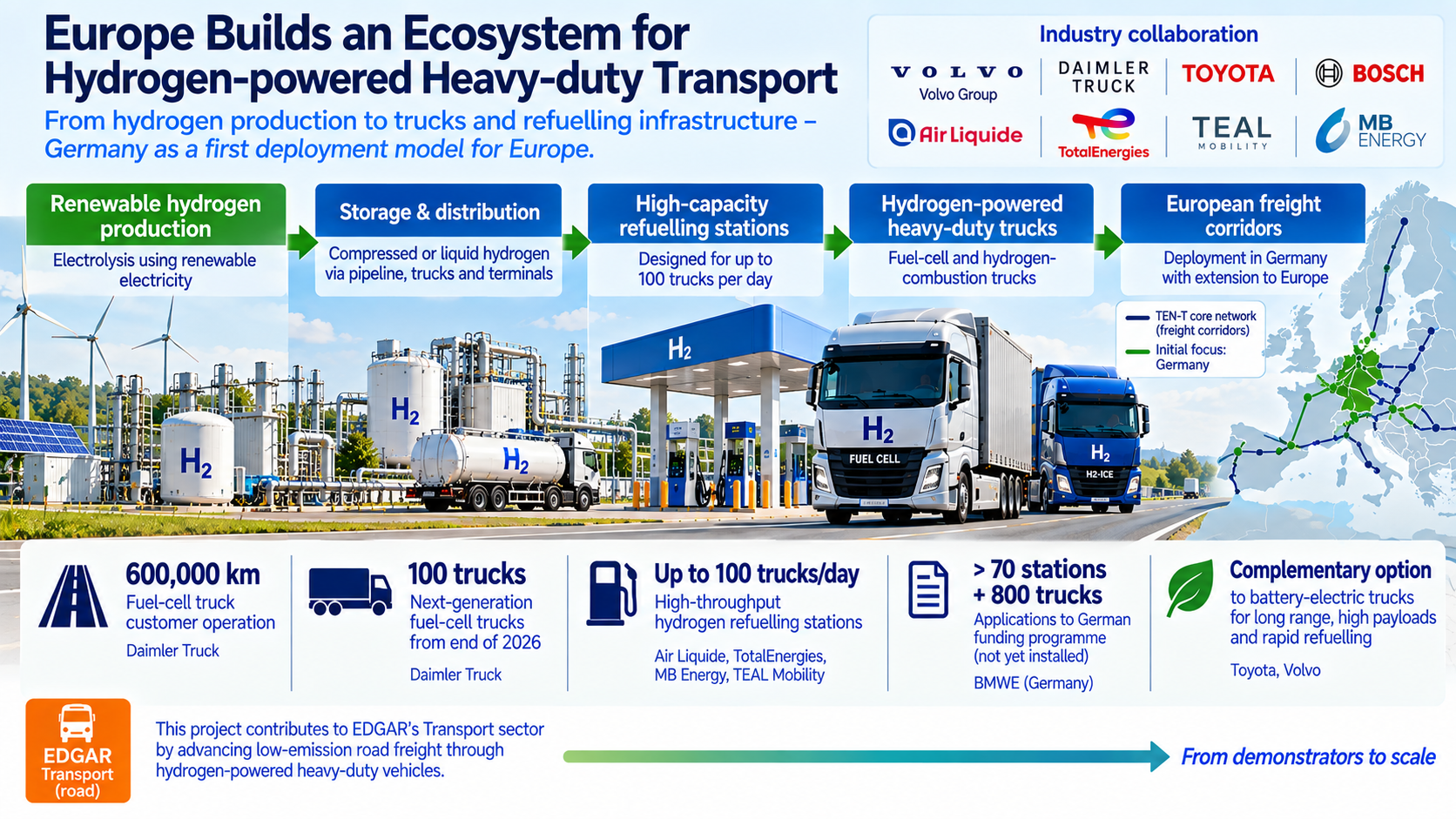
Germany is becoming a test case for linking hydrogen trucks, fuel supply and high-capacity refuelling infrastructure – with the aim of extending the model across Europe.
At the IAA Transportation 2026 in Hannover, a group of major vehicle, technology and energy companies presented a joint approach to accelerate hydrogen-powered heavy-duty transport in Europe. Participants include Volvo Group, Daimler Truck, Toyota, Bosch, Air Liquide, TotalEnergies, TEAL Mobility and MB Energy. Air Liquide – Industry collaboration
The initiative addresses a central problem of hydrogen mobility: trucks, hydrogen production and distribution, and refuelling stations must develop at the same time. A fleet operator will not buy hydrogen trucks without reliable fuel supply, while investment in large filling stations is difficult without sufficient vehicle demand.
Germany is intended to serve as the first deployment model. The partners are working towards hydrogen refuelling stations along major transport corridors, coordinated with the introduction of truck fleets and the availability of competitively priced hydrogen. If successful, this model could subsequently be extended to other European countries. Daimler Truck – European hydrogen mobility initiative
Technology development is already moving beyond individual prototypes. Daimler Truck reports almost 600,000 km of customer operation with fuel-cell trucks and plans to place 100 next-generation fuel-cell trucks with customers from the end of 2026. Volvo is developing both fuel-cell and hydrogen-combustion trucks for market introduction towards 2030. Toyota contributes fuel-cell technology, while Bosch supplies vehicle components and develops refuelling technologies for gaseous and liquid hydrogen. Air Liquide – Technology and vehicle deployment
Infrastructure is the other half of the equation. Air Liquide, TotalEnergies, MB Energy and TEAL Mobility are developing hydrogen supply and refuelling systems, including high-throughput stations designed to serve up to 100 trucks per day. Recent applications to a German funding programme included more than 70 high-capacity hydrogen stations and 800 heavy-duty trucks, indicating considerable industrial interest – although applications should not be confused with installations already built. Air Liquide – Hydrogen infrastructure and German funding applications
Hydrogen is presented by the partners not as a replacement for battery-electric trucks, but as a complementary option, particularly for applications requiring long range, high payloads, rapid refuelling and operational flexibility. Whether it becomes economically competitive will depend strongly on vehicle costs, hydrogen prices, infrastructure utilisation and public policy. Toyota Motor Europe – Hydrogen mobility collaboration
From demonstrators to scale: The significance of the initiative lies not in another hydrogen truck prototype, but in the attempt to develop an entire transport ecosystem simultaneously – vehicles → hydrogen supply → high-capacity refuelling → fleet operation → European transport corridors. Germany will provide an early indication of whether this coordinated approach can turn hydrogen heavy-duty mobility into a commercially scalable European option.