
In brief
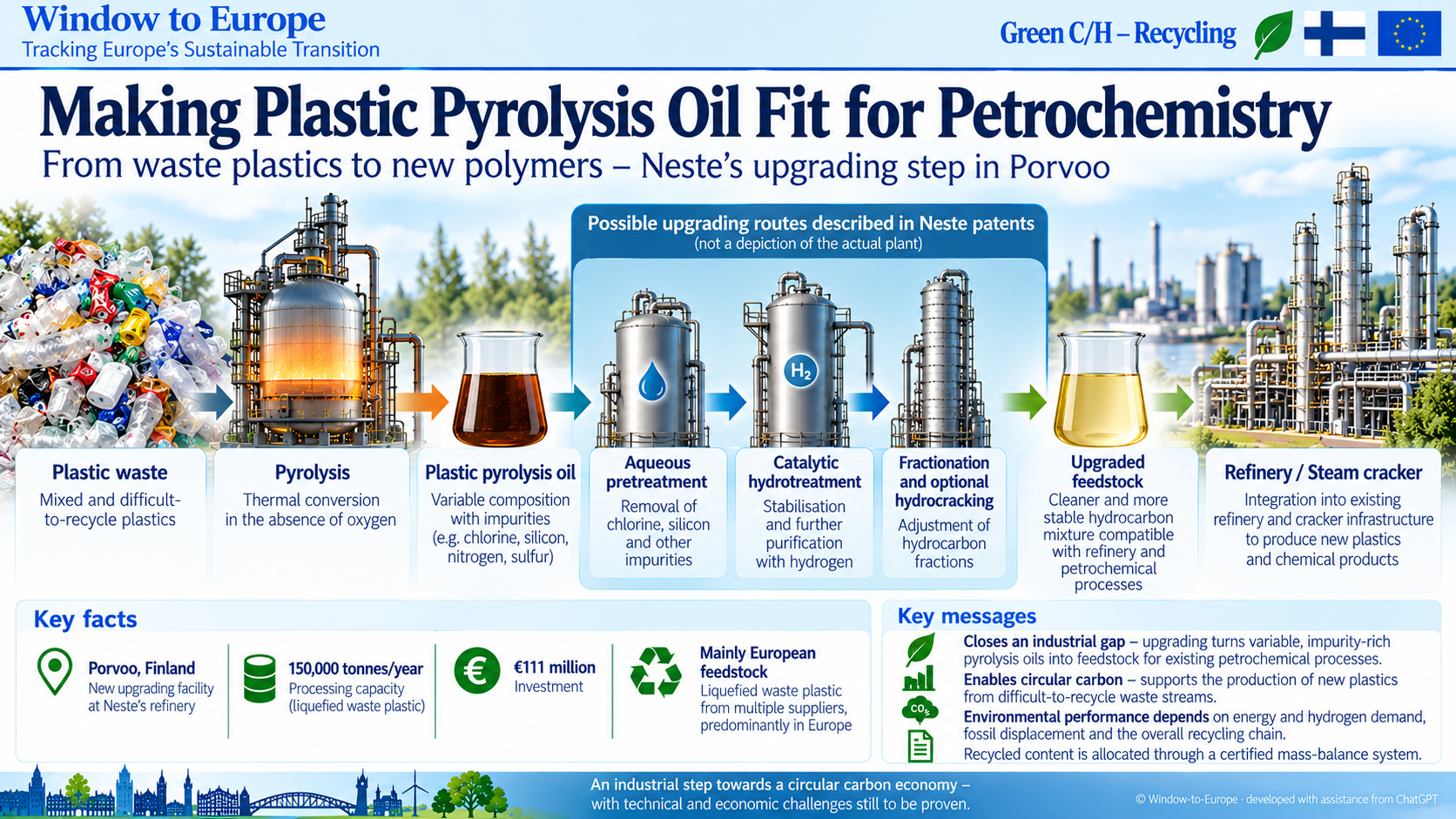
Chemical recycling of plastic waste is moving from pyrolysis towards industrial integration. In March 2026, Neste commissioned a €111 million upgrading facility at its Porvoo refinery in Finland, designed to process up to 150,000 tonnes of liquefied waste plastic annually. Its purpose is to turn variable, impurity-rich plastic pyrolysis oils into hydrocarbon feedstocks suitable for further processing in existing refinery and petrochemical facilities.
The critical step is purification and stabilisation. Chlorine, silicon compounds and reactive hydrocarbons can cause corrosion, catalyst deactivation and operational problems. Neste’s patent literature describes potential solutions involving pretreatment, catalytic hydrotreatment and fractionation, although the exact process configuration at Porvoo has not been disclosed.
The industrial significance lies in reconnecting waste-derived carbon with the production of new plastics. However, actual recycling volumes, hydrogen and energy consumption, operating costs and the plant’s net environmental performance remain to be demonstrated during the production ramp-up. The project illustrates both the potential and the remaining challenges of chemical recycling as a complement to mechanical recycling.
From Plastic Waste to Petrochemical Feedstock
Mechanical recycling remains the preferred route for many relatively clean, separately collected thermoplastics. However, mixed, contaminated or otherwise difficult-to-recycle plastic streams often cannot be processed economically into products of adequate quality.
Pyrolysis offers an alternative. In the absence of oxygen, plastic waste is thermally decomposed into a mixture of hydrocarbons, gases and solid residues. Depending on feedstock composition and operating conditions, the resulting liquid fraction may contain hydrocarbons spanning a broad boiling range.
Polyethylene and polypropylene are particularly suitable feedstocks for hydrocarbon recovery. Other polymers, additives and contaminants can substantially complicate the process.
The resulting pyrolysis oil is not equivalent to conventional refinery feedstock. Its composition and impurity levels may vary considerably between suppliers and production batches.
Neste’s new facility in Porvoo is designed to upgrade such liquefied waste plastic into material suitable for further processing within the company’s existing refinery infrastructure.
Why Pyrolysis Oil Needs Upgrading
Several classes of impurities can limit the direct use of plastic-derived oils in petrochemical operations.
| Component | Potential problem |
|---|---|
| Chlorine compounds | Corrosion, formation of unwanted chlorides and interference with downstream processing |
| Silicon compounds | Deactivation of sensitive catalysts |
| Nitrogen and sulfur compounds | Additional purification requirements and potential catalyst interference |
| Olefins and other reactive hydrocarbons | Product instability, polymerisation and fouling |
| Heavy hydrocarbons and residues | Unfavourable boiling range and operational difficulties |
These challenges explain why increasing pyrolysis capacity alone is insufficient to establish a functioning industrial recycling chain.
A reliable upgrading step is required between waste conversion and conventional hydrocarbon processing.
Technical Approaches: What Neste’s Patents Reveal
Neste has developed and patented several methods for purifying and upgrading plastic-derived oils. These documents provide useful insight into the chemistry involved, although they do not establish the exact configuration of the new Porvoo facility.
1. Aqueous and alkaline pretreatment
One Neste patent describes contacting plastic pyrolysis oil with an aqueous alkaline solution at elevated temperature.
The treatment aims to reduce troublesome impurities, including certain chlorine- and silicon-containing compounds, before further catalytic processing.
Such pretreatment can be particularly valuable when impurities would otherwise shorten the operating life of downstream catalysts.
2. Catalytic hydrotreatment
Hydrotreatment is another relevant upgrading technology. Under hydrogen pressure and in the presence of a suitable catalyst, reactive unsaturated hydrocarbons can be hydrogenated, while certain heteroatom-containing compounds can be converted into forms that are easier to remove.
Depending on the feedstock and catalyst system, hydrotreatment can improve oil stability and reduce impurities.
However, hydrogen consumption, catalyst lifetime and the origin of the hydrogen are important determinants of both operating costs and environmental performance.
3. Fractionation and possible hydrocracking
Further patented approaches combine hydrotreatment with fractionation and, where appropriate, hydrocracking.
Fractionation separates the treated hydrocarbon mixture into different boiling ranges. Hydrocracking can convert heavier hydrocarbons into lighter fractions more suitable for selected refinery or petrochemical applications.
These operations offer ways to adapt variable pyrolysis oils to the specifications of existing processing equipment.
An important distinction: The pretreatment, hydrotreatment and hydrocracking routes described above are based on Neste’s published patent literature. The company has not disclosed a complete process flow diagram, operating conditions or catalyst configuration for its newly commissioned Porvoo upgrading facility. They should therefore be understood as relevant technical approaches, not as a verified description of every installed process step.
Integration into Existing Refinery Operations
The significance of the Porvoo investment lies in its integration with established industrial infrastructure.
Rather than requiring a separate petrochemical complex dedicated entirely to waste-derived hydrocarbons, upgraded plastic-derived feedstock can enter existing processing routes alongside fossil-derived materials.
This approach offers advantages in terms of industrial infrastructure and potential scalability. It also introduces an important accounting issue.
When recycled and fossil-derived carbon streams are processed together, the recycled content attributed to individual products is generally established through a certified mass-balance system. Such accounting does not imply that every molecule in a product physically originates from plastic waste.
The distinction matters when evaluating claims about recycled-content polymers.
Neste states that it sources liquefied waste plastic from multiple suppliers, predominantly in Europe, and applies traceability and certification requirements to its supply chain. Exact feedstock quantities by supplier or country have not been publicly disclosed.
Industrial Scale – But Commercial Performance Still to Be Demonstrated
The Porvoo upgrading facility has a nominal annual capacity of 150,000 tonnes. Neste announced its commissioning in March 2026, with operations to be ramped up gradually.
The investment of approximately €111 million corresponds to about €740 per tonne of annual input capacity. This is a capital-intensity indicator, not the actual processing cost per tonne.
The economics of chemical recycling depend on several additional factors:
- Cost and quality of the incoming pyrolysis oil
- Hydrogen, electricity and thermal energy requirements
- Catalyst consumption and maintenance
- Yield of usable petrochemical feedstock
- Market demand and price premiums for certified recycled carbon
Neste has not published sufficient plant-specific operating data to quantify these factors for the new facility.
The company’s previously communicated lifecycle assessment suggests that chemical recycling can reduce greenhouse gas emissions compared with a defined reference scenario involving plastic incineration and fossil-based production. However, these are model-based comparisons, not measured lifecycle results from the newly commissioned Porvoo operation.
Nor should chemical recycling automatically be considered environmentally preferable to mechanical recycling. The appropriate comparison depends on waste quality, process energy, material recovery and the fate of the alternative waste stream.
W2E Perspective – Closing an Industrial Gap
Neste’s investment addresses a frequently underestimated problem in the circular carbon economy.
Converting plastic waste into a hydrocarbon liquid is only the first step. For large-scale integration into petrochemical production, that liquid must meet demanding specifications for stability, contaminants and process compatibility.
The Porvoo facility represents an industrial attempt to bridge this gap, using existing refinery infrastructure to connect waste-derived carbon with conventional chemical value chains.
Its contribution to defossilisation will ultimately depend on how much fossil feedstock it displaces, how efficiently the upgrading process operates and how much additional energy and hydrogen it requires.
The central achievement is the industrialisation of a difficult intermediate processing step. Whether it also delivers competitive economics and a convincing net environmental benefit at full capacity remains to be demonstrated.
Sources
- Neste (16 March 2026). Neste commissions the world’s largest upgrading facility for liquefied waste plastic and scales up chemical recycling. Company press release.
- Neste. Method for treating plastic pyrolysis oil. European patent EP4306619B1. Patent description.
- Neste. Process for upgrading plastic pyrolysis oil. Finnish patent application FI20235610A1. Patent application.
- Neste. Neste RE™ – renewable and recycled raw materials for polymers and chemicals. Neste website.
- European Commission, Innovation Fund. PULSE – Pretreatment and Upgrading of Liquefied Waste Plastic to Scale Up Circular Economy. Project information on the wider recycling investment programme. EU Innovation Fund.
Note: The EU-funded PULSE programme originally covered a broader development concept. Its projected capacity and environmental benefits should not be confused with the demonstrated performance of the commissioned 150,000-tonne Porvoo upgrading facility.