
Green C/H – C1/CO₂ | Germany / Spain | 26 October 2026
In brief
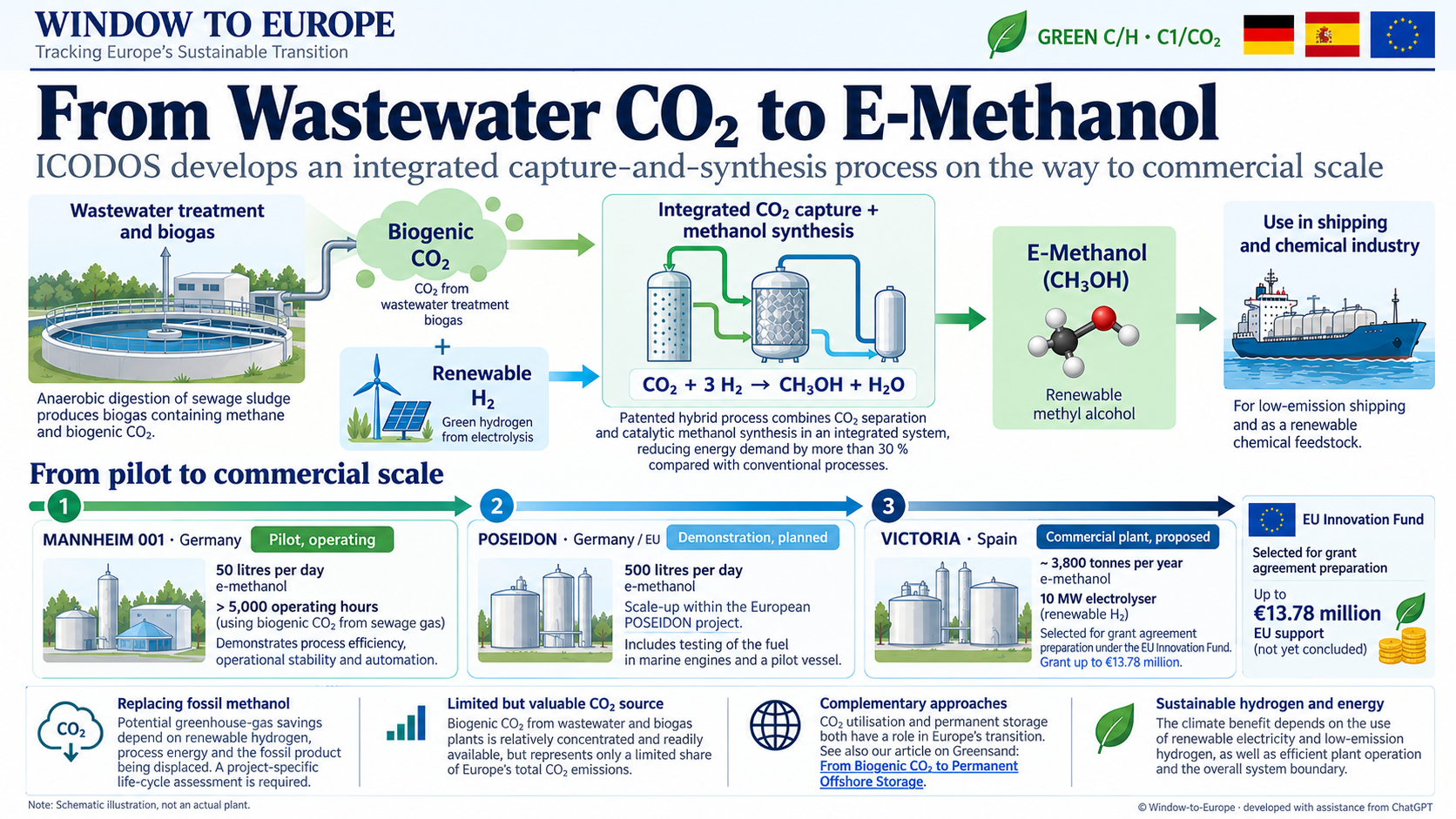
German technology company ICODOS is preparing to scale up an innovative process that combines CO₂ capture and methanol synthesis in an integrated system. Following successful pilot operation at a wastewater treatment plant in Mannheim, the company has been selected for potential support of up to €13.78 million from the EU Innovation Fund for a planned e-methanol facility in Spain. The project illustrates how biogenic CO₂ can become a feedstock for renewable chemicals and fuels, while also highlighting the opportunities and limitations of carbon utilisation.
From wastewater treatment to renewable methanol
Wastewater treatment plants generate biogas through the anaerobic digestion of sewage sludge. This biogas contains methane and substantial quantities of biogenic CO₂. While methane can be used to produce heat and electricity, the CO₂ is often released into the atmosphere.
ICODOS, working with the Karlsruhe Institute of Technology (KIT) and the municipal wastewater utility EBS Mannheim, has developed a patented hybrid process that integrates CO₂ separation and catalytic methanol synthesis.
The overall reaction is:
CO₂ + 3 H₂ → CH₃OH + H₂O
Unlike conventional approaches, in which CO₂ capture and methanol synthesis are separate operations, the ICODOS process combines them in an integrated system. According to GreenTech BW’s description of Mannheim 001, the integrated process reduces energy consumption by more than 30% compared with conventional methods. The precise system boundaries of this comparison are not specified.
Mannheim: Demonstrating the technology
The Mannheim 001 pilot plant has been operating at the city’s wastewater treatment site since March 2025. According to ICODOS, the installation has accumulated more than 5,000 operating hours using CO₂ derived from sewage gas.
GreenTech BW reports approximately 10 tonnes of e-methanol production per year, using around 14 tonnes of biogenic CO₂. The plant demonstrates process efficiency, operational stability and automation under realistic operating conditions.
A further step is being undertaken within the European POSEIDON project. Its demonstration plant, currently under construction in Mannheim, is designed to increase production capacity from approximately 50 to 500 litres of e-methanol per day. The project also includes testing the resulting fuel in marine engines and a pilot vessel.
These activities provide a technological foundation for subsequent commercial deployment.
VICTORIA: A first commercial-scale application in Spain
On 20 October 2026, ICODOS announced that its VICTORIA project had been selected for grant agreement preparation under the EU Innovation Fund.
The proposed facility in Spain would combine biogenic CO₂ recovered from wastewater-treatment biogas with renewable hydrogen produced by a 10 MW electrolyser.
The planned annual output is approximately 3,800 tonnes of renewable e-methanol, primarily intended for maritime applications.
The project has been selected for potential funding of up to €13.78 million. However, the grant agreement has not yet been concluded, and the Spanish facility is not yet operating.
The broader perspective: Biogenic CO₂ as a carbon resource
Biogenic CO₂ from biogas upgrading and fermentation offers an attractive starting point for carbon utilisation because it can be obtained in relatively concentrated streams. The European Biogas Association’s report on biogenic CO₂ documents the growing importance of these sources.
However, they represent only a limited part of Europe’s overall CO₂ emissions. A broader industrial impact would require extending CO₂ conversion technologies to larger emission sources, including energy-intensive industries and cement production.
Whether this translates into substantial climate benefits depends on the origin of the CO₂, the availability of low-emission hydrogen and energy, and the ultimate fate of the carbon. Methanol used as a fuel releases its carbon again as CO₂; its potential climate benefit therefore depends largely on replacing fossil-derived products. A project-specific life-cycle assessment is needed to quantify the net greenhouse-gas savings.
In this context, CO₂ utilisation and permanent geological storage should be regarded as complementary approaches.
An example of the latter is the Greensand project in Denmark, which aims to permanently store captured CO₂ in offshore geological formations. Where sustainably sourced biogenic CO₂ is permanently stored, it can contribute to carbon dioxide removal.
Related W2E article: Greensand Future – From Biogenic CO₂ to Permanent Offshore Storage
Outlook
ICODOS demonstrates a practical route for converting biogenic CO₂ into a renewable chemical feedstock and fuel. The experience gained in Mannheim, the ongoing construction of the POSEIDON demonstrator and the proposed VICTORIA facility represent successive stages towards industrial implementation.
The decisive next steps will be to demonstrate reliable operation at larger scale, verify energy efficiency and production costs, and establish the environmental performance of the complete process.