
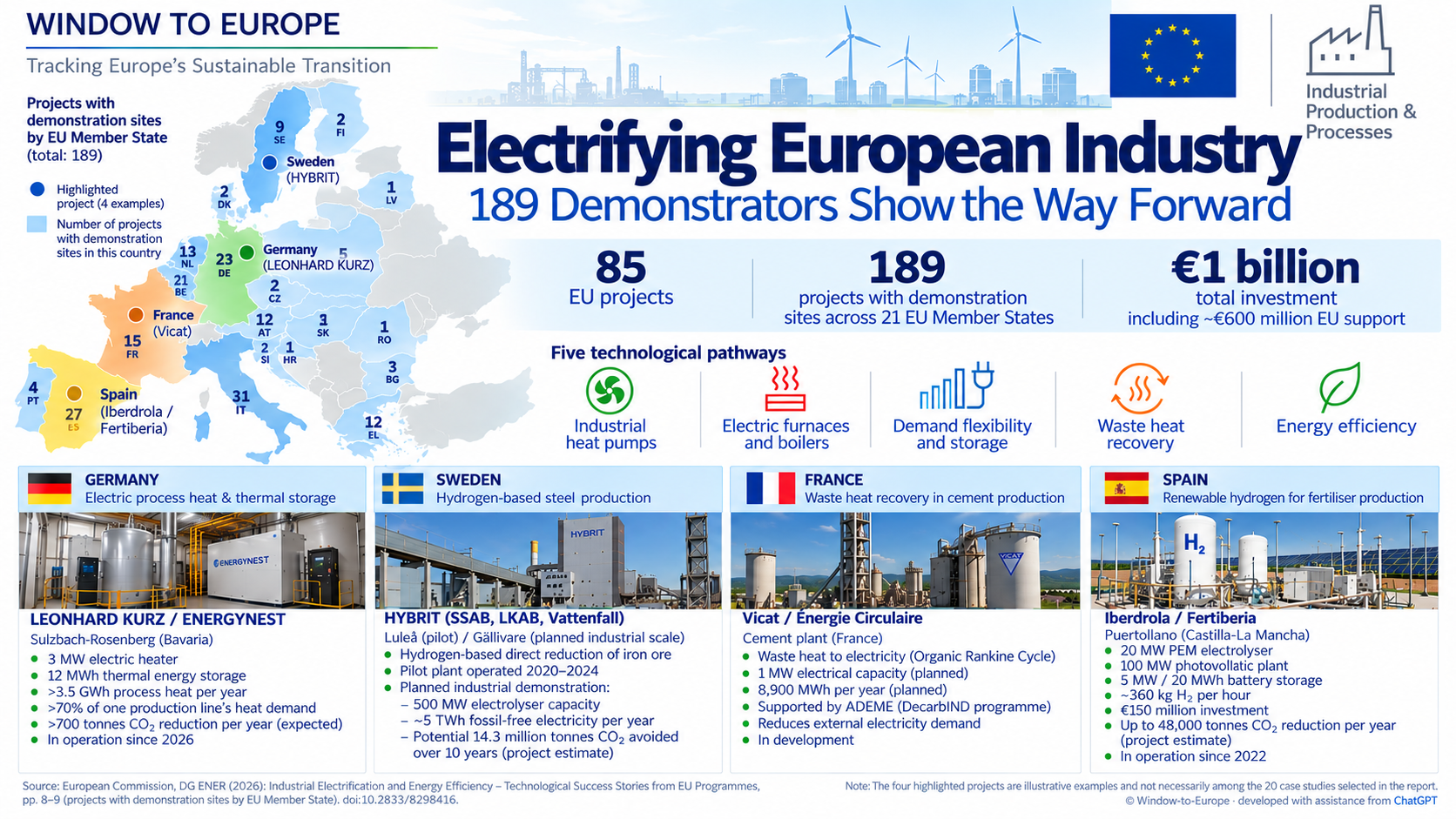
From industrial heat storage in Germany to fossil-free steel in Sweden, waste heat recovery in France and green hydrogen in Spain.
In brief
A new European Commission report highlights 189 industrial demonstrators across 21 EU Member States, representing approximately €1 billion in investment, including €600 million in EU support. The projects illustrate how industrial electrification, energy efficiency, waste heat recovery and flexible electricity use can reduce Europe’s dependence on fossil fuels.
Four industrial examples from Germany, Sweden, France and Spain demonstrate different technological approaches and stages of industrial implementation. They complement the Commission’s overview but are not necessarily among its 20 selected case studies.
Source: European Commission / CINEA, 20 October 2026
189 demonstrators – A European industrial transformation
Industrial production remains one of Europe’s major consumers of fossil fuels, particularly for process heat, steelmaking and chemical manufacturing.
Published in October 2026, the European Commission’s report Industrial Electrification and Energy Efficiency – Technological Success Stories from EU Programmes presents 20 selected success stories from a broader portfolio of 189 demonstrators supported through European programmes.
Five technological pathways are highlighted: industrial heat pumps, electric furnaces and boilers, flexible electricity demand and storage, waste heat recovery, and improved energy efficiency.
According to the Commission, widespread deployment of these technologies could halve the share of fossil fuels in industrial energy consumption by 2040. This represents a potential future development rather than an achieved reduction.
Source: European Commission, DG Energy (2026) – Full report
Four industrial examples across Europe
Germany – Electric process heat and thermal storage at LEONHARD KURZ
At its Sulzbach-Rosenberg production site in Bavaria, LEONHARD KURZ, together with ENERGYNEST, commissioned an industrial power-to-heat installation in September 2026, officially inaugurated in October.
The system combines a 3 MW electric heater with a 12 MWh thermal energy storage system and is integrated into the factory’s existing thermal-oil infrastructure.
Electricity from a directly connected photovoltaic installation is converted into process heat, which can either be used immediately or stored for later use.
According to the companies, the installation is designed to deliver more than 3.5 GWh of process heat annually, covering over 70% of the heat demand of one production line. The expected reduction in CO₂ emissions exceeds 700 tonnes annually.
The project demonstrates how renewable electricity and thermal storage can provide reliable industrial process heat while reducing natural gas consumption.
Source: LEONHARD KURZ, 14 October 2026
Sweden – HYBRIT advances fossil-free steelmaking
The HYBRIT (Hydrogen Breakthrough Ironmaking Technology) initiative brings together SSAB, LKAB and Vattenfall to develop an alternative to conventional coal-based ironmaking.
Instead of reducing iron ore with coke in a blast furnace, the process uses hydrogen produced with fossil-free electricity. The resulting sponge iron can subsequently be melted in an electric arc furnace.
Pilot operations conducted between 2020 and 2024 demonstrated hydrogen-based direct reduction, hydrogen storage and the melting of fossil-free sponge iron.
The proposed industrial demonstration in Gällivare includes approximately 500 MW of electrolyser capacity and would require around 5 TWh of fossil-free electricity annually.
According to project estimates, industrial-scale deployment could avoid approximately 14.3 million tonnes of CO₂ equivalent over ten years. These figures refer to the planned demonstration and should not be interpreted as emissions already avoided.
HYBRIT illustrates how renewable electricity and hydrogen technology can jointly transform one of Europe’s most emissions-intensive industries.
Source: European Commission – HYBRIT technology assessment
France – Recovering waste heat in cement production
Cement manufacturing generates substantial quantities of high-temperature waste heat, particularly from clinker kilns and their exhaust gases.
At a Vicat cement plant in France, a waste heat recovery project developed with Énergie Circulaire aims to convert otherwise unused thermal energy into electricity through an Organic Rankine Cycle (ORC).
The installation is designed for approximately 1 MW of electrical capacity and an annual generation of 8,900 MWh.
The project has received support from the French environmental agency ADEME through the DecarbIND programme.
The technology can reduce externally supplied electricity demand and improve the overall energy efficiency of cement production. However, waste heat recovery does not eliminate the process-related CO₂ emissions released during limestone calcination.
The installation is still listed as under development by the technology provider. Its stated output therefore represents planned rather than verified annual performance.
Source: Énergie Circulaire – Vicat industrial waste heat recovery project
Spain – Renewable hydrogen for fertiliser production
In Puertollano, Spain, Iberdrola and Fertiberia have established an integrated renewable hydrogen production system supplying the chemical industry.
Commissioned in 2022, the installation combines a 20 MW PEM electrolyser, a 100 MW photovoltaic power plant, a 5 MW / 20 MWh battery storage system, hydrogen storage and a direct connection to Fertiberia’s ammonia production facility.
The electrolyser has a maximum production capacity of approximately 360 kg of hydrogen per hour.
The project represents an investment of around €150 million. Iberdrola estimates potential annual CO₂ avoidance of up to 48,000 tonnes.
According to Fertiberia, renewable hydrogen has already enabled the decarbonisation of up to 10% of production at its Puertollano facility.
The project demonstrates how renewable electricity can replace part of the fossil-derived hydrogen traditionally used in ammonia and fertiliser manufacturing.
Source: Iberdrola – Puertollano green hydrogen plant
Source: Fertiberia – H2F project
From demonstration to industrial deployment
The four examples illustrate different stages of Europe’s industrial transformation.
In Germany and Spain, technologies are already integrated into operating production facilities. Sweden’s HYBRIT programme has demonstrated a new steelmaking route at pilot scale, while France’s cement industry is developing additional opportunities for industrial waste heat recovery.
They also show that industrial electrification does not simply mean replacing fossil-fuel burners with electric heaters. It may involve combining renewable electricity with thermal storage, hydrogen production, new metallurgical processes or more efficient utilisation of waste heat.
The environmental benefits depend on the availability of low-carbon electricity, technical integration and the emissions associated with the complete industrial process.
Outlook – Towards a more competitive European industry
The European Commission’s 189 demonstrators indicate that many technologies required for industrial decarbonisation have already progressed beyond laboratory research.
The challenge is now to scale up their application across industrial sectors and European regions.
Electrification, combined with renewable energy, improved efficiency and flexible energy storage, can reduce fossil-fuel dependence while strengthening European industrial competitiveness and energy security.
Europe’s industrial transformation will not depend on a single technology, but on the combination of solutions adapted to the requirements of individual industries.