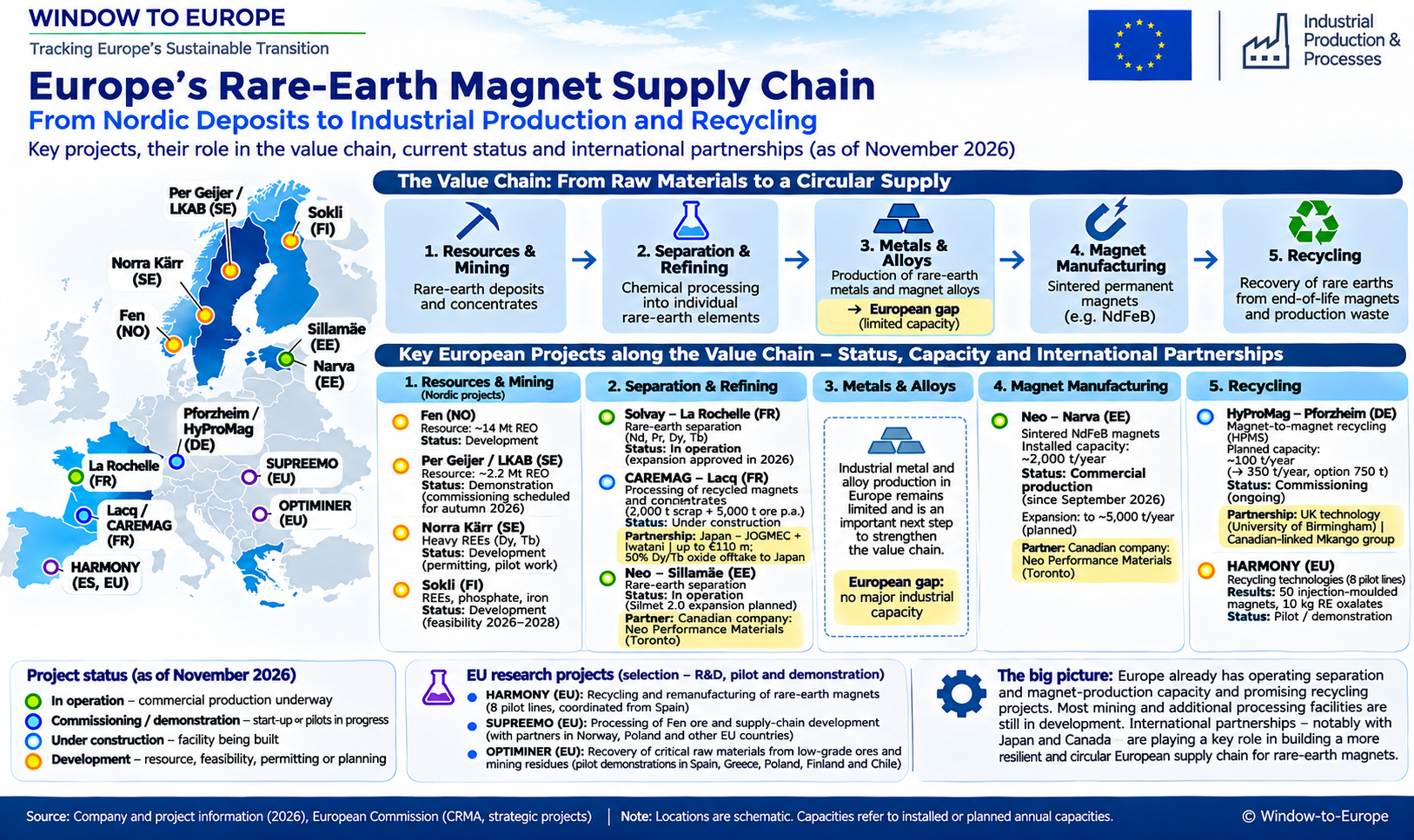
Nordic mineral resources, French and Estonian separation facilities, new magnet manufacturing capacity and recycling projects across Europe are gradually forming a more resilient supply chain. Partnerships with Japan and Canada play an important role.
In brief
Europe is developing a supply chain for rare-earth permanent magnets, essential components of electric vehicles, wind turbines and industrial machinery.
Significant mineral resources in Norway, Sweden and Finland could provide future raw materials. Established separation facilities in France and Estonia are being expanded, while commercial magnet production has begun in Narva, Estonia. Recycling technologies are advancing through industrial projects and EU-funded research programmes.
However, most new mining and recycling facilities are still under development, construction or commissioning. Another important feature is the geographical distribution of activities: industrial investment is concentrated at selected locations, whereas European research and demonstration projects involve partners across many countries.
International cooperation, particularly with Japan and Canada, is helping to connect these activities.
Four critical elements for permanent magnets
Neodymium-iron-boron (NdFeB) permanent magnets are essential components of electric vehicles, wind turbines, industrial motors and many other advanced technologies.
Four rare-earth elements are particularly important. Neodymium (Nd) and praseodymium (Pr) provide the strong magnetic properties, while dysprosium (Dy) and terbium (Tb) can improve resistance to demagnetisation at elevated temperatures.
Europe possesses significant geological resources but remains dependent on imported rare-earth materials and magnets. China dominates the global separation and magnet manufacturing industries.
The European Critical Raw Materials Act (CRMA) aims to strengthen European extraction, processing and recycling while diversifying international supply relationships.
Sources: European Commission – Critical Raw Materials | IEA – Rare Earth Elements
Nordic mineral resources – building Europe’s upstream supply chain
Norway: Fen – a potential Mine-to-Magnet supply chain
The Fen carbonatite complex in Telemark contains one of Europe’s largest identified rare-earth resources. In 2026, Rare Earths Norway reported an updated mineral resource estimate of approximately 15.9 million tonnes of rare-earth oxides.
The company aims to develop mineral processing and hydrometallurgical operations in Norway, while establishing partnerships for downstream separation, metal production and magnet manufacturing.
The European SUPREEMO project is investigating processing routes for Fen ores, including pilot activities involving Norway and Poland.
The project remains in development. Commercial mining and rare-earth production have not yet begun.
Source: Rare Earths Norway
Sweden: LKAB – integrating rare earths with established mining operations
Swedish mining company LKAB is developing its ReeMAP strategy to recover rare earths and phosphorus from mineral streams associated with iron-ore production.
The Per Geijer deposit near Kiruna contains an estimated 2.2 million tonnes of rare-earth oxides. LKAB intends to connect mining and mineral processing in northern Sweden with chemical processing at a new industrial facility in Luleå.
Commissioning of a demonstration facility was scheduled for autumn 2026, although regular operation has not yet been confirmed. Full industrial-scale production is envisaged during the 2030s.
The connected projects at Malmberget, Per Geijer and Luleå have received recognition under the European Critical Raw Materials Act.
Source: [LKAB – Critical Minerals](https://lka