
Researchers in the UK and Belgium reduce the production time of photonic cellulose films to minutes, adding a new manufacturing approach to advances in Japan and China.
In brief: A European research team has developed a rapid nanoimprint process for producing structurally coloured films from cellulose nanocrystals (CNCs). The method reduces fabrication times from several days to approximately ten minutes while achieving high-fidelity nanoscale patterns. The development builds on earlier European progress in continuous production of cellulose-based optical materials. Recent advances in Japan and China illustrate how different nanocellulose architectures are opening new applications for renewable functional materials.
Structural Colours Without Conventional Pigments
Structural colours arise from the interaction of light with precisely arranged microscopic or nanoscopic structures rather than from conventional pigments or dyes. Similar optical phenomena occur in butterfly wings, beetle shells and other biological materials.
Cellulose nanocrystals, obtained from renewable cellulose, can form optical structures capable of producing vivid colours. Their potential applications include decorative coatings, security features, sensors and alternatives to conventional effect pigments.
However, manufacturing structurally coloured cellulose films has remained challenging. Conventional methods often rely on the slow self-assembly of nanocrystals during solvent evaporation, requiring several days or even weeks.
A research team involving Imperial College London and KU Leuven has now demonstrated a much faster approach. The findings were published online in December 2025 and appeared in the January 2026 issue of ACS Nano.
Source: Mao et al., ACS Nano 20, 823–834 (2026).
From Days to Minutes: A European Manufacturing Advance
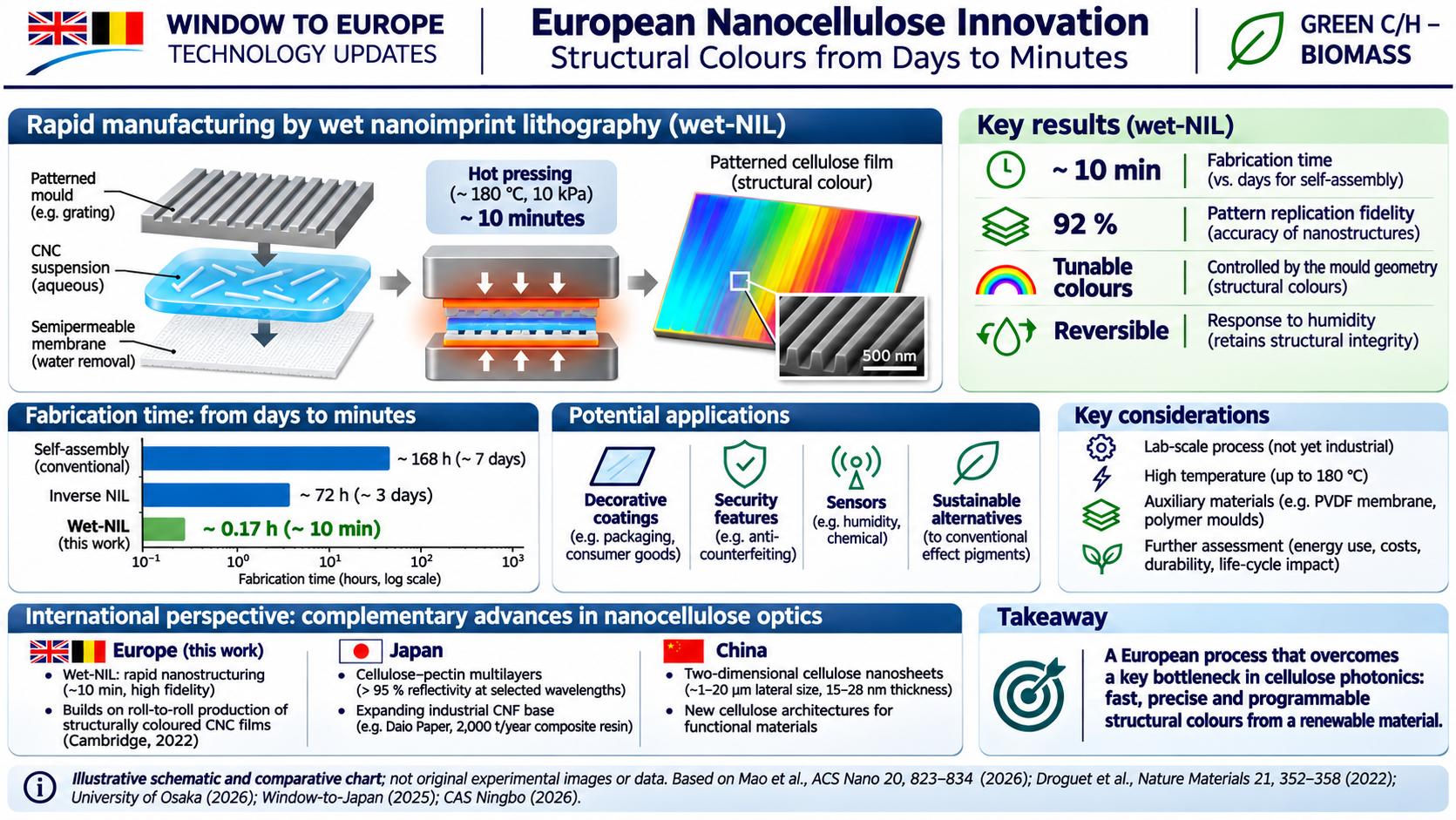
The researchers developed a process called wet nanoimprint lithography (wet-NIL).
An aqueous suspension of cellulose nanocrystals is placed between a patterned mould and a semipermeable membrane. Applying pressure and heat removes water while transferring the mould’s surface structure directly into the forming cellulose film.
Under optimised laboratory conditions, the team achieved:
- Approximately 10 minutes fabrication time, compared with several days for conventional self-assembly.
- 92% pattern replication fidelity, demonstrating accurate transfer of nanoscale structures.
- Tunable structural colours, controlled through the geometry of the imprint mould.
- Reversible responses to humidity, with the patterned surfaces retaining their structural integrity during the reported tests.
The optimised conditions included an 8 wt% CNC suspension, a temperature of 180 °C and an applied pressure of 10 kPa.
The process is particularly interesting because it generates colour primarily through surface relief structures rather than the slower formation of helically ordered cellulose nanocrystals.
The researchers report reductions in fabrication time of three to four orders of magnitude relative to conventional approaches. In their direct experimental comparison, the improvement was approximately 100–160-fold.
Source: Mao et al., ACS Nano (2026), Results and Conclusions.
Europe Builds on Earlier Advances in Cellulose Photonics
The new process complements earlier European work on the scalable production of cellulose-based structural colours.
In 2021, researchers at the University of Cambridge demonstrated roll-to-roll manufacturing of metre-long structurally coloured cellulose nanocrystal films. The resulting materials could also be processed into effect pigments suitable for dispersion in water-based formulations.
This development addressed an important requirement for industrial implementation: continuous manufacturing rather than small-scale laboratory preparation.
The two European approaches are complementary. Roll-to-roll processing addresses continuous film production, whereas wet nanoimprinting offers much faster and more precise control of optical surface structures.
Europe also has experience in industrial cellulose microfibrillation. Norway’s Borregaard commercially produces microfibrillated cellulose, demonstrating that cellulose-based functional materials have already entered industrial markets.
However, commercial MFC production should not be confused with industrial manufacturing of photonic CNC films.
Sources: Droguet et al., Nature Materials 21, 352–358 (2022); Borregaard – Exilva.
International Perspective: Japan and China
Recent Asian developments demonstrate that nanocellulose research is progressing along several complementary technological pathways.
Japan – High-performance optical multilayers and industrial CNF composites
Researchers at the University of Osaka recently developed highly reflective optical films made from alternating layers of cellulose nanofibers and pectin. Their precisely controlled multilayer structures achieve more than 95% reflectivity at selected wavelengths.
Unlike the European nanoimprint approach, which produces colour through patterned surface structures, the Japanese films exploit optical interference between layers with different refractive indices.
Japan also has an expanding industrial nanocellulose base. In 2025, Daio Paper began commercial production of cellulose nanofiber composite resin at a facility with an annual capacity of 2,000 tonnes.
These are distinct achievements: the Osaka optical films remain a laboratory development, while the Daio Paper facility manufactures CNF-reinforced composite materials.
Sources: University of Osaka (2026); Window-to-Japan – Optical Films (2026); Window-to-Japan – Daio Paper (2025).
China – New two-dimensional cellulose nanostructures
Researchers at the Chinese Academy of Sciences‘ Ningbo Institute of Materials Technology and Engineering have developed a method for obtaining two-dimensional cellulose nanosheets from native cellulose.
Their approach uses controlled modification of the hydrogen-bond network to produce thin, sheet-like cellulose structures.
The resulting nanosheets have lateral dimensions of approximately 1–20 µm and thicknesses of 15–28 nm.
This research focuses primarily on obtaining new cellulose nanostructures rather than directly manufacturing optical films. Nevertheless, it expands the range of available cellulose architectures for future functional materials.
Sources: Window-to-China – 2D Cellulose Nanosheets (2026); Original publication.
Sustainability and Industrial Prospects
The European nanoimprint process offers a potentially important route towards replacing certain conventional pigments and polymer-based optical materials with cellulose-derived alternatives.
However, renewable raw materials do not automatically guarantee sustainable manufacturing.
The demonstrated process operates at temperatures up to 180 °C and uses auxiliary materials including polymer moulds and a PVDF membrane. Their energy consumption, durability, reusability and environmental impacts must be considered when evaluating the overall process.
Likewise, the biodegradability of cellulose does not necessarily establish the environmental performance of a complete commercial coating or composite.
Industrial implementation will require further progress in continuous production, process economics, long-term stability and life-cycle assessment.
The current results therefore demonstrate a promising manufacturing technology, not yet a commercially validated sustainable alternative.
Source: Mao et al., ACS Nano (2026), Methods and Conclusions.
Outlook: Complementary Routes Towards Sustainable Functional Materials
Europe, Japan and China are advancing nanocellulose technologies from different directions.
European researchers are addressing manufacturing speed and scalability. Japanese groups are demonstrating highly sophisticated optical functions while industry expands commercial CNF applications. Chinese researchers are opening additional possibilities through new cellulose nanostructures.
These developments should not be interpreted as a direct competition between equivalent technologies. They involve different materials, manufacturing processes and application targets.
The European wet-nanoimprint development is particularly significant because it addresses a practical bottleneck: the time required to produce precisely structured optical cellulose films.
Whether this advantage can be translated into industrial production remains to be demonstrated.
Together, the international developments suggest that renewable cellulose is becoming an increasingly versatile platform for advanced optical and functional materials.