
In brief
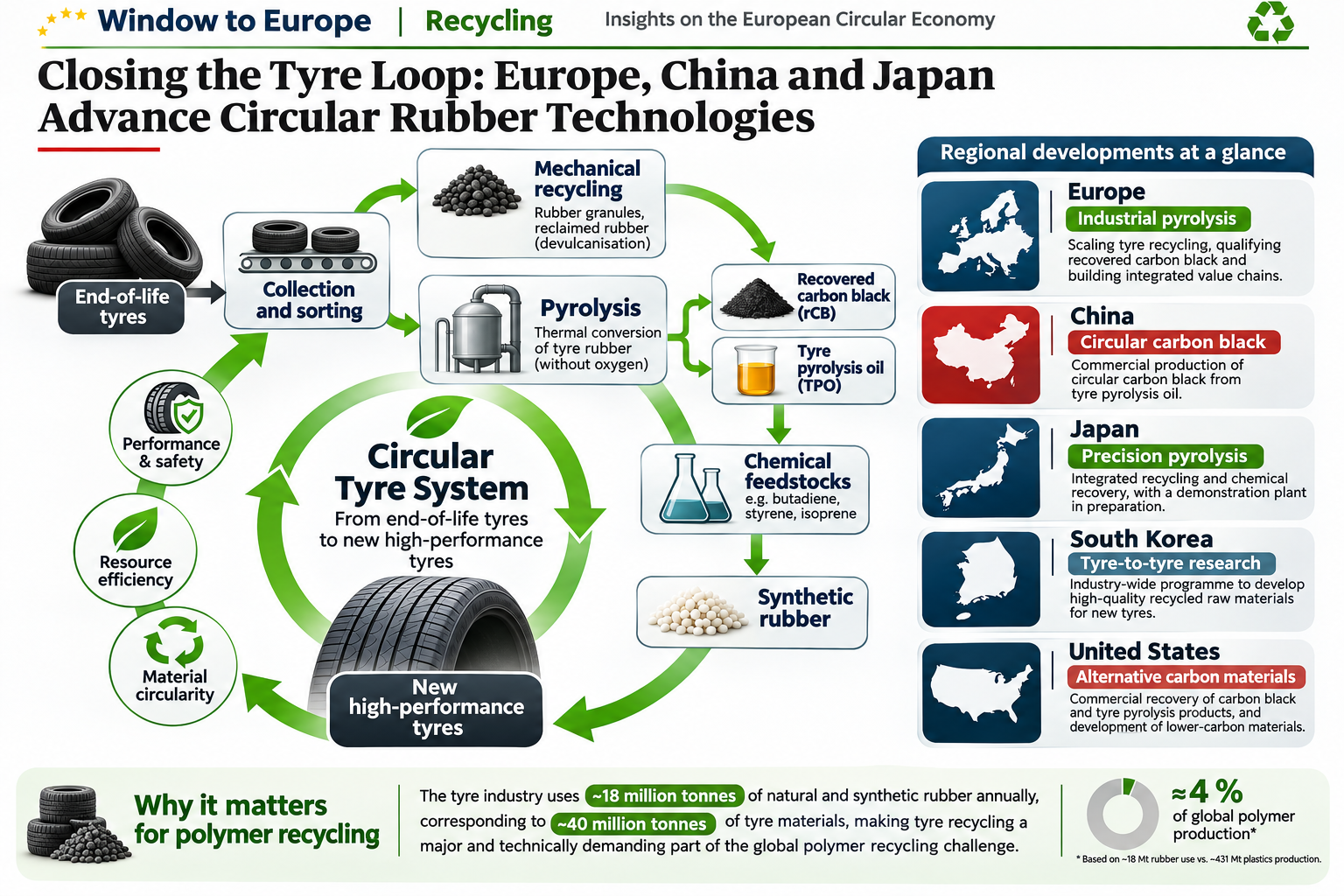
The global tyre industry consumes approximately 18 million tonnes of natural and synthetic rubber annually. Including carbon black, silica, steel and other components, this corresponds to roughly 40 million tonnes of tyre materials. Tyre recycling is therefore a significant challenge for the circular polymer economy.
Unlike thermoplastics, vulcanised rubber cannot simply be remelted. Advanced recycling must recover valuable materials while meeting the demanding quality requirements of new tyres.
Important industrial developments are emerging across several regions:
- Europe: CIRCTEC opened a 50,000-tonne-per-year tyre recycling facility in the Netherlands in January 2026. Continental qualified recovered carbon black from Pyrum for tyre manufacturing, while Pirelli, BASF and Synthos established an integrated circular raw-material value chain. CIRCTEC, 2026 · Pyrum, 2026 · Pirelli, 2026
- China: Orion launched commercial circular carbon black production using tyre pyrolysis oil at its Qingdao facility in June 2026, following an earlier industrial introduction in Poland. Orion, 2026
- Japan: Bridgestone and ENEOS are developing precision pyrolysis and chemical feedstock recovery. A demonstration facility with a planned capacity of 7,500 tonnes annually is scheduled to begin operating in September 2027. Bridgestone, 2025
- South Korea: Hankook is expanding its tyre-to-tyre research programme, targeting next-generation tyres containing more than 85% sustainable materials. This remains a development target, not demonstrated recycled tyre content. Hankook, 2026
- United States: Companies such as Bolder Industries are commercialising recovered carbon black and tyre pyrolysis products, while tyre manufacturers are exploring additional lower-carbon raw materials.
How close are we to fully circular tyres?
| Region | Principal technological progress | Industrial maturity | Remaining challenge |
|---|---|---|---|
| Europe | Pyrolysis, rCB qualification, integrated chemical value chains | Commercial operations and demonstration projects | Scaling, economics and material quality |
| China | Circular carbon black from tyre pyrolysis oil | Commercial production | Broad tyre-to-tyre implementation |
| Japan | Precision pyrolysis and advanced chemical recovery | Pilot and demonstration stage | Industrial scale-up |
| South Korea | Recycled feedstocks and sustainable tyre development | Industrial activities and R&D | Verified tyre-derived content |
| United States | Recovered carbon black and pyrolysis products | Selected commercial operations | Large-scale closed material loops |
The key challenge: Recycling tyres is not the same as manufacturing fully circular tyres. The decisive question is how much of the carbon and polymer material from an old tyre can be returned to a new tyre without compromising performance or economic viability.
Further reading – Technologies, industrial projects and sources
1. Why tyre recycling is a major polymer challenge
The global tyre industry uses approximately 18 million tonnes of natural and synthetic rubber annually. Since rubber typically represents around 45% of tyre mass, this suggests an annual tyre-material throughput on the order of 40 million tonnes.
This is an indicative calculation rather than a directly measured global production figure. The precise amount depends on tyre categories and material compositions.
For comparison, global plastics production exceeds 400 million tonnes annually. Tyres thus represent a smaller but technologically demanding material stream. Rubber and plastics statistics are not directly interchangeable.
Tyres contain a complex combination of natural rubber, synthetic elastomers, carbon black, silica, steel, textile reinforcement and chemical additives.
Vulcanisation creates crosslinks between rubber polymer chains. These crosslinks give tyres their mechanical strength and durability, but prevent conventional remelting and remoulding.
Three main recycling pathways are particularly relevant:
Mechanical recycling and devulcanisation recover rubber granules or modify crosslinked rubber to enable partial reuse. Their suitability for demanding new-tyre applications depends on material properties and processing conditions.
Pyrolysis thermally decomposes tyre rubber in the absence of oxygen, producing oil, gas and a carbon-rich solid residue. The latter can be processed into recovered carbon black (rCB).
Chemical feedstock recycling converts tyre-derived products into chemical intermediates, potentially including monomers used for new synthetic rubber.
These pathways are complementary rather than mutually exclusive.
2. Europe: Building industrial recycling value chains
CIRCTEC – Delfzijl, Netherlands On 27 January 2026, CIRCTEC officially opened the first phase of its industrial tyre recycling facility in Delfzijl.
The company reported that the facility was operating with an annual processing capacity of 50,000 tonnes of end-of-life tyres. Its longer-term expansion plan envisages up to 200,000 tonnes annually.
The process generates recovered carbon black, circular naphtha and other tyre-derived products. Partners include bp and Birla Carbon.
An important distinction is that not all recovered carbon necessarily returns to tyres. Some products are intended for chemical manufacturing or fuel applications.
Source: CIRCTEC, 27 January 2026 (Original source)
Continental and Pyrum – Dillingen/Saar and Korbach, Germany
Pyrum operates an industrial tyre pyrolysis facility in Dillingen/Saar.
In April 2026, its new recovered-carbon-black milling and pelletising facility entered regular operation, with a stated processing capacity of 750 kg per hour.
On 20 May 2026, Continental granted unrestricted delivery approval for Pyrum’s ThermoTireBlack following an industrial audit.
The approval confirmed consistent production conditions and reproducible material quality. It did not, by itself, establish that the plant had reached maximum continuous output.
Continental has used recovered carbon black in solid rubber tyres manufactured at Korbach since 2023.
Source: Pyrum, 20 May 2026 (Original source)
A second milestone was Continental’s ZEvRA concept tyre, presented in August 2026.
Its material composition included approximately:
43% recycled materials; 13% renewable materials; 25% mass-balance-certified materials. The concept tyre achieved the highest EU rolling-resistance rating.
This is an important technical demonstration, but the percentages describe different categories of sustainable materials and should not be interpreted as 81% physically recovered tyre material.
Source: Continental, 25 August 2026 (Original source)
Pirelli, Pyrum, BASF and Synthos – Closing the chemical loop On 22 July 2026, Pirelli announced a coordinated European tyre-to-tyre recycling initiative with Pyrum, BASF and Synthos.
The process combines two routes.
First, Pyrum recovers carbon black from end-of-life tyres. After upgrading, this material can partially replace virgin carbon black in Pirelli’s tyre production.
Second, tyre pyrolysis oil is supplied to BASF, where it is co-processed with fossil feedstocks to manufacture chemicals including butadiene and styrene.
Through an ISCC PLUS-certified mass-balance approach, recycled content is attributed to chemical products subsequently used by Synthos to manufacture synthetic rubber for Pirelli.
This creates an industrially coordinated material loop, although mass-balance attribution must be distinguished from the physical tracing of recycled carbon through every manufacturing step.
Source: Pirelli, 22 July 2026 (Original source)
Michelin and Infiniteria – Industrial scale-up remains difficult Michelin is a minority shareholder and commercial partner in Infiniteria, which is developing an industrial tyre recycling facility in Uddevalla, Sweden.
The facility has a planned initial capacity of approximately 35,000 tonnes annually.
However, construction delays and cost overruns affected the original schedule. In February 2026, Infiniteria publicly reported contractual disputes with its technology partner Scandinavian Enviro Systems.
In May 2026, the company appointed Proman as its new engineering, procurement and construction partner to complete the facility.
The project illustrates the difficulty of transferring promising pyrolysis technology into reliable industrial operation.
A confirmed regular commercial operating rate has not yet been established.
Sources: Infiniteria, 27 February 2026 (Original source) · Infiniteria, 6 May 2026 (Original source)
3. China: Circular carbon black enters commercial production
China – International technology deployed locally: In June 2026, Orion S.A., a Luxembourg-incorporated carbon black producer with its principal executive offices in the United States and German industrial roots, launched circular carbon black production at its Qingdao facility. The technology had already been commercially deployed at Orion’s plant in Jasło, Poland, in 2025. The development therefore illustrates the global transfer and industrial implementation of circular carbon black technology rather than an exclusively Chinese innovation.
On 4 June 2026, Orion announced commercial production of three ECORAX Circular carbon black grades at its ISCC PLUS-certified plant in Qingdao, China.
The products are manufactured using tyre pyrolysis oil as a feedstock.
Orion had already introduced large-volume production of circular carbon black at its Jasło plant in Poland in 2025.
The two facilities illustrate an important distinction between recovered carbon black and newly manufactured circular carbon black.
Recovered carbon black is obtained from the solid residue of tyre pyrolysis.
Circular carbon black produced from tyre pyrolysis oil is manufactured in a carbon black reactor using tyre-derived liquid feedstock. Its production can be integrated into existing industrial carbon black manufacturing processes.
Orion reports that its ECORAX Circular 200 and 210 products are designed as replacements for conventional ASTM carbon black grades N326 and N330.
The approach is particularly relevant because it offers a route to established carbon black specifications while incorporating recycled feedstock.
However, certification and commercial availability do not establish the total proportion of the tyre industry’s carbon black demand currently supplied by circular materials.
Source: Orion, 4 June 2026 (Original source)
4. Japan: Bridgestone pursues integrated tyre-to-tyre recycling
Bridgestone’s EVERTIRE initiative addresses several stages of tyre material recovery.
Together with ENEOS, Bridgestone is developing precision pyrolysis technologies that convert end-of-life tyres into tyre-derived oil and recovered carbon black.
The oil may subsequently be refined into chemical intermediates, including butadiene, an important building block for synthetic rubber.
Recovered carbon black is being investigated as a feedstock for upgraded reinforcing materials.
Bridgestone announced a demonstration plant at its Seki facility in Gifu Prefecture, with a planned annual processing capacity of approximately 7,500 tonnes.
The intended start of operations is September 2027.
The programme is supported by Japan’s NEDO and includes cooperation with Tokai Carbon on carbon black upgrading.
Its technological ambition is significant: instead of merely recovering low-value materials, Bridgestone seeks to develop controlled processes capable of supplying high-quality tyre raw materials.
Nevertheless, the integrated industrial loop remains under development.
Source: Bridgestone, 30 January 2025 (Original source)
5. View from South Korea: Hankook expands circular tyre research
Hankook Tire established a tyre-to-tyre recycling consortium in 2023.
In June 2026, it launched a government-supported research programme involving eleven industrial and academic organisations.
The programme focuses on recovering high-quality raw materials from end-of-life tyres and incorporating sustainable materials into new tyre manufacturing.
Participating organisations include Kumho Petrochemical, KRICT and KAIST.
Hankook has already introduced the iON GT tyre containing more than 70% sustainable materials, while the new research programme aims for next-generation tyres containing over 85% sustainable materials and achieving more than 50% lower carbon emissions.
These figures require careful interpretation.
Sustainable materials may include renewable feedstocks and certified materials that do not originate from recycled tyres. The programme’s future targets are not equivalent to demonstrated closed-loop recycling rates.
Source: Hankook Tire, June 2026 (Original source)
6. View from the United States: Recycling and alternative carbon technologies
The United States has several commercial and emerging industrial approaches to tyre-derived materials.
Bolder Industries has developed processes to recover carbon black, oil and steel from end-of-life tyres.
Its recovered carbon black product, BolderBlack, is intended for applications including rubber manufacturing.
The company’s activities also connect the US and European recycling markets through planned industrial investments.
A different approach is pursued by Goodyear and Monolith, which have investigated carbon black manufactured through methane plasma pyrolysis.
This process can produce solid carbon and hydrogen, but it should not be classified as tyre recycling because the carbon feedstock does not originate from end-of-life tyres.
Such technologies may contribute to lower-carbon tyre materials, but their environmental performance depends on the source of methane, energy requirements and overall process emissions.
For the United States, the central question remains how rapidly recovered materials can penetrate the large commercial tyre market.
7. What still prevents fully circular tyres?
Despite considerable industrial progress, several technical and economic obstacles remain.
Material quality Recovered carbon black differs from conventional furnace carbon black in ash content, particle characteristics, surface chemistry and reinforcing performance.
Purification, milling, pelletising and consistent quality control are therefore essential for demanding tyre applications.
Chemical recovery Tyre pyrolysis oil contains a complex mixture of hydrocarbons and potentially problematic impurities.
Further treatment may be necessary before it can serve as a reliable feedstock for petrochemical production.
Selective depolymerisation could eventually provide more direct access to valuable chemical building blocks, but many approaches remain at the research stage.
Economics and industrial reliability Large-scale pyrolysis plants require stable feedstock supplies, reliable continuous operation, competitive energy consumption and markets for recovered products.
The delays encountered by some European projects demonstrate that successful pilot operation does not automatically establish commercial viability.
Measuring genuine circularity Three measures should be reported separately:
1. Recycling rate: The proportion of end-of-life tyre material recovered for further use. 2. Recycled content: The proportion of secondary raw materials incorporated into a new product. 3. Tyre-to-tyre circularity: The proportion of material originating from old tyres that returns to new tyre manufacturing. Mass-balance certification can support industrial accounting and feedstock substitution, but should not be confused with physical material tracing.
A comprehensive assessment must also account for process losses, energy use, emissions and the destination of by-products.
Conclusion
Tyre recycling is becoming an important industrial application of circular carbon technologies.
Europe has established commercial recycling operations and integrated value chains linking tyre manufacturers with chemical and materials companies.
China is commercialising carbon black production from tyre-derived feedstocks, Japan is developing advanced integrated recycling processes, and South Korea is strengthening industrial research into sustainable tyre materials.
The United States contributes commercial recycling technologies and alternative carbon production routes.
The next technological milestone will not simply be a larger recycling plant. It will be the demonstrated, economically viable return of substantial quantities of tyre-derived carbon and polymer materials into new high-performance tyres.
The tyre industry is moving from waste management towards circular materials manufacturing – but a fully closed industrial tyre loop has yet to be demonstrated at global scale.